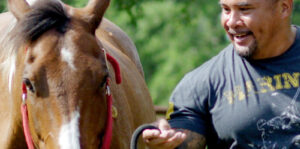
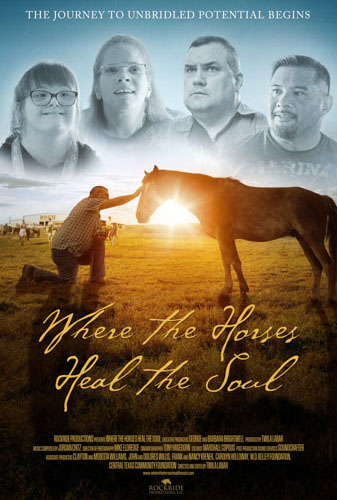
Horses are a gift to this earth, and they provide untapped healing qualities. Documentary filmmaker Twila LaBar taps into themes of faith and redemption in her film, Where the Horses Heal the Soul. LaBar’s documentary focuses on several individual figures: Dr. Nancy Krenek, Faith Smyth, Todd Plybon, Will Estrada, and Hunter Adkins. Dr. Nancy Krenek has a background in physical therapy. She came up with the idea to create an equine center that could help children with physical disabilities. It was a bold idea, and through the power of God, she came across land for sale in Georgetown, Texas. The Brightwell family sold it to Krenek after hearing about her incredible plan for the property. The property became ROCK (Ride on Center for Kids), and this therapeutic facility serves both children with disabilities and veterans.
ROCK is the hub for several remarkable stories. Faith Smyth was born with Down Syndrome, and her mother was determined to get her on a horse for therapeutic purposes. She has been attending this facility since she was two years old, and it changed her life. Faith developed friends, became stronger, and is able to compete in the Special Olympics. Todd Plybon was a former science professor turned soldier who fought in Afghanistan. He was severely disabled when he was driving a Humvee with fellow soldiers, and it was blown up on the road. Plybon was the only survivor, and his life was forever changed. He returned home with head and leg injuries. At ROCK, he was able to bond with the horses, where his health improved. Plybon was able to return to his childhood hobby of photography, and this sparked a new outlook on life.
“Dr. Nancy Krenek…came up with the idea to create an equine center that could help children with physical disabilities.”
Will Estrada is a veteran suffering from severe PTSD, depression, and anxiety. Kevin Bowers, a former Vietnam veteran and riding instructor, helps him learn to understand the horse and how they respond to people. Estrada gradually becomes comfortable with one of the horses, Playboy. For him, he is able to bond with the creature and develop a new frame of mind. It creates a profound spiritual and psychological effect on him. Hunter Adkins was born with cerebral palsy, and her time at ROCK made her athletic and able to compete in other activities like any neurotypical individual. Her posture also significantly improved due to training. Most importantly, Adkins is an advocate for those with disabilities within the state of Texas. She speaks with senators and even Governor Greg Abbott in pursuit of making life better for disabled individuals and veterans. LaBar’s documentary also covers ROCK’s research collaboration with Texas A&M University to study how equine therapy can have a variety of health benefits.
LaBar’s film is touching, euphoric, and an eye-opener. The whole documentary has a divine quality to it, and that is due to the cinematography work of Mike Eldredge and Tony Hagedorn. The horses look masterful and graceful on the rustic Texas plains. Each of our key figures glows with the best of humanity. I am excited to see what Hunter’s advocacy goals will do for veterans and those with disabilities in the long run. Dr. Krenek’s work on equine therapy is exceptional, and these studies prove science can still lead to positive change. LaBar enriches the film with intimate moments and countless images of veterans and disabled children being healed by the apostle-like horses.
On a personal note, horses have a profound impact. LaBar’s documentary is truthful. Growing up with Autism, horseback riding is soothing and peaceful. They are firm and patient creatures. It is hard to describe their affect on me at a young age. Where the Horses Heal the Soul is a documentary that will touch audiences on so many levels. It provides a great educational tool alongside representing how people can prove themselves beyond their circumstances. The film is an uplifting piece of entertainment, and it proves that miracles can still happen in our world.
"…Plybon was the only survivor, and his life forever changed."

Twila, I’m so happy you appreciated my review! It was a joy to watch. I wish all the best for your film, whether it’s on streaming, the festival circuit, and on physical media.
Ethan, thank you so much for watching Where the Horses Heal the Soul and for your beautiful review. We’re truly grateful! We’re thrilled to know that you enjoyed our film and also to know how horses have been a part of your life. Thank you again!