You couldn’t ask for two better leading actresses to anchor this film. Einbinder and Anderson are fully bought into both the satire and the sincerity of the project. Anderson brings to life a Norma Desmond archetype, shrouded in mystery. For much of the film, we’re not quite sure if she’s insane in her isolation or if she’s just in on a secret the rest of society isn’t. She has an undeniable pull that not only draws Kris closer, but disarms her. Meanwhile, Einbinder wonderfully channels the overly academic director, saddled with the pressure of reviving the franchise she loves. She’s stuck inside of her own mind, and it takes a force like Anderson to shake her out of it. There’s a clear generational divide, and Schoenbrun exploits it in service of the humor, but that divide also speaks volumes about the younger generation’s inability to exist in the moment. Despite those clear differences, their chemistry is off the charts, eliciting an electricity that travels through your whole body. It’s why the humor works so well, but it’s also why the film is able to flex into unadulterated romantic bliss.
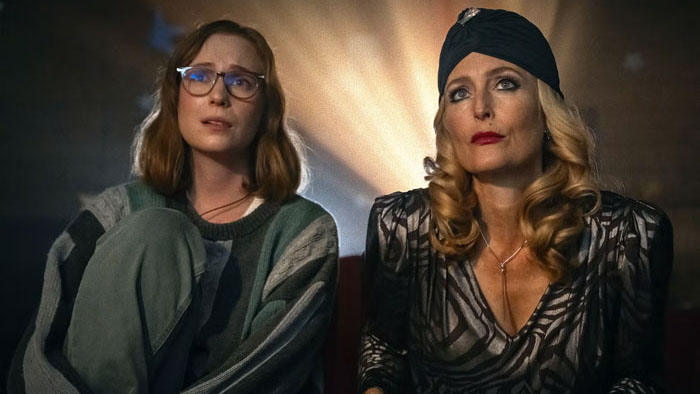
Kris (Hannah Einbinder) and Billy Presley (Gillian Anderson) sit together at a screening in Teenage Sex and Death at Camp Miasma.
“…pure cinematic euphoria…”
The film is packed with moments of pure cinematic euphoria—some of the best visuals you’ll see on screen all year. Eric Yue’s stunning cinematography both conjures something familiar in how he injects the aesthetic of classic horror while also showing us something we’ve never seen before. The 35mm filmstock and hand-painted, matte backdrops create a warmth and texture in this heightened reality Schoenbrun crafts. But here, the real achievement is in the meticulous details—slow dissolves reminiscent of 80s style, playful use of a split diopter, and shot-for-shot recreations of famous kills from films like Friday the 13th. This fusion of stylistic choices births something entirely original, leaving audiences steadily engaged by the wonders on display.
This film solidifies Jane Schoenbrun as a singular voice in modern filmmaking. In under two hours, they manage to reclaim and recontextualize the monster in slasher films, which has historically been riddled with trans killer tropes. But that’s not all. The film deconstructs our tendency to over-intellectualize the things in life that should simply be felt. It explores the complex journey towards self-discovery and rebirth, breaking free from our complicated relationship with sex. But above all else, Teenage Sex and Death at Camp Miasma is a love letter to the movies—the good ones, the bad ones, the ones worth cuddling up on the couch with candy for and the ones that open up our world, leaving us with an insight about ourselves we didn’t have before pressed play.
"…some of the best visuals you’ll see on screen all year..."