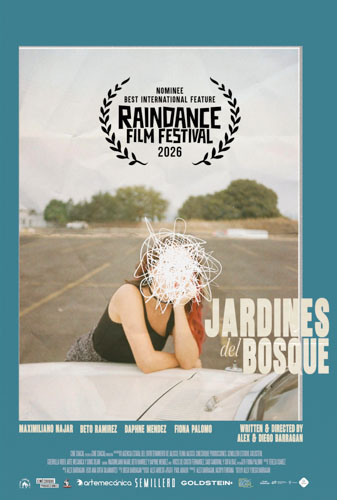
Childhood can be a confusing time–fleeting crushes, schoolyard bullies, endless gossip. But those moments in youth have a massive impact on the person we become. Alex and Diego Barragán’s Jardines del Bosque follows three young teenagers as they get wrapped up in a disappearance that will shape the rest of their lives.
The story is told through three distinct perspectives. Santos (Maximiliano Nájar Márquez), Lechuga (Beto Ramírez), and Daniela (Daphne Méndez) are best friends, spending their 13-year-old summers exploring their neighborhood, pulling pranks, and making lasting memories. Santos is the group’s leader and mastermind. Lechuga (which translates to lettuce, a nickname earned after a short-lived diet) is Santos’ loyal sidekick. And Daniela has earned the role of the group’s videographer, her camera always in tow. When the older, cooler, cigarette-smoking Arlette (Fiona Palomo) moves in across the street from Santos, the three hatch a plan to study her behavior and win her over. But before long, Arlette goes missing. After discovering her tablet, the three decide to launch their own investigation to help find her. They quickly get in over their heads, leading to a harrowing event that no kid should ever experience.

“…follows three young teenagers as they get wrapped up in a disappearance that will shape the rest of their lives…”
Bouncing between the three leads, the film is narrated by the adults recounting their experiences from that summer. This clever storytelling choice helps underscore how those traumatic moments have stuck with them. The narration also builds a wistful atmosphere as the three reflect on their relationships with their best friends of the past. Alex and Diego Barragán’s engaging visual aesthetic amplifies that atmosphere, creating a comforting and relatable warmth in the early moments of the film, with cuts to lo-fi camera footage shot by Daniela, providing a jolt of nostalgia. It also brilliantly captures the energy of a summer spent with friends–an air of momentary freedom that makes them feel like they’re at the center of the universe. But that warmth and energy fade away as the innocence of Santos, Lechuga, and Daniela dissipates along with it. It’s an expertly crafted film with a sharp, resonant screenplay to match.
The performances from the three young leads are as refined as they are heartbreaking. You’ll see a bit of yourself in each of them. They wonderfully bring to life the nuances of youth, from emotions dictated by rumors started at school to the most insignificant moments feeling giant. And each lets their imagination run wild until they’re fully thrust into their harsh reality. But it’s Mendez’s performance as Daniela, in her feature debut, that may be the most affecting. There’s an understated but tragic moment when you see her begin to realize what Arlette’s vanishing means for her. The world is not a friendly one for women, and that epiphany hits her like a ton of bricks. But we don’t hear it in the script; we see it on her face.
“Kids don’t have to worry about these things,” Arlette’s distraught mother tells Lechuga as he offers a helping hand. But the reality is, trauma like this has a massive impact on the children living through it. The film is used as a representation of many stories like it, highlighting the crisis of unsolved disappearances in Mexico. It’s not only a somber reminder of all that’s lost when a life is cut short, but of the lasting effect each disappearance has on friends, family, and community. As the three kids drift apart and go their separate ways, they’ll always be connected by this harrowing summer, carrying it with them forever.
"…an expertly crafted film with a sharp, resonant screenplay to match..."