No one is making films quite like Jane Schoenbrun. In Teenage Sex and Death at Camp Miasma, they continue to reinvent their own cinematic language, bucking convention to deliver something wholly unique. This blood-soaked, surrealist horror comedy follows a young director meeting the former star of a slasher franchise in hopes of convincing her to return for the reboot.
Fresh off her hit TV show Hacks, Hannah Einbinder stars as Kris, a buzzy, queer filmmaker who has been tasked with rebooting the Camp Miasma slasher franchise, which is heavily influenced by classic 80s slashers like Friday the 13th and Sleepaway Camp. It doesn’t just mirror the events and characters of those films; it captures the way they spun into a cultural phenomenon. In Camp Miasma, Jason Voorhees makes way for Little Death (Jack Haven), the monster created from a trans child drowned by the bullies at summer camp, now living at the bottom of the lake. The film opens by highlighting the ephemera related to the franchise—posters, video games, and toys that reference sequels like Little Death Takes Manhattan (sound familiar?). To crack the film she’s developing, Kris pays a visit to Billy Presley (Gillian Anderson), the final girl from the first film, who disappeared after her star turn. Kris finds her living at the abandoned camp where the first movie was set, full of reminders of the franchise’s legacy. The two spend a few days together, getting closer as they slowly dissolve into the world of Camp Miasma.
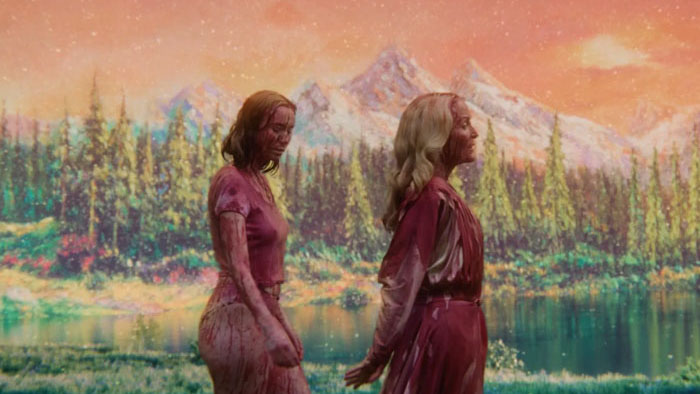
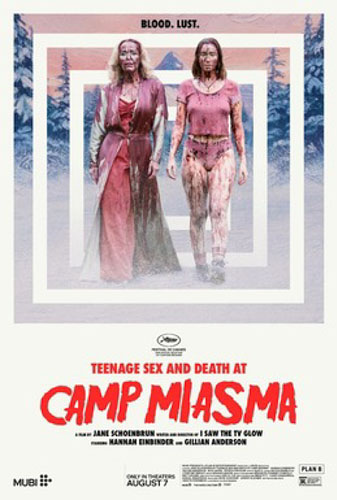
Blood-soaked Kris (Hannah Einbinder) and Billy Presley (Gillian Anderson) walk past a hand-painted lake backdrop in Teenage Sex and Death at Camp Miasma.
“…a young director meeting the former star of a slasher franchise in hopes of convincing her to return for the reboot…”
If you’re a fan of Schoenbrun’s work, there are plenty of hallmarks you’ll recognize. Much like their previous two films, this one is a profound exploration of queer identity; it’s stuffed with sumptuous nostalgia, and it prods at our relationship with the media we consume. We’re All Going to the World’s Fair demonstrated a need for connection in the Internet age. I Saw the TV Glow used a television show to represent the protagonist’s authentic self. Schoenbrun’s latest film brings us into the world of cinema, positioning movies as vital tools in the journey towards queer awakening and discovery. But in every other way, Teenage Sex and Death at Camp Miasma couldn’t be more different from those first two films. For starters, it doesn’t feel like a gut-punch. Because while their previous films represent Schoenbrun’s terrifying and fraught experience while transitioning, this one is about what comes next. Scintillating romance, pure joy, and uproarious humor leap off the screen in this homage to the classic slasher films of the 80s that helped Schoenbrun on their path towards finding themselves.
The film is such an impressive high-wire act from Schoenbrun. It tonally tiptoes between irreverent humor grounded in pitch-perfect pastiche and penetrating emotional catharsis. One minute, you’re laughing at the overt product placement mocking Hollywood blockbusters, and the next you can’t blink, completely captivated by the vulnerability on display. The film is fiercely romantic, slowly building tension as Kris undergoes a metamorphosis, leaning on the older Billy to guide her. But at the same time it consistently evokes belly laughs, mostly driven by the mélange of references to the most absurd parts of the old slashers we know and love. I’m still not quite sure how Schoenbrun pulled it off, but they masterfully blend different genres that are often at odds with each other.
"…some of the best visuals you’ll see on screen all year..."