There are many different genres in film, from straightforward drama or comedy to blends like dramedy, dark comedy, black comedy, and more. This one falls into the category of experimental film from writer/director Stephen Bailey Michaels. To understand it, it also helps to know it was inspired by Through the Glass of the Silver Key by H.P. Lovecraft and E. Hoffman Price. That piece centers on Randolph Carter, who uses a silver key to transcend the boundaries of time and space.
In To Beyond, there isn’t quite a linear story, but a character named Randolph Carter—according to the credits—is echoed throughout. The film is primarily shot in black and white, built around long, static takes across various locations. If you’re an Angeleno like myself, some of these settings feel familiar, from Century City’s Avenue of the Stars to the 2nd Street Tunnel in downtown Los Angeles. Some shots rely on natural ambient sound, while others, if you listen closely, introduce subtle layers that let your imagination drift beyond the frame.
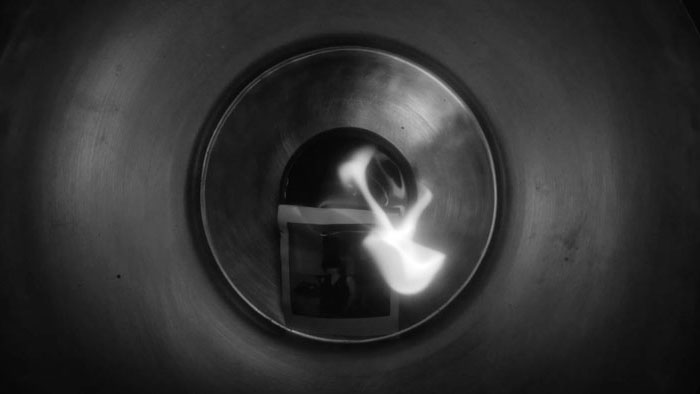
A mysterious photograph burns inside a circular metal chamber in To Beyond.
“Michaels succeeds in getting me to actively think about what I was seeing and hearing.”
When I turned this on, one of the first things that came to mind during the opening sequence was guerrilla filmmaking. It brought me back to a college project where we were working with camcorders and lighting kits, and I remember getting around it by altering footage in Avid, desaturating it into black and white. That same sensibility feels present here. Many of the scenes also appear to be shot at night, and when filming in Los Angeles, permits can be costly and restrictive—so the workaround is often the early morning hours, when the city is empty. At the same time, there is intent behind it, as the film is meant to exist within a desolate urban landscape.
Running just shy of 75 minutes, the film feels like it could have also worked as a 30-minute short. But as noted, this is an experimental piece that resists traditional storytelling. Different filmmakers engage their audiences in different ways—whether to entertain or to provoke thought. Here, Michaels succeeds in getting me to actively think about what I was seeing and hearing. I even went back to read H.P. Lovecraft’s original story afterward to better understand his inspiration, and there is something to be said for that.
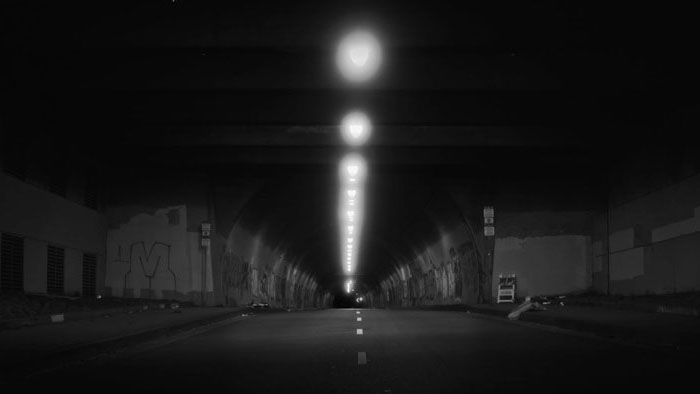
"…Some of these settings feel familiar..."