
The story grew out of my own lived experiences: the language barriers, the cultural misreadings, the subtle and not-so-subtle exclusions. Language is both a barrier and a bridge between people. When I came to Canada, it was definitely a barrier of enormous proportions. The inability to sound like the majority automatically makes you an outsider. People form opinions about you based on your accent, not entirely dissimilar to how people respond to racial differences.
This creates a lot of pressure on accented people to erase their accent as quickly as possible, to become “normal,” to fit in. I felt this many times and, of course, losing one’s accent either takes years or, in many cases, never fully happens.
The realization that I might never completely lose my accent ultimately liberated me and changed my life. My signature self-deprecating humour became centered around my foreignness and my “inability to speak English properly.” It became my “brand.” Suddenly, this newfound confidence opened many doors. It was my attitude that resonated with people, and people always respond to honest humour. I started celebrating being an immigrant.
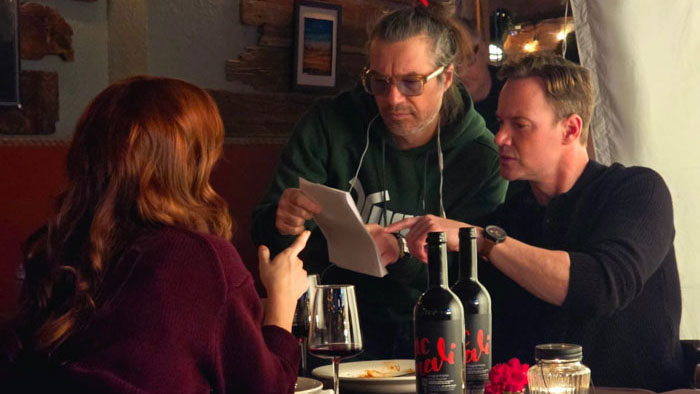
“My signature self-deprecating humour became centered around my foreignness and my inability to speak English properly.”
So, in exploring Kathy’s character, I realized that she would only become happy and truthful to herself once she accepted who she is now – a woman who hit her head, gained a Bosnian accent for reasons science doesn’t fully understand, and chooses to accept that as her new reality, regardless of what the world thinks of her.
She learns, just like I did, to love it. But there are consequences everyone faces in real life and in the dramatic structure……
You also talk about humor. How do you draw the distinction between a film that is preachy versus one that is humorous or satirical? What’s a line you didn’t want to cross?
Ultimately, Foreign Tongue is a comedy with serious undertones, real emotions, and a gentle nudge to reconsider certain social norms while looking at our society during a time of tribulation and global anxiety.
Comedy is incredibly difficult. It’s terrifying and deeply subjective. Something can be funny on the page, funny on set, and then completely dumb in the edit room. Or even when it’s funny in the edit room, I constantly fear that it’s only funny to us because we made the movie. Then, if the test audience laughs, I wonder if it’s simply because we chose them.
When we screened the film for fellow filmmakers and collaborators, all I really cared about was whether they laughed or not.