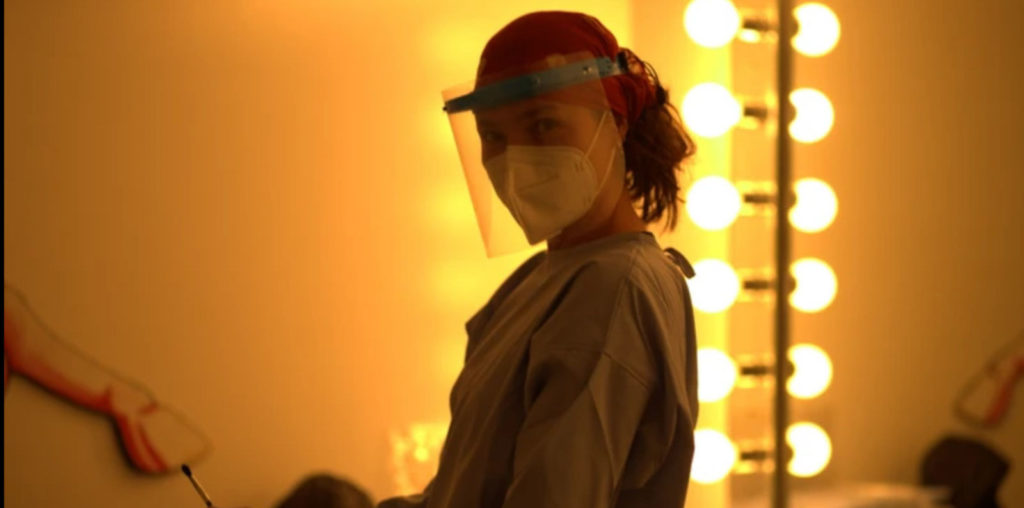
After a freak accident leaves her speaking with a Bosnian accent, Kathy is suddenly seen as a stranger in her own world. What begins as an unfortunate linguistic mishap becomes a gently absurd journey into the immigrant experience—one she never meant to have. Foreign Tongue, the new film from director Boris Mojsovski, is an emotionally rich exploration of identity, perception, and belonging that uses comedy and magical realism to examine what it truly means to be “foreign.” In this interview, Mojsovski—himself a Bosnian refugee and immigrant—discusses how his own lived experience of language barriers and cultural displacement inspired the film, the meticulous casting and accent work with actress Kimberly-Sue Murray, the delicate balance between comedy and preachiness, and what he hopes audiences will take away from Kathy’s absurd but deeply human journey. He also reveals the creative philosophy behind making a film that communicates through curiosity rather than certainty.
Foreign Tongue explores the theme of being “foreign.” What was your inspiration for the film, and now that you have developed this idea into a feature film?
I am a foreigner, a Bosnian refugee, immigrant, and outsider who, with the passage of time, became culturally adjusted in some ways but not in others. My futile (but relentless) attempts at self-analysis and conclusions about how I fit into the world around me inspired me, in many ways, to write Foreign Tongue. That, combined with Cynthia Ashperger’s original story about a woman with foreign-accent syndrome, became the backbone of the film.
The inversion of the familiar theme of a foreigner’s journey through a new environment is the most satisfying and fulfilling aspect of making this film for me. Kathy is the unlikely immigrant. She is not actually an immigrant, but rather a person mistaken for one because of an unfortunate accident. Her accent leads people to treat her as a stranger. In a strange but logical turn of events, she slowly becomes what the world sees her as: a Bosnian immigrant.
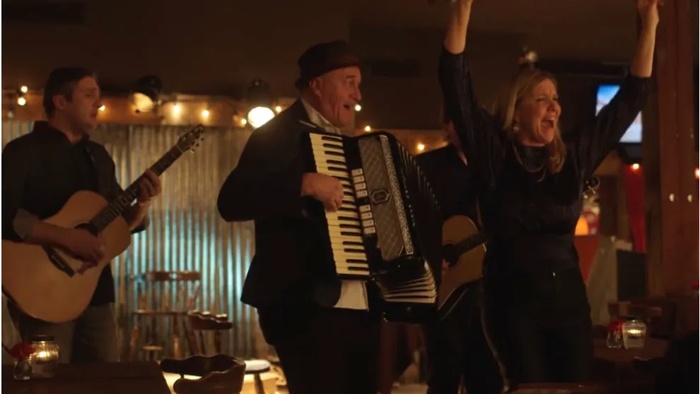
“Foreignness is not a flaw, but a perspective and that empathy, sometimes, begins with misunderstanding.”
The absurdity of this situation allowed us to explore a lot of comedy within this romantic story about identity. It inspired my favourite elements of magical realism, situational angst, and the universal need we all feel for belonging.
The group of real immigrants teaches Kathy what it means to be kind, genuine, and non-judgmental. They also teach her about the struggles immigrants and foreigners face in the new countries they come to. I wanted to talk about all of these themes and ideas in a rational, gentle, and comedic way that would allow the audience to process them without the need for big, preachy statements about our world.
I see this film as a subtle reflection on what identity really is, and Kathy’s absurd situation as a reminder that “foreignness” is not a flaw, but a perspective, and that empathy, sometimes, begins with misunderstanding.
You really zero in on the language barrier most foreign visitors or immigrants face in a new country. Can you speak to that, as you developed not only the story but the character of Kathy?
In a narrative focused on the main character and her unlikely archetype, we wanted to give more colour and voice to the immigrant community and the real foreigners who fully accept Kathy’s new persona and welcome her without hesitation. While they themselves are waiting to be accepted by society, they immediately accept Kathy.
This is a completely new experience for Kathy. She has never really had this kind of sense of belonging. Suddenly, she is misunderstood, underestimated, misheard, and quietly pushed to the margins everywhere, except within this community.