
Independent cinema has always gravitated toward pressure-cooker environments where character is everything. Few settings deliver that tension as efficiently as a casino floor, a dimly lit poker room, or an informal card game with rent money on the table. Increasingly, indie filmmakers are treating these spaces not as genre backdrops but as psychological arenas, places where a single hand reveals more about a person than a dozen scenes of conventional dialogue.
What makes gambling settings particularly attractive isn’t spectacle. It’s intimacy. A single blackjack round, played out in real time, compresses risk, identity, and consequence into minutes. For directors working with tight budgets and tighter shooting schedules, that’s an extraordinarily efficient narrative tool.
Why Indie Directors Keep Returning to Casinos
The cultural moment matters here. U.S. commercial gaming revenue hit a record $71.92 billion in 2024, a 7.5% increase from the previous year. This is driven heavily by online platforms and sports betting.
Gambling isn’t a niche anymore. It’s woven into everyday life in a way that makes it dramatically legible to general audiences, and irresistible to directors mining contemporary culture.
Online casino options have expanded dramatically alongside this growth. These platforms tend to offer larger gaming libraries, bonuses, and up-to-date offerings like faster payment methods like crypto (source: https://www.cardplayer.com/online-casinos/fast-payout-casinos). That normalization feeds directly into how audiences read gambling on screen, less as transgression, more as a current condition.
Risk and Character: What Gambling Reveals
Gambling strips characters bare in ways that most dramatic situations don’t. When someone bets money they can’t afford to lose, every micro-expression, every hesitation, every false bravado becomes meaningful.
Indie filmmakers recognize this instinctively. This is why so many low-budget character studies keep returning to felt tables and stacked chips as their central visual language.
Recent films highlight the point. On Swift Horses (2024) uses a character’s compulsive casino trips to Las Vegas as both an escape route and an emotional confession.
Ballad of a Small Player (2025) goes further, treating Macau’s casino floors as a literal psychological cage, a space that holds its protagonist captive while illuminating everything broken inside him. Neither film is interested in the glamour. Both are interested in what gambling exposes.
Real Money Culture Bleeds Into Storylines
A survey of slot and casino film sequences demonstrates that gambling aesthetics have long functioned as storytelling shorthand, but the language is evolving.
The smoky backroom of classic crime cinema is giving way to regulated casino floors, resort lobbies, and digital adjacencies that reflect how real audiences now actually encounter gambling.
This matters thematically. When gambling looks familiar rather than exotic, it stops being a genre marker and starts being a social condition. Indie directors can use that shift to ask harder questions about class, desperation, and the seductive logic of risk.
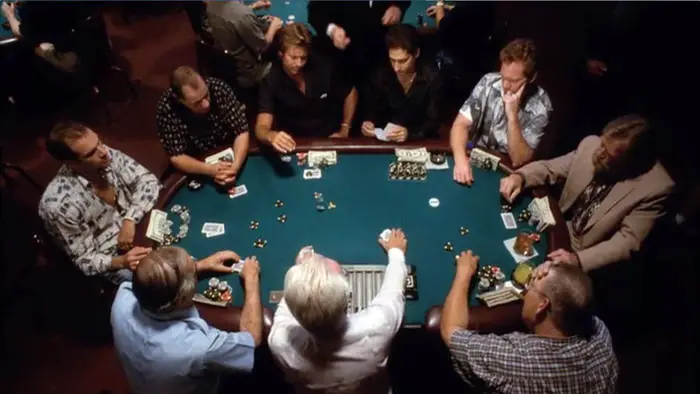
When the Table Becomes the Whole Film
The most ambitious indie gambling films don’t just use the casino as a setting; they let it become the entire world of the story. The Queen of Vegas (2023) and High Stakes: Monte Carlo (2024) are emblematic of this approach. They are smaller, talkier films that use the casino environment to explore gender, intelligence, and power rather than heist mechanics.
The visual language of gambling in film is actively moving away from physical mythology toward something more fluid and culturally current. For indie filmmakers, that means open territory.
The table isn’t just a prop; it’s a mirror, reflecting whatever a character most fears losing. That’s not a genre conceit. That’s just good drama, and independent cinema has always known where to find it