Independent horror blogs are run by critics who own their words, publish steadily, spotlight subtitled micro-budget films, warn before spoilers, and link to legal streams. Nail those five checks and you’re in.
Google’s top result for “best horror blogs” is a 90-link Feedspot list that ignores what’s current or who’s reviewing Korean shaman thrillers and Nollywood cult chillers. Horror is the fastest-rising film genre, and non-English titles already supply a third of Netflix viewing.
Below, you’ll find 15 active, independent sites, sorted by the job they do best.
How we chose
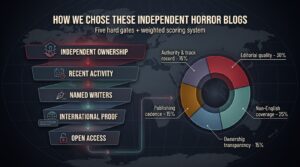
We audited more than 70 candidate sites on November 24, 2026, then ran each one through five hard gates:

1. Independent ownership. If a studio or streamer signs the checks, it’s out.
2. Recent activity. At least one post after July 1, 2026.
3. Named writers. By-lines only; no anonymous round-ups.
4. International proof. A subtitled or foreign-produced title covered within the last 18 months.
5. Open access. Optional subscriptions are fine; mandatory paywalls are not.
Sites that cleared those gates earned a weighted score:
- Editorial quality: 30 percent
- Depth of non-English coverage: 25 percent
- Ownership transparency: 15 percent
- Publishing cadence: 15 percent
- Authority and track record: 15 percent
We use that score to decide whether a blog belongs. Afterward, we sort the winners by the job they do best: daily global pulse, regional microscope, or critical lens. This lets you jump straight to the voice that fits your search.
Broad global discovery engines

Think of this first group as your genre compass. Each outlet publishes multiple pieces every week, crosses borders with ease, and keeps space for under-the-radar releases alongside headline fare. Even on a quiet news day, a quick scroll here can fill your watchlist with fresh subtitled chills.
The Slab: where mechanics meet mayhem
Andrea Hagopian files every review like an autopsy report. Each case file answers six survival questions (killer competence, response quality, rule clarity, beat-ability, restraint, pace) then drops the movie into one of 64 classifications, letting you weigh Hostel against a Korean shaman thriller without guesswork.

Screenshot of The Slab Horror Review Blog Homepage
The Foreign Bodies index is the heartbeat: as of November 24, 2026 it logged 73 films across 24 countries, pairing Indonesian folk nightmares with Spanish creature features and Japanese pinku oddities. Reviews stay spoiler-free until a red divider, then flip into “ending analysis” for detail-hungry readers.
Utility matters here. A nightly What to Watch Tonight post matches premieres to legal streams, while monthly U.S. expiry alerts warn you before algorithms bury a title.
Caveat. The Slab is a one-writer shop, so big festival waves may outpace it, yet that same focus means sloppy plotting rarely slips through.
ScreenAnarchy: a round-the-clock passport to genre
Founded in 2004, ScreenAnarchy publishes several stories every day (Feedspot notes over 35,000 Facebook followers and clocks its Domain Authority at 76). A left-rail menu lets you jump straight to Africa, Asia, Europe, Latin America or the Middle East instead of scrolling past Marvel chatter.
During festival season the team files capsule reviews from Montreal to Sitges before the applause fades. In slower weeks you’ll still catch deep dives into Chilean creature features or restorations of Thai slashers. That constant pulse, plus trailers, box-office context and cross-cultural interviews, makes ScreenAnarchy a reliable daily radar for global genre film.
It is not horror-only, and display ads keep the lights on. The payoff is a contributor network that spans six continents and keeps new titles (mainstream or micro-budget) on your map long before they hit Western streamers.
Certified Forgotten: underseen horror gets its day
Launched in 2021, writer-owned Certified Forgotten shines a light on films that have fewer than ten reviews on major aggregators. One film earns one long-form essay, no listicles, just a clear case for why a micro-budget Canadian ghost story or a Mexican slasher deserves space in your brain.
A new essay drops most weeks, and two alternating podcasts fill the off-Fridays: an interview series with filmmakers and a round-table that unpacks neglected titles scene by scene. The payoff is context (festival history, distribution hurdles, cultural subtext) so you can champion the movie yourself.
Optional memberships fund the project, so the core essays stay free while the occasional interview sits behind a paywall. That model lets the editors ignore click-driven urgency and focus on films that slipped through the cracks. Certified Forgotten will not tell you what opened last Friday; it will explain why a 2012 Thai fetus-in-a-jar thriller still claws at your subconscious.
MOVIES & MANIA: an 11,100-entry rabbit hole
If Certified Forgotten is a boutique record store, MOVIES & MANIA is the Library of Congress. Founder Ade Smith’s team has logged thousands of film pages since 2012 and still updates the archive daily, sometimes hourly when a juicy trailer drops. The site even provides links to legitimately watch thousands of movies free online.
Each page stacks the essentials in one scroll: a fresh review, excerpts from print-era critics, links to legitimately free streams, and a gallery of vintage posters or VHS art. You get context at a glance and save a dozen separate searches.
International scope is the second hook. One minute you are reading about a Bolivian folk-horror short, the next you are knee-deep in an Italian giallo restoration or a Filipino aswang thriller. Country and sub-genre tags let you surf a whole micro-scene with two clicks.
Caveat. The data-dump style means some entries read like research dossiers rather than flowing criticism, and the rapid cadence can swing tone from page to page. Treat MOVIES & MANIA as a reference shelf first, a review magazine second, and a shelf that rarely disappoints when you need an obscure release date or lost VHS synopsis.
Regional & bilingual specialists
Global round-ups help until you need a microscope. These outlets live inside the cultures on screen, catch nuances translation can blur, and surface titles even festival databases miss. Reach for them when backstory and local context matter as much as the jump scares.
Asian Movie Pulse: one continent, dozens of dialects
Launched in 2008, Asian Movie Pulse drops eight-plus stories on a busy day, powered by a team of more than 25 writers across three continents. Country tags turn the firehose into a filter, so you can binge Vietnamese slashers without wading through Japanese kaiju news.

Screenshot of Asian Movie Pulse Homepage
Recent weeks brought a Laotian folk-ghost film, a Pakistani urban-legend short, and an Indonesian eco-horror doc. Festival wrap-ups land almost in real time because contributors file from Seoul to Sydney. Styles vary. A 400-word verdict appears here, a 2,000-word socio-political dive there, yet that sprawl means a micro-budget Filipino splatter flick with a single-screen release often shows up here first.
Treat Asian Movie Pulse as radar: scan the country filter, note titles that surface twice, and you’ll build a regional watchlist months before the streamers catch on.
10th Circle: spoiler-free scares in English and Spanish
Founded in 2019, 10th Circle keeps reviews strictly spoiler-free, then spins plot details into a separate “ending explained” post for anyone who has already pressed Play. The line stays clear, even when a film hinges on a late-act mythological twist.
Solo creator Dante Yurei writes every piece twice, English and Spanish. That bilingual mirror lets readers in Boston and Buenos Aires trade links without machine translation. Country tags pull double duty too: click “Argentina” for a shapeshifter yarn and you’ll see legal streaming options if they exist.
Cadence averages about two reviews a week, enough to grow the archive without flooding your feed. Limited bandwidth is the trade-off, but the payoff is a consistent critical voice and a catalog that already spans Korea, Spain, Mexico and the Philippines.
Bookmark 10th Circle when you want a clean recommendation, with zero risk of an accidental reveal.
Latin Horror: cultura, folklore, y fear
Launched on Halloween 2008, Latin Horror promises Latin-rooted terror the spotlight U.S. slashers get. Founder Edwin Pagán keeps that pledge through interviews, folklore explainers and reviews that zigzag between languages and media. One week brings an essay on Nahua shapeshifters, the next a Q&A with a Peruvian director fresh from Fantasia.
Because community building sits at its core, coverage stretches beyond film: literature, visual art and comics frame references casual viewers miss. That depth paid off when Huesera: The Bone Woman hit North American cinemas, as Latin Horror had already unpacked its commentary on motherhood and Catholic guilt.
Expect a handful of posts each month rather than a relentless news feed. Breaking scoops may land elsewhere first, but treat Latin Horror as a curator and you’ll leave with titles steeped in centuries-old storytelling and modern reclamation alike.
desistfilm: cinema, politics, and Latin American nightmares
Founded in Peru in 2012, bilingual magazine desistfilm treats horror as one strand in a wider cultural tapestry. Essays link a film’s dread to colonial scars, economic upheaval or ecological crisis, turning a simple possession story into a case study on land rights or religious syncretism.
The site hums during festival season: contributors file dispatches from Lima, Rotterdam and Buenos Aires, stitching South American premieres to global trends. Between festivals output slows, but the archive is deep. Dig around and you’ll find pieces on Andean corpse rituals, Brazilian body-horror experiments and Chilean gender-fluid slashers that rarely surface on mainstream radar.
desistfilm is not horror-exclusive, and English translations sometimes trail the Spanish originals by a week or two. Treat the delay as an invitation to compare versions and sharpen your genre Spanish along the way.
What Kept Me Up: Lagos-based lens on Nollywood chills
Founded in 2021, Lagos collective What Kept Me Up mixes brisk news hits, scene reports and reviews, often several posts a week, so you can track premieres, censorship debates and streaming pickups almost in real time. (Its companion YouTube channel tops 7,200 subscribers, a useful sidebar for trailer drops and interviews.)

Screenshot of What Kept Me Up Nollywood Film Blog Homepage
When Alive Till Dawn hit Prime Video, the team was quick to dissect its campus-cult twist and the production hurdles unique to Nollywood budgets. Because the writers cover every genre, horror posts arrive in bursts, but the “dark theme” tag and monthly recaps pull the macabre into one scroll.
The payoff is local context Western outlets miss: how witchcraft tropes trace back to Igbo belief systems, or why cinema chains shy away from explicit gore despite a booming appetite. What Kept Me Up proves African horror is not a monolith; it is an ecosystem inventing its own jump-scare playbook while the rest of the world looks away.
Criticism through a social or scholarly lens
Some critics do more than review a film. They weave history, identity and academic theory into each paragraph, turning midnight creature features into cultural seminars. The next entries spotlight those voices.
Grimoire of Horror: folklore meets formaldehyde
Founded in 2020 and boasting over 24,000 Facebook followers for its Asian horror branch alone, Grimoire of Horror splits its front page in two. The Yurei covers J-horror, kaiju and manga nightmares rooted in centuries-old yōkai tales, while The Banshee leans toward Western giallo, occult thrillers and extreme cinema. Side-by-side menus let you compare how a Shinto revenge spirit and an Italian masked killer weaponize fear in different ways.
New pieces land a few times each month. Each one digs deep, tracing monsters back to regional myths or unpacking the censorship battles that shaped a director’s choices. Recent pivots ranged from a queer reading of Battle Royale to a primer on Filipino aswang lore.
Country tags and sub-genre filters keep the archive navigable, and bold red spoiler warnings appear before every reveal. The site also covers games and books, so headlines alone do not always signal a film review; use those filters and Grimoire of Horror becomes a master class in how folklore mutates on screen.
Horror Homeroom: academia meets adrenaline
Launched in 2015 and sitting at a Domain Authority of 35, Horror Homeroom treats slashers and ghost stories like required reading yet keeps the prose lively enough for late-night scrolling. Essays pull folklore studies, eco-criticism and gender theory off the shelf and plug them into films that range from silent classics to this month’s festival darling.
Cadence is measured, about one or two pieces a week, leaving room for special issues. Recent dossiers tackled folk horror, family trauma and eco-terror, each packed with guest essays that bounce ideas around like a well-moderated seminar. You leave understanding why a pagan-ritual thriller lands differently in a climate-crisis era.
Navigation helps. Tabs separate essays, podcasts and themed collections, and bold spoiler alerts guard key twists. The trade-off for that rigor is speed; if you crave instant release-day reactions, look elsewhere. If you want to know how a film fits into a century of cultural fears, grab a seat, class is in session.
Morbidly Beautiful: spotlight on indie and overlooked voices
Founded in 2015 and boasting over 35,000 Facebook followers, Morbidly Beautiful wears its mission on its sleeve: amplify horror made outside the studio echo chamber and give a megaphone to creators audiences seldom hear. Editor-in-chief Stephanie Malone steers a volunteer squad of critics, podcasters and filmmakers who file several stories every week, from festival dispatches and deep-cut reviews to interviews that double as DIY guides for emerging talent.
Recent angles prove the range. One essay linked Huesera: The Bone Woman to reproductive-rights debates, while a podcast episode broke down how micro-budget crews stretch practical effects without lawsuits. Because contributors include women, LGBTQ+ and BIPOC voices, representation talk is built in, never bolted on.
International coverage comes in waves, often tied to festival slates or VOD drops, so keep an eye on the “world cinema” tag for subtitled gems. Caveat. News, fiction and gear round-ups can swamp the homepage; use category filters or the weekly newsletter to surface the critical essays first.
Anatomy of a Scream: intersectional horror on every wavelength
Launched in 2016 with more than 550 podcast episodes on deck, Anatomy of a Scream grew from Valeska Griffiths’s one-woman zine into an inclusive audio-first network. Co-captains Griffiths and Joe Lipsett lead a crew of women, queer, BIPOC and disabled contributors who dissect horror’s power structures while still reveling in the carnage.
Most of the action happens in earbuds. Weekly shows parse new releases, revisit final-girl tropes and spotlight region-specific niches such as Korean occult thrillers. Written essays backstop the audio with close readings on everything from trans embodiment in body horror to the capitalist grind at the heart of Squid Game.
Perspective matters here, not plot recap, so spoilers arrive early but are always flagged. International coverage depends on the week’s host. Subscribe to the “global horror” feed for a steady stream of subtitled fare and sharp, intersectional commentary.
Exquisite Terror: slow-burn essays, razor-sharp insight
Founded in 2011, Exquisite Terror publishes at a measured pace, often one long-form piece a month, yet each release lands like a mini-monograph. Editors Naila Scargill and Stefanie Cuthbert favour essays that linger on composition, performance and subtext: close readings of J-horror sound design, or analyses of queer identity stitched into French extremity.
Tags keep the archive navigable (“Japan,” “Body Horror,” “Critical Studies”). Click one and you might tumble into a 3,000-word study linking Joko Anwar’s Satan’s Slaves to Indonesia’s post-dictatorship anxieties, or a meditation on surgical imagery in trans-authored cinema. Interviews deepen the bench, treating directors as craft partners rather than quote machines.
Cadence is monthly at best, so Exquisite Terror will not feed a daily scroll. What it offers instead is rigor: every paragraph argued, every citation earned, perfect for sharpening critical vocabulary and seeing familiar films through an unsettlingly precise lens.
Coverage gaps: where English-language horror criticism is still thin
A November 24 2026 sweep of thousands of search results revealed two regions with zero active, English-language, horror-only review sites:

- Middle East. Genre filmmaking thrives in Egypt, Lebanon and Saudi Arabia, yet English readers find only scattered festival capsules or ScreenAnarchy’s Middle East tag when an Arabic-language fright flick lands on Netflix.
- Africa beyond Nigeria and South Africa. Kenyan, Ethiopian and Senegalese horrors appear in culture pages or personal newsletters but not in dedicated review hubs.
Why name the gaps? Sunlight sparks growth. If you run or translate a horror blog in Cairo or Dakar, reach out. Until then, supplement today’s list with outlets such as Egyptian Streets and CairoScene, and watch regional festival line-ups for the first sparks of a local scene taking shape.
How to build a better horror-review diet
Think of critics as personal trainers for your watchlist: too few and your taste plateaus, too many and the program gets muddled. Three complementary voices usually hit the sweet spot.

- High-cadence global pulse. A site like ScreenAnarchy or MOVIES & MANIA posts multiple times a day, so release windows and trailer drops never slip past you.
- Regional specialist. Asian Movie Pulse keeps J-horror on your radar, while What Kept Me Up tracks Nollywood premieres and censorship battles the Western trades miss.
- Perspective shifter. Grimoire of Horror unpacks folklore, and Anatomy of a Scream filters slashers through intersectional politics, essays that echo long after the credits roll.
- Read two reviews from different regions before pressing play on an unfamiliar title.
- Track a critic’s recurring likes and dislikes; patterns teach you when to trust, or invert, their verdict.
- Subscribe to newsletters or RSS feeds so algorithms cannot bury niche voices.
- Heed spoiler warnings, and bail until you have watched.
- Compare how region-native and U.S. critics frame the same film; the contrast often reveals more than the plot.
Rotate critics, note your reactions, and your horror intake will stay fresh, global and spoiler-smart.
FAQ: independent horror review blogs, answered
What makes an independent horror blog trustworthy?
Look for by-lines you can search, a visible masthead or ownership page, a dated corrections policy, and spoiler warnings placed before plot reveals. When a critic cites region-native sources or links to legal streams, that is another green flag.
Which sites are best for J-horror and wider Asian horror?
Start with Asian Movie Pulse for rapid, country-tagged coverage, add Grimoire of Horror for folklore context, and use ScreenAnarchy’s Asia feed for festival dispatches. Together they cover everything from big-budget Korean occult hits to micro-budget Filipino slashers.
Where can readers find Latin American horror criticism?
Latin Horror offers accessible English-language reviews and interviews, while desistfilm supplies bilingual essays that tie dread to politics, colonial history and Indigenous myth. Pair the two for both discovery tips and deep scholarship.
Which site keeps tabs on Nollywood or African horror?
What Kept Me Up leads the charge with weekly news and reviews straight from Lagos. For scattered coverage of South African or Egyptian titles, add Spling or ScreenAnarchy’s Africa tag until more region-native blogs emerge.
Who provides reliably spoiler-free reviews?
10th Circle keeps the main review spoiler-free, then publishes a separate “ending explained” post. The Slab flags spoilers mid-review with bold dividers so you can bail before big twists surface.
What are the top alternatives to Bloody Disgusting?
Need global news? ScreenAnarchy. Crave under-seen indie gems? Certified Forgotten. Obsessed with survival mechanics? The Slab.
Do people still read horror blogs?
Yes. ScreenAnarchy boasts over 35,000 Facebook followers, and Grimoire of Horror’s Asian horror branch alone has over 24,000 followers. Engagement tends to spike during Fantasia and Fantastic Fest season. Readers still want the cultural nuance short-form video rarely supplies.
Conclusion
Search results still drown us in the same handful of horror brands, yet new terrors keep arriving in new tongues. Independent blogs cut through the noise: they translate culture, surface micro-budget premieres, and spotlight blind spots long before corporate media looks up.
Use the three-point diet: one high-cadence global feed, one regional specialist, and one critic with a distinct lens. The 15 sites in this guide will stock your queue with Korean ritual nightmares, Nigerian cult chillers, and Latin American folk curses. More important, they explain why those stories land harder than an algorithm’s latest jump-scare.
This guide reflects data checked on November 24 2026. Horror never sleeps, and neither should the map. If you run or read an active English-language horror blog we missed, especially from the Middle East or wider Africa, let us know so we can keep the compass accurate.