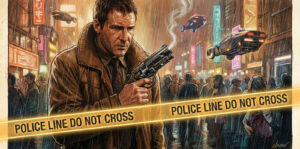
The room at the top of the Tyrell Corporation is bathed in golden reflections of phantom water, cast by a piercing golden sunset that will soon give way to the perpetual rain of 2019 Los Angeles washing over neon skyscrapers, but inside, two people sit across a heavy desk in near silence.
On one side is Rick Deckard, an ex-cop (a Blade Runner) brought back for one specific job: hunting down rogue artificial humans known as “skin-jobs” or replicants. In the polite corporate doublespeak of his world, he doesn’t murder them; he “retires” them, a clinical term for putting a bullet in a machine that looks, bleeds, and talks like a person.
On the other side sits Rachael, an immaculate corporate assistant who has no reason to believe she is anything other than human. Deckard is there to run a hundred-question “Voight-Kampff” test, measuring pupil dilation and capillary flushes to detect whether she possesses genuine empathy or just a synthetic facsimile of it.
Before the machine can even begin humming, Rachael looks Deckard dead in the eye and asks a simple question:
“Have you ever retired a human by mistake?”
Deckard answers with an instinctive, professional “No.” Rachael doesn’t flinch: “In your position, that is a risk.”
A moment later, Deckard outlines his entire operating philosophy with flat, blue-collar pragmatism:
“Replicants are like any other machine. They’re either a benefit or a hazard. If they’re a benefit, it’s not my problem.”
It is a remarkably level-headed stance for a dystopian story. Deckard isn’t an ideological crusader. He doesn’t wake up angry at the existence of technology, and he doesn’t view synthetic beings as a personal insult to his own dignity. If the machine does its job without harming anyone, he leaves it alone. He only pulls the gun when it becomes an active hazard.
Weirdly, modern internet culture could learn a great deal from that distinction. Because right now, our creative ecosystem is overrun by self-appointed Blade Runners who carry none of Deckard’s professional restraint, yet all of the paranoia the movie bathes us in.
The Paranoia of the Machine-Hunter
In Ridley Scott’s universe, the subtle tragedy of the Blade Runner isn’t just the presence of synthetic life; it’s what the hunt does to the hunter. To spend all your waking hours looking for an artificial twitch of the iris or an unnatural hesitation in a heartbeat requires perpetual, neurotic suspicion. You have to train yourself to stop looking at the person in front of you and look only for the imposter.
That fictional paranoia has become the everyday reality of modern creative spaces.
Over the past few years, social media has turned into an open-air precinct of self-deputized inquisitors. But unlike Deckard, these mobs aren’t waiting for a hazard. They view the mere existence of new technological tools as an existential crime, roaming comment sections and forums desperate for an excuse to pull the trigger.
The result is precisely what Rachael warned about: they have begun retiring real humans by mistake. Or maybe not by mistake.
We see it constantly across art platforms, writing circles, and creative competitions. Traditional painters, seasoned 2D animators, and digital illustrators- craftsmen who have spent decades developing their trade and have never touched a neural network- find themselves swarmed by online mobs accusing them of being fakes. An intricate piece of ambient lighting, a stray digital brushstroke, or an unusual perspective angle is suddenly treated as a failed “Voight-Kampff” test.
The mob doesn’t look at twenty years of sketches, and they don’t care about the human intent behind the frame. They operate on modern “spectral evidence,” the Salem-era belief that an invisible phantom only the accuser claims to see is sufficient proof of guilt.
They shoot first, ruin reputations, and congratulate themselves for defending “human art,” entirely ignoring the fact that they just executed a human artist in the process.
The False Promise of the Voight-Kampff Machine
This zealotry has now moved from online mobs to institutional policy. We see it in the frantic race to deploy automated AI detectors (ironically automated using AI), and more recently, in Anthropic’s decision to embed invisible, machine-readable watermarks into Claude to comply with European regulatory mandates.
The gatekeepers celebrated the move under the assumption that they finally had a foolproof machine to catch the “cheaters.” This would be a win for the “Is Deckard himself a replicant?” camp of Blade Runner fans, for those keeping score.
Yet Anthropic had to issue an immediate, glaring caveat: Detecting a watermark does not prove the machine authored the work. The watermark trips if the software was used to proofread a paragraph, format an outline, clean up syntax, or translate a line of dialogue. A writer could spend three years pouring their own blood, sweat, and heartbreak into a manuscript, run a messy draft through a model for basic grammar polish, and the document is marked with an invisible scarlet letter.
The automated test is fundamentally flawed because it confuses the processing of a tool with the source of human authorship.
In Blade Runner, the “Voight-Kampff” machine struggled because the line between memory, learned behavior, and genuine emotion was porous. In our world, setting up automated purity detectors to audit the creative process doesn’t protect the soul of storytelling. It just creates a bureaucratic dragnet where anyone who uses an assistive tool is presumed guilty until proven pure.
Hazard vs. Benefit: Reclaiming Accountability
The core mistake of the modern anti-tech movement is endowing the tool with a moral agency it does not possess. A neural network cannot steal, deceive, or feel pride. It is an instrument of computation.
Deckard had it right from the beginning: They’re either a benefit or a hazard.
If someone uses software to commit actual fraud- plagiarizing a specific creator’s expression, impersonating another artist, or deceiving an audience- that is a hazard. We already have clear laws and ethical standards to deal with measurable harms.
But if an artist uses modern computation to solve a visual problem, build a complex world on an independent budget, or streamline their workflow so their story can actually reach an audience, that is a benefit. And if it’s a benefit, the software pipeline they used is nobody else’s business.
The measure of a story was never supposed to be an audit of the tools used in the shed. The measure of a story is whether the human being who signed their name to it had something meaningful to say.
Did the movie make you feel the weight of mortality? Did the book make you understand the ache of another human soul? Did the characters stay with you long after the screen went black?
By the end of Blade Runner, Deckard realizes another great irony of his profession: by obsessing over the mechanics of what was “real” and what was “manufactured,” he had been ignoring the reality of the lives right in front of him.
If we spend all our time acting like machine-hunters, policing software licenses, demanding purity tests, and mistaking the presence of a tool for a lack of soul, we become the very thing we claim to fight against. The machine isn’t what dehumanizes our culture; our willingness to destroy each other over it is.
Christopher Moonlight is an animator, special effects artist, and the director of the ‘Award This’ winning movie, The Quantum Terror. His upcoming animated sci-fi adventure, Escape From Planet Omega-12, combines traditional film-making special effects with AI to create something never seen before in independent film. You can follow the behind-the-scenes, including tutorials, tips, and tricks, on his YouTube Channel, Substack, and christophermoonlight.productions website.




Well, hello there, Mr. Fancy Pants.
Good article buddy. Well done.
You did a man’s job.