
For a brief stretch of cinema history, films built around high-stakes decisions were treated as niche entries in the broader crime or sports drama categories. Then Rounders arrived in 1998, then Uncut Gems arrived in 2019, and somewhere along that twenty-year stretch the high-stakes decision film became a legitimate genre of its own. The defining characteristic is not the specific subject matter, whether poker, jewelry trading, financial speculation or sports brokering, but the structural commitment to placing a single character in a situation where every choice has irreversible consequences and the audience watches them either crack or transcend under that pressure.
How the structural rules came together
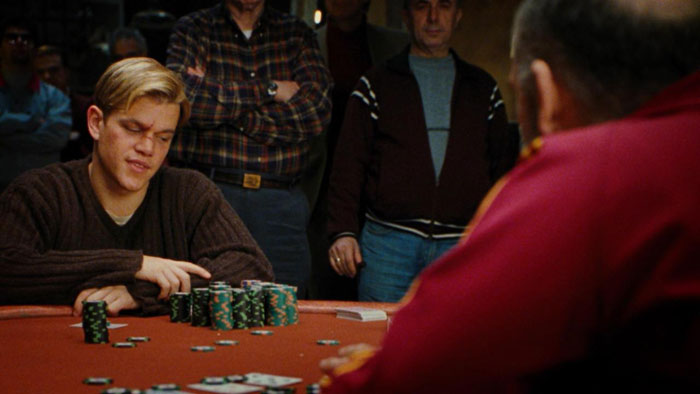
Rounders codified the formula. Matt Damon’s Mike McDermott returns to underground poker rooms to dig his friend out of debt, and the entire film operates on the principle that any given decision could end his life or his future. The film treats card-table reads as a form of legitimate intellectual discipline, builds tension through the cost of being wrong rather than the spectacle of being right, and refuses to romanticize the lifestyle even as it celebrates the cognitive demands of the work. Two decades later, critics still cite Rounders as the film that proved a poker movie could be a serious drama without requiring any of the genre’s usual escape hatches.
Uncut Gems took the same structural principle and stripped out all of the safety. Adam Sandler’s Howard Ratner spends 135 minutes making decisions that any rational observer would have stopped him from making, and Josh and Benny Safdie deliberately strip away every moment of relief or composure. The result is a film that feels less like a story being told and more like the audience strapped to a chair watching a man choose his own destruction in real time. Where Rounders gave its protagonist intellectual control even when he was losing, Uncut Gems took that control away entirely, and the genre split into two competing schools as a result.
The films that refined the formula across two decades
Across the twenty-year stretch connecting those two anchor films, dozens of works refined the formula. Croupier turned the dispassionate observation of a casino dealer into existential cinema. 21 simplified the math for mass audiences and made card counting into spectacle. Molly’s Game treated the high-end poker world as a venue for genuine character study. Mississippi Grind chronicled the slow erosion of a man who can no longer separate the rush of risk from the comfort of self-destruction. Each of these films held to the core convention: a protagonist whose decisions matter more than the outcomes they generate, watched by an audience that knows the stakes well enough to feel them.
Where the genre’s logic crossed into gaming and finance cinema
The genre’s success on screen has rippled outward into other forms of entertainment that share its structural DNA. Survival games, narrative roguelikes and even social casino games borrow the same emotional shape: a player whose choices carry weight, whose losses cannot be undone in the same session, and whose decision quality compounds across a play session in ways the player can feel. The appeal sits in the same place for both audiences. Watching someone make decisions under pressure is intrinsically dramatic, and making those decisions yourself is intrinsically engaging, because the mind cannot easily separate cognitive load from emotional investment.
The genre also overlapped with adjacent territory through the rise of finance-focused cinema. The Big Short, Margin Call and The Wolf of Wall Street all use the high-stakes decision film grammar even though they are nominally about Wall Street rather than card rooms. Adam McKay’s direction of The Big Short in particular owes more to Rounders than to any conventional finance drama, because McKay understood that the structural appeal was watching smart people work out asymmetric information puzzles in real time. The clothes change, the lighting changes, but the basic dramatic engine remains identical.
The expansion into superhero game design
Even superhero themed games have absorbed the same structural ideas in their modern incarnations. Marvel’s Midnight Suns, Telltale’s Batman series and Marvel’s Guardians of the Galaxy all include moral choice systems, branching decision trees and irreversible consequences that owe a clear debt to the high-stakes decision film. The hero does not simply win or lose; the hero makes decisions that close certain narrative paths and open others, and the player feels the weight of those decisions in a way that earlier action-game design rarely produced. The genre’s influence is now visible across forms of media that have nothing to do with its original card-table or jewelry-store roots.
What makes the high-stakes decision film durable as a genre is that its core premise translates cleanly across every shift in cultural taste. Whether the cultural moment is celebrating finance, mistrusting it, romanticizing crime or condemning it, the structural question of how a person makes consequential choices under pressure remains compelling. New films will keep being made in this mold for as long as audiences enjoy watching characters think under pressure, which is to say indefinitely. The faces and props will keep changing, but the engine that Rounders built and Uncut Gems perfected will keep running.
Why the genre’s grip on audiences only tightens with every cultural shift
The clearest sign that the high-stakes decision film has become a permanent genre is that each new generation of filmmakers can pick up the form and apply it to whatever situation feels most fraught to their audience. The 1990s gave us card-room cinema. The 2010s gave us anxiety cinema. The 2020s appear to be giving us crypto-and-AI cinema, with films like Dumb Money already showing that the genre’s grammar adapts to whatever decision-making arena currently feels most consequential. As long as audiences are fascinated by other characters making choices that cannot be taken back, this genre will continue to find new arenas and new protagonists. It is one of the few film genres that becomes more relevant rather than less with each technological shift, because every new technology creates new ways for people to make consequential decisions, and every new way of making consequential decisions becomes raw material for the next generation of films.