The internet is currently having its scheduled, predictable, weekly meltdown over Eli Roth’s new independently produced Ice Cream Man.
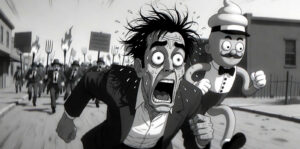
If you haven’t been following the drama, here’s the short version: early reviewers noticed telltale AI artifacts in a couple of animated sequences, a 1920s rubber-hose cartoon used to hypnotize kids, and an origin flashback for the film’s villain. When pressed on it, Roth initially claimed he sat down and hand-drew the frames himself because of his animation background. Then the credits rolled, revealing an AI VFX vendor named Dark Half. Twenty-four hours later, Roth issued a classic Hollywood backpedal, claiming he “misspoke,” and that AI was only used for a “very small portion” to help bring his vision to life. If you know anything about AI assists, it’s probable that Roth did draw key-frames for it, and then had AI handle the heavy lifting of finished animation… or maybe he didn’t. My feeling is, “Who cares?”
Well, naturally, the anti-AI crowd crash-outs on social media erupted, as they always do. Smelling blood in the water, the accused Roth of “stealing,” and declared the movie a moral failure before most people even had a chance to buy a ticket.
As an independent filmmaker who builds practical miniatures, sculpts monster puppets, and runs local AI diffusion models directly on my own hardware, I watched this entire PR circus unfold with a mix of frustration and utter exhaustion.
The problem with Ice Cream Man isn’t that Eli Roth used generative AI. I’m glad he did. He had a viability gap to fill, which, if you don’t know that term, I’ve written about before.
The problem is that he was terrified to admit it, and by lying, backpedaling, and apologizing, he handed the anti-tech pitchfork mob the exact conditions for victory they needed.
The Myth of the “Easy Button”
Let’s dismantle the biggest lie circulating in the film industry right now: the idea that incorporating AI into a visual pipeline is an “easy button” used exclusively by untalented hacks who don’t know how to make real art.
I draw. I paint. I construct physical sets in my shop, and I shoot practical special effects. I don’t use AI because I can’t do the work; I use it as an artistic forklift. When you are an independent creator trying to put studio-level scale, world-building, and visual ambition onto a screen without a $100 million corporate blank check, you use every single tool available to punch above your weight class.
If you need an unsettling, uncanny, dream-logic 1920s animation sequence that feels fundamentally off-kilter, blending hand-drawn keyframes with generative diffusion models is a brilliant, creative use of hybrid technology, good at adding that wonderfully weird feeling to a moment. It allows a mid-budget or indie film to achieve a specific stylistic texture that would otherwise be cost-prohibitive.
Using a power tool doesn’t make you a bad carpenter. But sitting there with sawdust on your shirt while swearing to a reporter that you cut every log with a hand-saw makes you look like a liar with something to hide, when you shouldn’t have had to hide anything in the first place.
The Cowardice of the Hollywood Backpedal
Eli Roth’s mistake wasn’t his means of making a movie; it was his press strategy.
He tried to play both sides of the fence. He wanted the speed, efficiency, and visual flair of generative tools in post-production, but he wanted the pure, artisanal “hand-crafted traditionalist” clout during his press junkets. He was terrified of the immediate online backlash, so he told a half-truth, got caught by his own end-credits, and then scrambled to issue a corporate-approved apology.
The moment you apologize to a mob, you validate their outrage. You signal to the world that there is something inherently dirty, unethical, or shameful about your creative process. You give them the authority to judge your legitimacy as an artist based on the software in your stack rather than the final image on the screen.
If you are going to use neural generation, ControlNets, or hybrid digital-practical workflows in your movie, own it.
Stand on the stage, look the audience in the eye, and explain the exact pipeline. Show them how the prompt, the keyframes, the local models, and the practical elements merged to create the shot. When you speak with total technical confidence and complete pipeline transparency, you strip the critics of their primary weapon: the thrill of “exposing” you. And let’s face it, they were never going to be on your side, or do a damn thing for your movie in the first place. They were looking for someone to destroy before they ever heard of you. They’re bottom feeders looking for clout they could never earn on their own, so they use anger to try and take yours.
What They Are Actually Scared Of
Let’s take that apart and look at it for a minute.
For decades, the studio system held a complete monopoly on scale. If an independent director had a wild, ambitious sci-fi or horror vision, they were forced to crawl on their knees to corporate boards, beg for development funds, and trade away their creative control just to get their movie made.
Local compute, open-source models, and hybrid AI workflows break that leverage permanently. When an independent creator can sit at a custom workstation, combine practical effects with local open-weight visual generators, and output a film that looks like it cost $50 million for a fraction of the price, the gatekeepers lose their power. They can no longer dictate who gets to build big worlds and who gets relegated to two people talking in a kitchen, and it drives these people crazy, because that’s the world they wanted us all to live in, where in their minds, they would get absurd amounts of money to be adored, shout orders on set, and walk flashy red carpets, while we forever sat on the sidelines with our quaint little indie films.
That is what the anti-tech mob is actually terrified of: creative sovereignty.
I love the tactile history of cinema. I love practical gore, rubber monsters, and physical sets. I still plan on using them, where it counts the most. But I refuse to pretend that technology stops being legitimate the second it makes a studio executive or a self-important guild lackey redundant.
Eli Roth had a chance to stand up for modern, hybrid indie filmmaking. Instead, he hid behind a press release and let the mob dictate the terms of his own art.
To every independent filmmaker watching this mess: don’t let anyone make you feel like you need to be ashamed for your toolbox. Master your gear, build on your own iron, tell the truth about your process (or at the very least don’t feel like you owe anyone an explanation), and put the best damn story you can on the screen. The audience doesn’t care about the internet’s hall monitors; they just want to see something great, and that’s where the paying field truly levels, because when everyone has the ability to put the exact same level of quality on screen, the only thing that can tip the scales is a killer story. That’s something they haven’t been able to create in ages, and they know that you can.
Christopher Moonlight is an animator, special effects artist, and the director of the ‘Award This’ winning movie, The Quantum Terror. His upcoming animated sci-fi adventure, Escape From Planet Omega-12, combines traditional film-making special effects with AI to create something never seen before in independent film. You can follow the behind-the-scenes, including tutorials, tips, and tricks, on his YouTube Channel, Substack, and christophermoonlight.productions website.