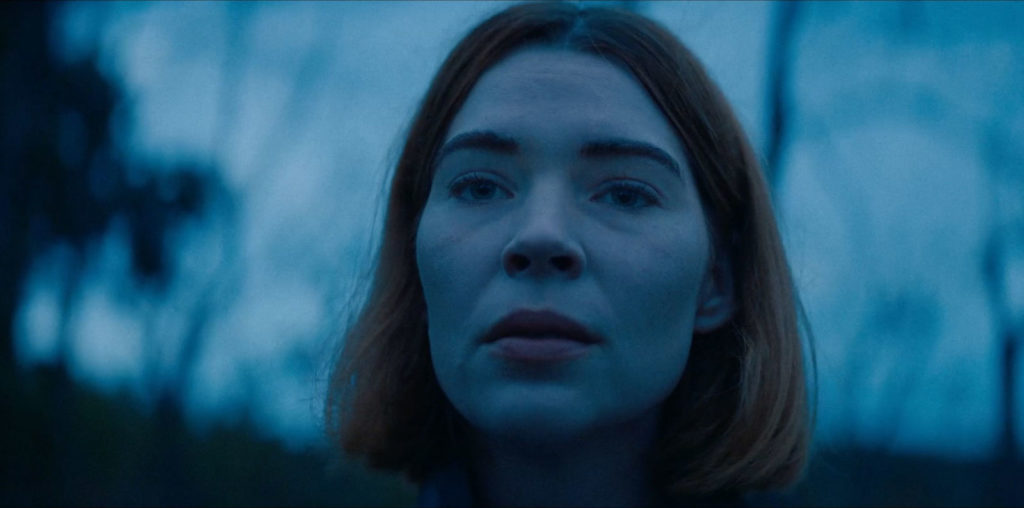
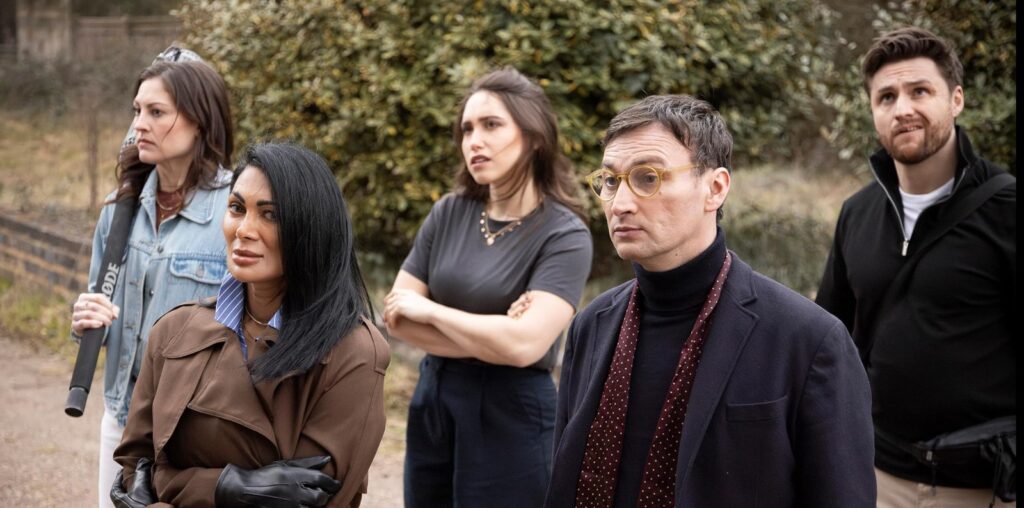
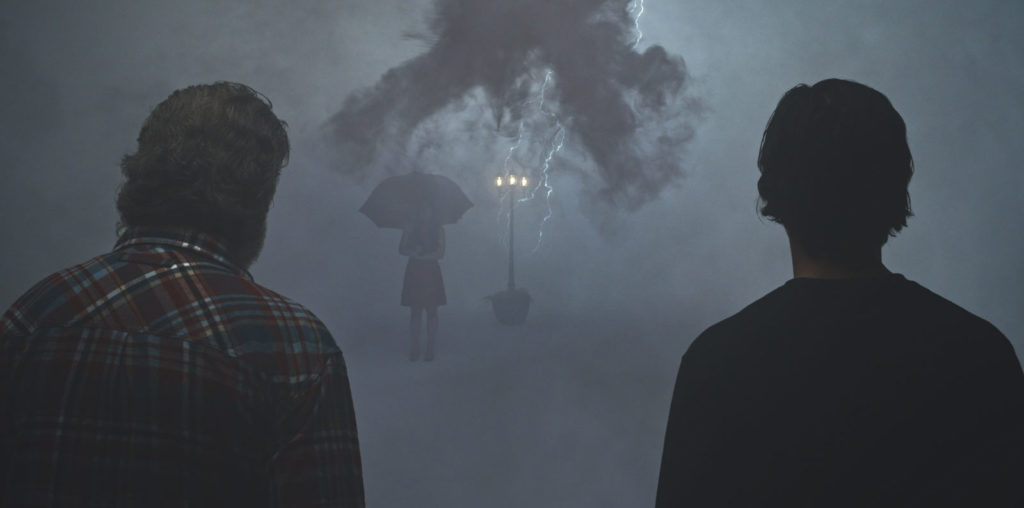
Director/writer Jeffery Husselman’s Yellowbrain does not recycle familiar supernatural conventions or fill the “space” with “space” in an effort that simply shows a lack of ideas. Part folk horror, part psychological nightmare and part experimental fever dream, it occupies an unusual territory where the boundaries between reality, death and the imagination become increasingly difficult to distinguish. The view is not in a “populist” way of showing a plunging roller coaster or through the eyes of some found artifact.
The premise initially suggests familiar territory. Opening shot of horror classics on a desk, like Dracula, along with the full jacket of Lost Face by Jack London. Curious choice, in that the anthology story is about human survival in the remote areas, featuring seven stories that portray the raw instincts and psychology of both humans and dogs. John is a solitary blacksmith, which in itself is an odd occupation choice for a non-period picture. Working away in a forgotten small village, he unknowingly releases an ancient evil through his labours. As inhabitants begin disappearing, the fabric of reality starts to unravel. Yet this conventional outline of supernatural horror only hints at the stranger cinematic experience that follows. John does not speak during the majority of the film; the audience watches him forge materials, watch a film and attend weekly therapy sessions. He salvages material from the river to make ceremonial bladed weapons. Drinks himself to sleep like Jack London, who had a lifelong destructive relationship with drink, often needing it to “begin the day.” Later, John encounters a gravelly, pitched-voice presence that manifests itself as long black nails reaching around him. The key is the fungus in the forest, the “yellowbrain,” which is essential, and the wood to hold the weapons. The viewers become numb with the details of John’s life, much like the majority of Bret Easton Ellis’ book American Psycho. You become part of the torrent of detail, then something hits you.
Yellowbrain is intriguing in its willingness to move away from straightforward storytelling in favour of atmosphere, imagery and unsettling associations. Alongside the blacksmith’s predicament are a therapy group he attends, discussing individuality and existence, and the curious, repeated viewing of an old 8mm film, which is later revealed to feature a dog. There is an almost dreamlike disregard for conventional narrative logic, as though the film is inviting us to make our own connections between events.
A striking aspect is the appearance of the lead actor John, played by Matthew Smith. There is something genuinely unsettling about his screen presence, particularly in the night-time sequences. With his hair falling around his face and the lighting catching his features in just the right way, he bears an extraordinary resemblance to a certain Canadian real-life serial murderer. I shall leave the identity unmentioned, but people familiar with the individual will probably recognize the resemblance. It is an accidental or deliberate piece of casting that adds another layer of discomfort to an already peculiar film. Sometimes a face can be more disturbing than any amount of prosthetic makeup.
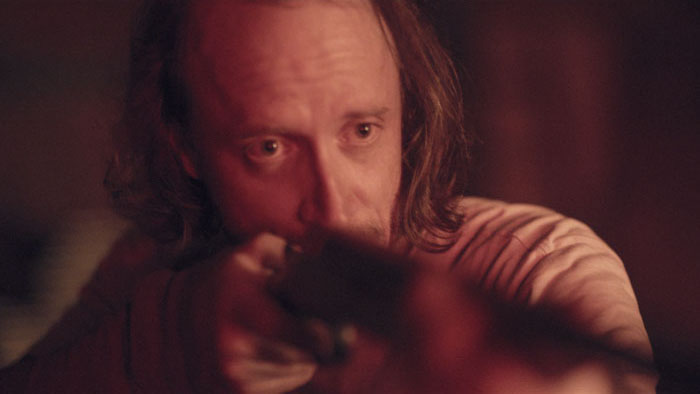
John (Matthew Smith) takes aim in a red-lit room in Yellowbrain.
“Later John encounters a gravelly pitched voice presence that manifests itself as long black nails reaching around him.”
The work has individual moments almost like set pieces, such as an open grave sequence, which becomes another memorable visual moment. Shovelfuls of earth descend towards the camera, placing the viewer in the position of someone being buried alive. The perspective has an almost vampiric quality, suggesting a consciousness trapped between life and death. It is precisely this kind of subjective imagery that gives the film its experimental character, which has been used in Carl Dreyer’s subjective vampire meditation, Vampyr. The stunning crying egg moment is about as unsettling as the dancing baby from Ally McBeal.
The title itself, Yellowbrain, brings to mind the strange appearance of yellow brain fungus, an organic growth resembling diseased neural matter. Whether intentional or otherwise, it provides an appropriate metaphor for a film concerned with corrupted consciousness, decay and the intrusion of something alien into the human world.
There is also an appealing old-fashioned quality to the presentation. The opening credits, with their parade of cast and production personnel, recall the elaborate credit sequences of Amicus horror productions. There is something wonderfully nostalgic about this approach, evoking a period when genre filmmaking took obvious pleasure in introducing its cast before proceeding to deliver its particular brand of cinematic nastiness.
The cast itself contributes to the film’s unusual atmosphere. Corissa Gabor appears as Mother, with Megan Guynn as Beth, Keith Ortiz as Brian, and Joshua Pariese as Dan. James Husselman takes on the role of Goatman, while Seth Besteman appears as the Cop. Jeremy Ball, Kate Bode, Stacie House, Jules Lyzenga and Ashley Normand populate the support group, providing the human dimension to the film’s more existential preoccupations. Dominique Beltzer and Alex Bernhardt appear as bar patrons, while Tim Pierzchala plays the bartender and Joye Davis the server. Charlie the dog and Rajah the cat round out an eclectic collection of performers and animal cast members.
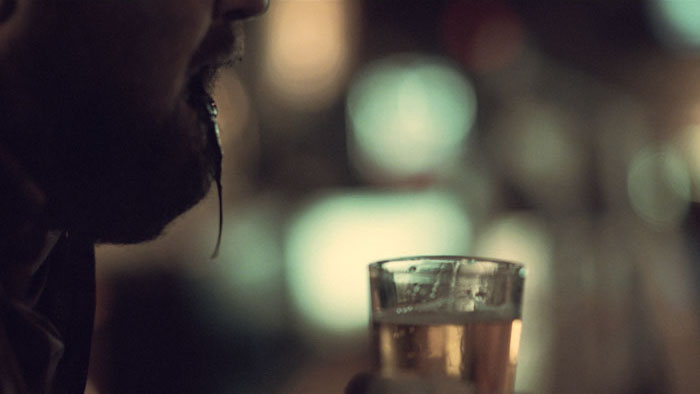
A bearded man sits with a beer in a dimly lit bar in Yellowbrain.
“Some nightmares are better left unresolved, and Yellowbrain seems to understand that perfectly.”
The practical effects deserve particular recognition. In an era increasingly dominated by digital manipulation, there is something refreshing about a production that embraces physical makeup, prosthetics and the tactile possibilities of traditional horror craftsmanship. The filmmakers’ connection with Tom Savini‘s effects school is an interesting part of this background, and the film’s affection for hands-on genre filmmaking is evident. One has pigment dropped in a liquid material bursting into shapes and colours similar to pulsating lava lamps used in 1960s psychedelic music shows.
Husselman’s earlier film Streetwalker provides an interesting point of comparison. That picture embraced retro exploitation aesthetics, eccentric characters, distinctive cinematography and psychological references, including quotations from Carl Jung. Its combination of seventies sensibilities and contemporary independent filmmaking suggested a director comfortable operating outside conventional genre boundaries. Yellowbrain appears to continue that interest in the strange and unexpected, although with a more overtly supernatural and surreal dimension.
Ultimately, Yellowbrain sounds like a film less concerned with explaining its mysteries than immersing its audience in them. The blacksmith, the disappearing villagers, the therapy sessions, the old film footage and the disturbing grave imagery form an eccentric collection of ideas that seem to orbit questions of identity, consciousness and mortality. With underground surrealism and practical horror effects, there is much to appreciate here. It has the appearance of a film made by people who still enjoy the peculiar possibilities of horror cinema and use a unique voice. Not everything needs to be explained, nor is it simply lazy writing. Some nightmares are better left unresolved, and Yellowbrain seems to understand that perfectly. Every dog has his day, or in this case…night.

"…psychological nightmare and part experimental fever dream,"