Voyeurism itself is part of the film-going experience, as one watches events that, at best, deliver an emotional response. Director Noboru Tanaka’s The Watcher in the Attic belongs firmly to the latter category. Released in 1976 as part of Tanaka’s celebrated work for Nikkatsu Studio, the film takes the tropes of the Roman Porno, which is Japan’s version of the Italian Giallo genre, and turns them into something considerably stranger: an atmospheric psychological study of loneliness, sexual obsession, and the dangerous distance between watching and participating.
The picture draws on two stories by writer Edogawa Rampo, The Human Chair, which I was familiar with, and The Attic-Stroller, combining their grotesque fascination with spaces, secret observation and distorted desire. This recalls other adaptations of work more on the edge of the traditional ghost story, such as Horrors of Malformed Men and Blind Beast.
The premise is wonderfully decadent in the old-fashioned literary sense of the Geisha intimate ‘pillow book ‘. Saburo Goda, played by Renji Ishibashi, becomes a watcher hidden above in the building’s structure. From his concealed vantage point, he observes a woman involved in various sexual moments, one with a version of a kabuki theatre clown. One time he finds the woman involved in murder, which he finds more fascinating. What begins as observation gradually becomes obsession. The attic ceases to be merely a physical hiding place and becomes a psychological refuge in which desire, fantasy and reality begin to collapse into one another.
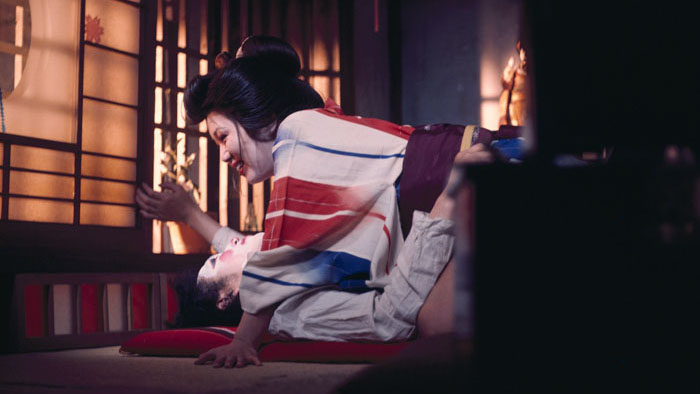
Minako Kiyomiya (Junko Miyashita) in a tense, intimate moment on the tatami floor in The Watcher in the Attic.
“From his concealed vantage point, he observes a woman involved in various sexual moments, one with a version of a kabuki theatre clown.”
Ishibashi as Saburo is not a conventional cinematic villain. He is awkward, isolated, and desperately hungry for some connection with the world beyond his hiding place. His voyeurism becomes an attempt to understand desire itself. He watches other people because he cannot fully participate in their emotional and sexual lives. The more he watches, however, the less capable he becomes of separating fantasy from reality.
Junko Miyashita is equally compelling, bringing an extraordinary mixture of vulnerability and erotic confidence to her performance. Minako Sayanomiya also makes a strong impression, particularly as the film explores the complicated relationship between being watched and knowing that one is being watched. Nobody in Watcher in the Attic is entirely innocent, as the work refuses to reduce these people to simple victims and predators.
This is where the film becomes considerably more interesting than a conventional exploitation picture. The erotic material is frequently presented through suggestion, framing, and expressions rather than the explicitness of some of the Asian Extreme Cinema. The viewer is repeatedly placed in the uncomfortable position of looking through something or wondering whether somebody is looking at us, such as zooming in on the eye of a large artwork on a ceiling.

"…Nobody...is entirely innocent as the work refuses to reduce these people to simple victims and predators"