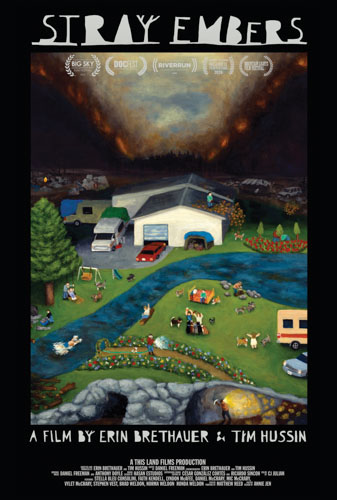
Smoke still lingers from the ruins of the homes consumed by flames when co-directors Erin Brethauer and Tim Hussin arrive in Paradise, California, in the wake of the 2018 Camp Fire that claimed 85 lives and uprooted 50,000 residents. Amidst the ash and desolation stands one home on a rare patch of greenery where Brad Weldon and his friend Mic McCrary stayed and fought the flames to save his property and the life of his blind, elderly mother. Stray Embers documents a community’s attempt at rebuilding as Weldon takes in 20 displaced friends and family members into his home.
The film picks up just five days after the fires have been extinguished, introducing the audience to Weldon and his harrowing story. As the fire began, there was no siren or alert, but a decision had to be made quickly: flee or stay? They were one of the few to stay, turned away by the gridlock on the roads. With just a garden hose and a few buckets, Weldon and McCrary battled the most destructive wildfire in California history for 30 hours straight, heroically preserving the home he and his wife bought together before she passed away.
But for Weldon, the fire was just the beginning. In the coming months, he welcomed dozens of people into his home for refuge. He has families with children as young as six months old living in tents and campers around his property, and at one point, as many as 12 dogs roaming about. They do their best to try to create a sense of normalcy. There are inevitable moments of conflict; there are ups and downs, but the film captures the perseverance and resilience of a group of people bearing the weight of unimaginable loss.

Brad Weldon and Mic McCrary sit together outdoors at night in a scene from Stray Embers.
“…documents a community’s attempt at rebuilding as Weldon takes in 20 displaced friends and family members into his home.”
This story could’ve been told many different ways, centering the handful of distressing stories about survival amidst the chaos of the fires. But there aren’t many characters as compelling as Brad Weldon, which is why Brethauer and Hussin smartly turn the cameras towards him. He’s the perfect documentary subject—magnetic, funny, outgoing, selfless, and kind. And he’s not just turning it on for the cameras. When he shares a tender moment with his mother, you can sense that his compassion is the norm. Even amidst the destruction, Weldon sees the beauty of the world around him. The burden of caring for so many starts to wear on him, but he never caves in.
Brethauer and Hussin’s approach to the film is simple—step back and observe. They rarely meddle; they just let the amazing story unfold in front of our eyes. But it’s their commitment to telling this story that really stands out. They didn’t visit for a few days or weeks; they returned over and over again during the three years following the fires to capture the full picture of a town putting the pieces back together. Brethauer and Hussin have a hand in everything—they’re producing, directing, behind the camera, and even assisting with the edit. The result is a film that feels incredibly intimate, like the filmmakers have been accepted into this community as one of their own.
The people of Paradise, California, spend very little time looking backward. Outside of a few moments of regret for items they didn’t grab, the focus is on forging ahead. Stray Embers is a story about death and rebirth, about being beaten down but finding the strength to get back up. The reminders of what was lost will always loom in the soil of the ground they walk on, but out of that soil grows something entirely new.
"…there aren’t many characters as compelling as Brad Weldon..."