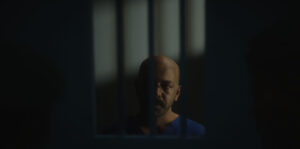
Raed Aboghnia’s Huwan shines a light on how, in life, guilt and grief can lock us up in a prison cell, even if we never actually commit a crime.
Jaber (Naif Al-Fawaz) is being escorted by two prison guards into solitary confinement. He has not yet been convicted, but the charges against him are serious. As the door shuts, Jaber heads to the lone mattress on the floor and sits down. He sees that he is not alone. On the other side of the cell is a dark, hooded figure (Salem Al-Khuzayem) that only he can see. The figure does not speak but signs to him, telling Jaber that his heart has grown numb.
Here, Jaber is transported back to the scene of the crime. He is having dinner with his wife, Aryam (Saraa Al-Otaibi), and son, Fareeh (Raed Al-Asiri), who has a facial deformity. Jaber is ashamed of his son and highly critical of him whenever the boy speaks. Aryam can’t stand Jaber anymore and leaves him and Fareeh. Blaming himself, Fareeh will do anything for his father’s approval…anything.

The Hybrid emerges from the shadows of a solitary confinement cell in Huwan.
“Jaber is being escorted by two prison guards into solitary confinement.”
According to writer/director Raed Aboghnia, Huwan explores the “prison” we put ourselves in. Guilt, denial, and fear of facing the truth build the prison walls. Like solitary confinement, that guilt leads to emotional, and eventually physical, isolation from our loved ones. Here, Jaber’s tragedy is not his son’s disfigurement, but that he let the boy’s appearance keep him from loving a son who loved him unconditionally.
Shot like a black-box theater production, the film centers on Naif Al-Fawaz, who shows Jaber’s guilt and grief through his physical performance. As we learn of the tragedy that befalls Fareeh, filmmaker Raed Aboghnia finds a way to turn heartbreak into hope and, ultimately, accountability. It’s a simple story, but an emotionally powerful one.

"…guilt and grief can lock us up in a prison cell..."