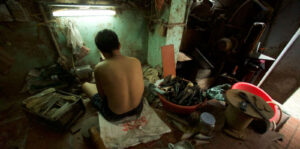
Horn Maker, Juliette Marquis’s latest documentary, is a tragedy of government inaction. Matthew Markus, the titular character, had a daring plan to save rhinoceri. He founded a bio-fabrication company, Pembient, in order to maximize through 3-D printing the supply of Rhino horn. By doing so, Markus reasoned he would eliminate the demand for poached rhino horn. Standing firmly in Markus’ way are all the NGOs founded by the world governments to ostensibly conserve nature and protect animals like rhinoceri. In practice, though, Horn Maker demonstrates how the NGOs, much like their governmental partners, are solely concerned with protecting their funding. The need to maintain their bottom lines, and ensure that people will find organizations like WildAid to be useful trumps the practical design of people like Markus to actually enact innovations that might save the species going extinct. Instead, as demonstrated in Horn Maker, WildAid would rather produce commercials featuring celebrities such as Beckham, Jackie Chan, basketball player Yao Ming, and others, attempting to disincentivize people from buying rhino horns. This strategy, dear reader, is not only insipid, but it’s also useless. Rhinos are being poached to extinction, yet the government and its NGOs do nothing; or at least nothing useful.
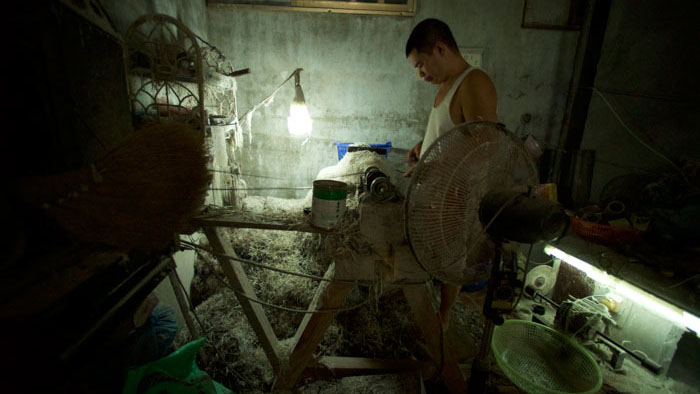
A man works at a lathe in a dimly lit horn workshop in Horn Maker.
“…the scientists, pencil pushers, and authorities attending that conference viewed Pembient as a threat to their bottom line.”
Marquis is a very brave person. To take on the Environmental lobbies in Horn Maker, and produce a film that unflinchingly documents the egos being bruised by the very notion someone’s innovation could end their gravy train is worthy of commendation. In Horn Maker, Marquis captures visual and audio-only interviews with many proponents of NGOs and Government conservation groups. Her film spans the globe, and we hear from experts in Vietnam, China, Mozambique, and America. Mozambique is especially tragic. Mozambique, as we learn in Horn Maker, is among the poorest nations in the world. They are the recruiting ground for poachers. Any male between 13 and 50 could end up being a poacher. As a village elder relates, they are offered a million dollars for each and every Rhino Horn. In Africa, dear reader, that’s life-altering money. Even more so than in the States, a million dollars and the poacher have utterly improved his family’s, if not his village’s, living conditions.
Horn Maker climaxes at the CITES conference. A conference that meets once every 3 years, or triennially, CITES is where the conservation laws for the next period of enforcement are set. In 2023, Markus attended CITES in order to move Pembient forward and gain NGO backing to start printing Rhino Horn. Sadly, the scientists, pencil pushers, and authorities attending that conference viewed Pembient as a threat to their bottom line. In the most bruising footage, we see officials of the US Fish and Wildlife Service attend a panel organized to clamp down with regulation to prevent Pembient from acting.
Horn Maker is an exercise in brilliant direct storytelling. I appreciate that Horn Maker fell in my lap. This is once-in-a-lifetime storytelling. The environmental equivalent of a Classical Greek Tragedy, we witness NGOs, charities, and other organizations sanctioned by the world governments to protect wildlife fail to do so. Not only do they fail, but they actively prevent anyone who would innovate a solution from doing so. Seek out Horn Maker. It’s an essential civic duty to watch Horn Maker.
For screening information, visit the Horn Maker official website.
"…an exercise in brilliant direct story telling..."