American universities have long been bastions for progressive thought, from the anti-Vietnam War protests in the 60s to the pro-Palestine movement of the present. But that doesn’t mean they haven’t been met with pushback. First They Came For My College chronicles the undoing of a Florida liberal arts college as the state’s right-wing government turns it into a political pawn in their authoritarian agenda.
New College once topped the charts as one of the best public liberal arts colleges in the country. It was created and developed not around sports programs or Greek life, but with a focus on academic curiosity and independence. But what happens to that culture when Florida’s traditionalist governor Ron DeSantis takes aim, irked by nothing more than the school’s commitment to radical acceptance? The film takes us into the lives of various students around campus as their freedoms slowly slip away. It starts with a hostile takeover of the college’s board of trustees, newly appointed by DeSantis himself. The board includes right-wing grifter Christopher Rufo, known for homophobic and racist remarks, who quickly imposes his will. Their first order of business is the swift removal of the beloved president while faculty, parents, and students watch on in horror.
Director Patrick Bresnan paints a bleak portrait of how quickly things can change. From one year to the next, a culture of bigotry sweeps through campus as the newly recruited students settle in. Meanwhile, the existing students try to cling to the safe spaces that are dwindling in front of their eyes. The new administration eliminates the gender studies program, and faculty find a dumpster full of books the board no longer approves of. The library is stripped of literature about race, gender, and indigenous history, following the blueprint of fascist governments from the past.
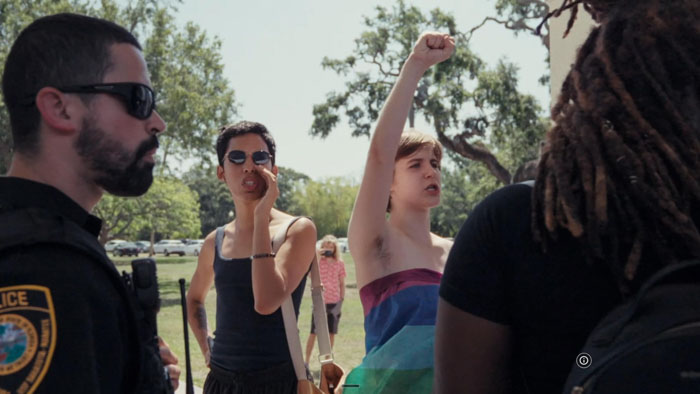
New College students chant and raise their fists beside a campus police officer in First They Came For My College.
“…chronicles the undoing of a Florida liberal arts college as the state’s right-wing government turns it into a political pawn…”
But perhaps the most interesting story in the many different threads the film pulls is that of a new conservative student, courted by DeSantis’ promise of a college committed to stamping out liberalism. What seems like Bresnan’s attempts to provide a foil to the stories of the many progressive students pushing back on the changes turns into something far more powerful. By the end of the film, the student is almost unrecognizable as he stars in a classmate’s film project. He’s found a rekindled love of creativity; he’s energized, tolerant, and he seemingly sees the value in the merits of the school’s disappearing culture of inclusion. It’s quietly the best argument the film makes about why the right-wing imposition is so dangerous, coming from the least likely source.
Bresnan cleverly shows the duality of the new campus environment. One minute, we’re watching idyllic scenes of students peacefully enjoying life on campus—painting, lounging, or paddleboarding. The next, a contentious board meeting unfolds, emphasizing the tightening grip of the new oppressive administration. And while this is compelling, urgent, and essential storytelling—a warning for a conservative blueprint being used across the country—the film leaves us with a glimpse of hope. On her way out, a frustrated professor encourages the students to find joy in the darkness. That’s exactly what they do. In the final act of the film, a blissful production of Rocky Horror Picture Show in front of a packed room of students stands proudly in opposition to the new administration’s tyranny. It’s proof that despite everything, the identities of the students can never be repressed as long as they keep fighting.
"…compelling, urgent, and essential storytelling..."