For women across the United States, access to essential reproductive care is becoming harder and harder to come by. Co-writer and director Evan Miller’s feature debut Due West outlines the consequences of those restrictions through one woman’s quest to terminate her unplanned pregnancy despite all the systems in place to stop her.
We meet her in a rural Texas town outside of a bar, where she’s clearly in trouble. She plans to meet someone the next day, who requires $700 for their services. What services? We’re not quite sure yet. She drives out to her brother’s home to ask for a loan, where she runs into her brother-in-law. Her reaction to his presence speaks volumes and the pieces start to fall into place. We’d later learn that he sexually assaulted her, resulting in a pregnancy. The mysterious meeting and the money are to acquire medication for an abortion. After her brother reluctantly gives her the cash, she hits the road for the meetup. On the way, her truck breaks down. It’s the first of many hurdles she’d need to clear during the rest of her tumultuous and heartbreaking journey.
The film is anchored by a powerhouse performance from Adrianne Palicki in the lead role. She fully disappears into her character, who faces a challenge more complex and agonizing than many of us could ever imagine. But for the 80-minute runtime, she lets us into her world, allowing us to feel a fraction of her pain. Her eyes are consistently welling with tears. Anger, grief, fear, and exasperation dance across her face throughout her trip, but it’s her subtle moments in some of the most difficult moments that hit the hardest. Palicki doesn’t need to say or do much, yet the weight of her anguish seeps off the screen and into the hearts of the audience.
“…one woman’s quest to terminate her unplanned pregnancy despite all the systems in place to stop her…”
Co-writers Miller and Hardy Janson resist the urge to pack the screenplay with heavy-handed lessons or politics. They barely allow the lead character to speak about her experiences until late in the film. Instead, they leave breadcrumbs for the audience to slowly collect. It mirrors the experiences of the many women who are forced to keep these encounters close to their chests, or else they risk ostracization or even arrest. The societal pressures are ever-present throughout the film. She runs into her pastor, who questions why she hasn’t been attending church. She hears the playful cries of her coworker’s children–a reminder of what she’s giving up. There’s even a schism between her and her family, created by the anxiety of the secret she’s holding onto and the stigma that secret may carry with it. Miller and Janson’s impressive restraint in crafting the story makes it so much more powerful. It all feels so real.
We don’t learn the lead character’s name until the final line of the film. She’s referred to in the end credits simply as “The Woman”. It’s not an attempt to dehumanize her; it’s a powerful statement. This isn’t the story of one woman–it’s the story of all of them. Restrictive laws on access to reproductive healthcare make women less safe. In Due West, acts of kindness from unexpected places save the day. But the harsh and sobering reality is that not everyone will be that lucky.
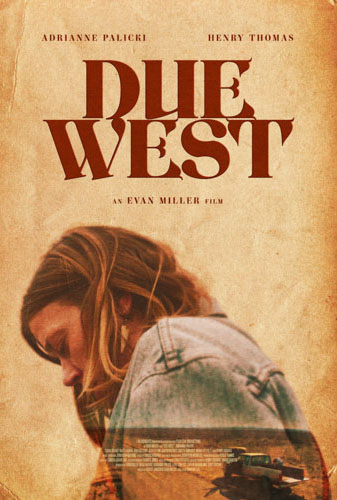
"…a powerhouse performance from Adrianne Palicki..."