Japanese creature feature meets erotic body horror in Doug Roos’ bloody gore-fest, Bakemono. Those elements would usually sweep me off my feet, but beyond the practical effects and monster mayhem, I just couldn’t fall in love.
Bakemono centers on a seedy apartment rental in Tokyo, where unsuspecting guests don’t realize that something evil lurks within. Instead of following traditional three-act structure, pacing, or a straightforward timeline, the film uses haphazard time jumps and uneven storytelling between different guests. We learn, mostly through characters awkwardly talking to themselves, that the room has a dark supernatural element, with the shapeshifting creature pulling out people’s worst qualities—driving them to their breaking point if they stumble across it.
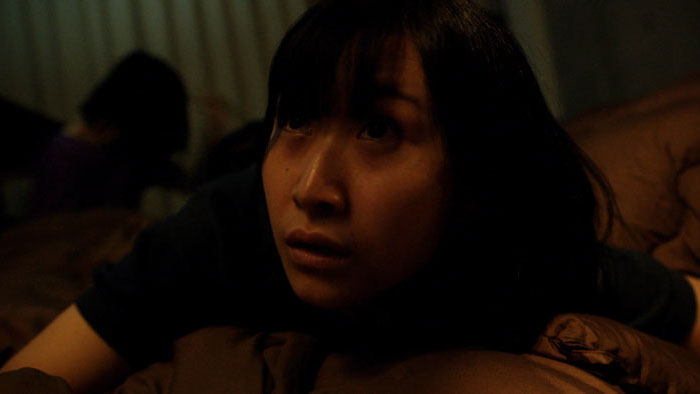
A frightened woman looks up from her bed in the dark Tokyo apartment in Bakemono.
“Bakemono centers on a seedy apartment rental in Tokyo, where unsuspecting guests don’t realize that something evil lurks within.”
As a horror fan, I will always choose rubber creatures and buckets of blood over a digital monster, and Bakemono doesn’t disappoint. The film’s greatest achievement is its gritty practical creature and stomach-turning effects. Flesh snaps, monster tentacles invade, and things get gooey. While killer practical effects matter to me, a driving script does too, and unfortunately this one wasn’t polished enough to support such a cavalier approach to storytelling. I was left confused at every turn, and I’m not sure the choppy cinematography or ear-splitting sound design helped.
While the cast commits, Bakemono throws in so many characters who immediately become monster chow that I struggled to connect with anyone–except perhaps the creepy landlord played by Takashi Irie, who really shines. In his character’s unsettling scenes, Irie delivers memorable performances that draw similarities to Jigsaw from the Saw franchise.
Essentially shot in one room, director Roos harnesses the limiting location into a cinematic pressure cooker, using suffocating close-ups and sharp angles. The production design also deserves some atmospheric points for creating such a claustrophobic and oppressive set design–I could almost smell the sweat and stagnant, trapped air.
The film hits some splatter-horror notes and surreal moments that might be fun to experience with a crowd, but I wish the movie had stronger legs between those moments. If you enjoy low-budget surreal creature features on the cusp of arthouse and aren’t too concerned about the story, Bakemono might be your bloody cup of tea.

"…Japanese creature feature meets erotic body horror in Doug Roos’ bloody gore-fest, Bakemono."