
The film’s strangest extension of this idea is an AI avatar based on Luca. Digital Luca is a marketed companion for lonely girls who need someone to talk to. The real Luca, whose face is being technologically reproduced to cure other people’s loneliness, has almost nobody; eventually, her digital self becomes her friend when relationships with other humans fail.
Sexuality in Babystar can also be understood as part of Luca’s confused search for genuine human connection. Her parents commercialize it by televising the birth of their next child. Her encounter with the female friend who rides a motorcycle, Julia, played by Joy Ewulu, begins as an attempt to experience something spontaneous and personal outside the controlled world of her family, but it becomes uncomfortable, exposing how poorly prepared she is for intimacy. Later, asking the hotel clerk to sleep with her similarly ends badly. These moments are less about sex than Luca trying to reach for one of the most private human experiences while lacking the emotional tools to navigate intimacy.
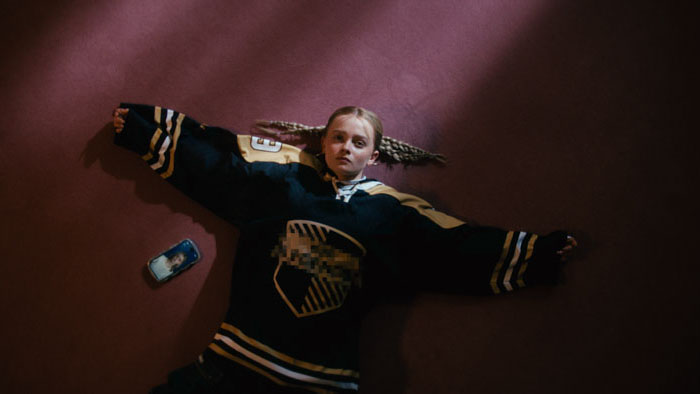
Luca (Maja Bons) lies still on the floor in a hockey jersey in Babystar.
“What initially looks like an enviable influencer lifestyle gradually reveals itself as something far cruel.”
There is an unexpected parallel between Babystar and the Star Trek episode Charlie X. Charlie has spent his formative years isolated from ordinary human contact, surviving through the intervention of the Thasians, but when he is finally exposed to other people, he desperately wants the intimacy and belonging he never learned how to negotiate. At the end, as the Thasians take him away, his anguished cry, “I can’t even touch them! makes the tragedy painfully clear: possessing extraordinary power is meaningless when you cannot form an ordinary human connection.
Maja Bons makes Luca’s awakening convincing because she does not play it as an instantaneous transformation. Confusion becomes suspicion that becomes anger, which produces actions that are sometimes immature and troubling. She does dangerous things to get the attention of her parents, which don’t work, such as tossing her father’s laptop in the pool, taking her clothes off in a public restaurant, and finally running away. Even that is controlled, as her parents send her money for the hotel.
Babystar can feel deliberately slow, particularly once Luca attempts to move beyond the environment that has defined her. Yet that uncertainty is part of the film’s point. The ending is an attempt to stop the cycle and toss a wrench into the plans of her parents. The picture becomes less an attack on social media itself than an indictment of what happens when the distinction between family, audience, and marketplace disappears.
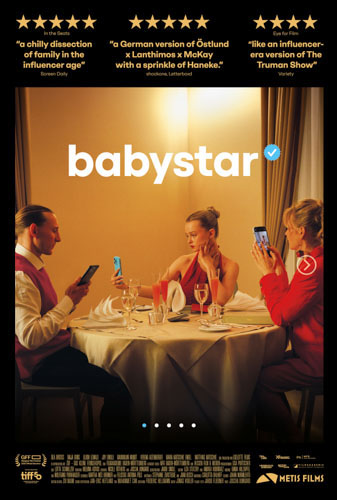
"…What initially looks like an enviable influencer lifestyle gradually reveals itself as something far cruel."