
Joscha Bongard’s Babystar takes the idea of the exploited child star and updates it for an age in which the studio, stage and audience can all exist inside the family home. For sixteen-year-old Luca (Maja Bons), filming never really ends. Her home is the set, her parents are effectively her managers and producers, and millions of strangers have watched her grow up. What initially looks like an enviable influencer lifestyle gradually reveals itself as something far cruel.
Luca and her parents, Stella (Bea Brocks) and Chris (Liliom Lewald), the arrangement seems almost ordinary by the standards of how much some mega social influencers make in terms of money and lifestyle. Luca is beautiful, confident, and accustomed to being photographed, much like Brigitte Bardot was in life. Followers visit the house, cameras record their interactions, and sponsorships are woven into daily life. Luca appears to be the star around whom everything revolves. Luca may be the face of the family business, but that does not mean she controls it.
The family makes jokes with other families, staging funny situations; individuals offering little fragments of their lives is now entertainment on a mass scale. Chris, the father, remarks that “One basically gets paid to be themselves.
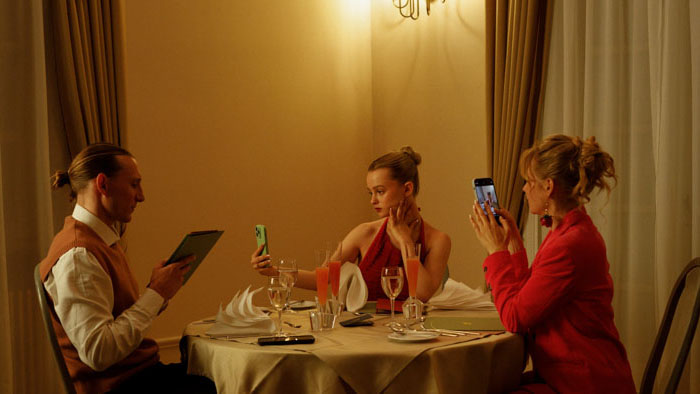
Chris (Liliom Lewald), Luca (Maja Bons) and Stella (Bea Brocks) each stay fixed on their phones at a restaurant table in Babystar.
“Her home is the set, her parents are effectively her managers and producers, and millions of strangers have watched her grow up.”
Bongard and co-writer Nicole Ruethers approach this technological horror story through a premise that deliberately recalls The Truman Show when Luca’s father quotes Truman Burbank’s famous farewell: “Good afternoon, good evening and good night.” But Luca is not Truman. She knows cameras are recording her and understands that an audience exists and basks in the light of it with an often-troubled awkwardness. What she has never fully understood is that participation and consent are not necessarily the same thing when you have been raised inside the system.
The catalyst is her parents’ decision to have another baby. You get a younger model to increase revenue, similar to what happened to Demi Moore’s character in The Substance. Luca initially appears jealous, and some of her increasingly extreme behaviour can be dismissed by her parents as adolescent acting out. One moment she dreams of smothering a neighbour’s child, or is it a dream- when the boy starts to laugh. But the issue becomes more disturbing than sibling rivalry. The family’s 2.6 million followers are an invisible presence in almost every decision. The audience must constantly be fed.
Cameras often observe Luca from elevated corners, suggesting both security-camera surveillance and the omnipresent influencer lens. Brand names are bleeped and logos obscured, ironically making us even more conscious of commercialization. Nothing can simply exist; everything has potential promotional value.
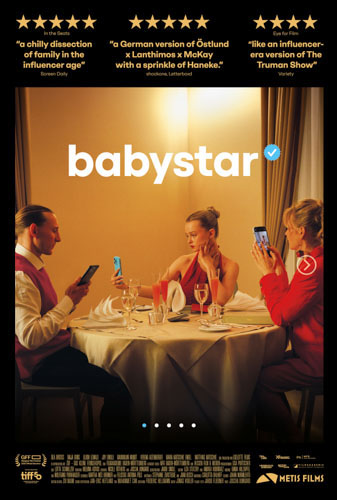
"…What initially looks like an enviable influencer lifestyle gradually reveals itself as something far cruel."