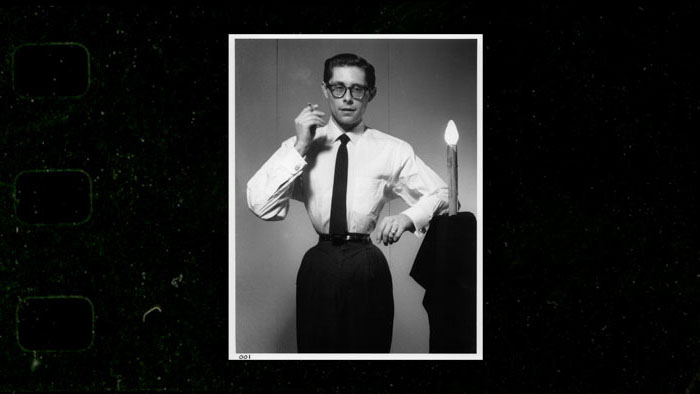
NOW IN THEATERS! In contemplating the life of Roland B. Loomis, who would come to be renowned as transgressive BDSM artist Fakir Musafar, there is a secret element few pay attention to. His acts of piercing, bondage, and minor mutilation were all sacred. They all spoke to a deeply held spirituality and religious fervor deep within Musafar. This notion of tormenting and damaging the body to create a sacred space is integral to understanding the art showcased in A Body to Live In, written and directed by Angelo Madsen.
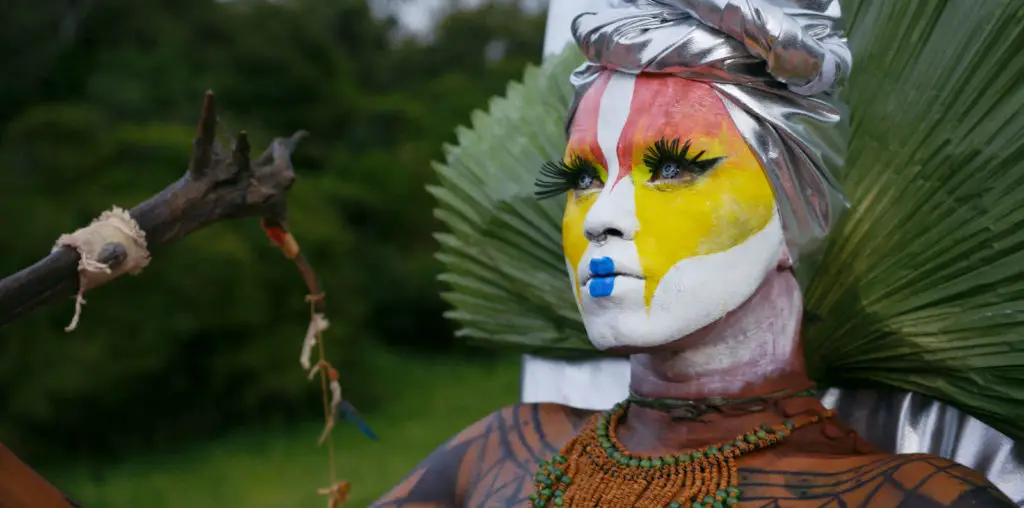
Starting from his earliest days in Nebraska, Musafar knew he was different. While his mother had intended he would become a fundamentalist Protestant Evangelical, Musafar was drawn to the torment and flagellation that such Christians were meant to purify themselves. The film delves into the spiritual growth of Musafar and his close compatriots. Well-known personalities in BDSM and related circles are highlighted. For example, at the first round of shows where Musafar demonstrated his various contortions and BDSM magic, Anton LaVey played the organ. LaVey, notorious for starting the Church of Satanism, was a deep adherent to the spirituality inherent in body modification and tattoos. Ganymede, a man known for leading spiritual body-piercing rituals while dressed as a satyr, discusses how the ritualistic nature of communal body piercings allows participants to create a sacred community. It’s within the sphere of BDSM that they find the holy praxis between sexuality and spirituality.
Many practitioners of BDSM were a part of the LGBTQIA community as well. In the 1980s, they too were stricken with the plague of AIDS. Many people in Musafar’s tribe were lost to that disease. What was striking about this section of A Body to Live In is the way the people interviewed spoke of this time in spiritual ways. Ganymede relates how he found himself wanting to commune with the souls of the dead. Cleo Dubois tells us the tale of how she performed one of Musafar’s modern primitive rituals to attempt to ward off death from her then-lover. He was HIV positive, and she wanted to keep him alive through the shamanistic body piercing and dance rituals created by this sacred community.
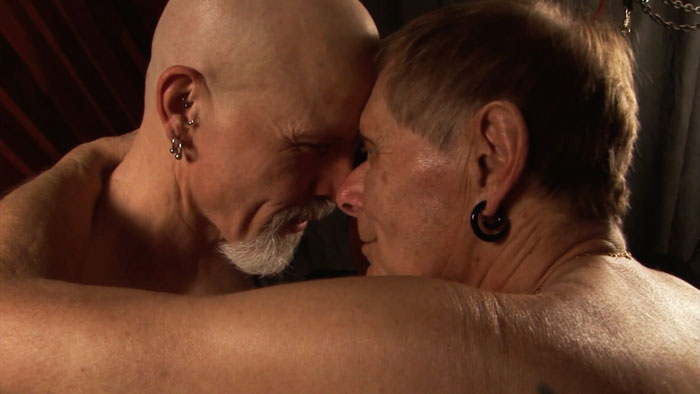
Grin (left) and Fakir Musafar share a tender, spiritual moment in A Body to Live In, directed by Angelo Madsen. Image courtesy of HARD FLOW.
“…Loomis, who would come to be renowned as transgressive BDSM artist Fakir Musafar…”
One of the most intriguing parts occurs when Musafar is elevated from underground shaman of the Modern Primitive BDSM movement to spokesman on talk shows. The detail particularly struck me concerns a contentious interaction on such a talk show in 1986 with Native Americans. They were enraged by his appropriation of their Sun Dance ritual. After that interaction, Musafar developed a script he would stick to in all future talk show appearances. It was as if he wanted to avoid controversy. Musafar is there to revel in a new form of primitive worship and did not wish to be a source of notoriety.
A Body to Live In would not have happened had Madsen not uncovered the story of Fakir Musafar. This film is equal parts grainy home movies, brief interviews, found footage, and several extended Stan Brakhage-esque moments. The filmmaker chooses to intersperse bits of the subject’s poetry between segments. After a particularly passionate poem in which Musafar extols the virtue of the blood flowing through his and his partner’s bodies, we are treated to a clip of red, with blood cells flowing. This is the sort of thing Brakhage would have done. It was most poignant. You can tell Madsen has a lot of love and respect for Musafar and the Modern Primitive movement.
Ultimately, A Body to Live In is a heartwarming tale of sexual deviance blended with the pursuit of pure spirituality. This film is not for everyone. I do not recommend showing this to children or anyone under the age of 18. While a heady experience, this should only be viewed by those of an iron constitution and an insatiable curiosity of adult age.
A Body to Live In screened at the 2025 Frameline Film Festival.
"…a heartwarming tale of sexual deviance..."