Experiencing Cinecon 62 at the Landmark Nuart Theatre was a diverse showcase of classic material from the silent era, Hollywood’s Golden Age, and the early days of television. Stan Taffel, Bryan Cooper, and the Cinecon team brought an amazing line-up.
The morning kicked off with a Technicolor musical short from Paramount Pictures called Paris In The Spring (1947), the fourth entry in the Musical Parade Featurette series. This short is notable because it features the Bob Baker Marionettes. The short was presented by a friend of Baker, Harry Arends. His introduction gave a brief bio on Baker and showed behind-the-scenes material from this short. Notably, the Bob Baker Marionette Theater team had items from their archives in the lobby, including costume concept art designed by Mary Kay Dodson. Arends’ introduction described how the short was the beginning of his solo career in the film industry. He had done prior work on Edgar G. Ulmer’s Bluebeard, and home movie footage shot in color was featured. That film featured a condensed version of the opera Faust, featuring Baker’s lifelike marionettes.
Seeing this footage gave us a wonderful tease of the elaborate puppetry seen in the short film. Paris In The Spring surprised me! My experience with live-action musical shorts has involved seeing films with elaborate numbers, surreal imagery, and thin plots. I appreciate the charm and novelty of Warner Bros’ Vitaphone shorts, MGM musical shorts, and Soundies. Even Women Haters, starring The Three Stooges in Columbia Pictures’ Musical Novelties series, is a zany, plotless film. Paris In The Spring’s screenplay by Peter R. Brooke and Jack Roberts is a well-crafted mix of operetta and backstage musical. The puppetry is integrated into the story seamlessly, while emphasizing the talents of Baker and his puppeteers. Mel Epstein’s direction makes the performances of Roger Dann, Sally Rawlinson, and Max Willenz believable. Roger Dann may vaguely resemble Dennis Morgan, yet his vocals sound like a crooner version of Maurice Chevalier. He is quite commanding onscreen, and it’s too bad that he never became a major star. The film’s real stars are the opulent and rustic production design by Hans Dreier, Mary Kay Dodson’s sparkling costumes, and Van Cleave’s lavish score. I hope this film gets a major Blu-ray release, and we need a complete set of the Musical Parade Featurette series from Kino Lorber.
“… Cinecon 62 at the Landmark Nuart Theatre was a diverse showcase of classic material from the silent era, Hollywood’s Golden Age, and the early days of television.”
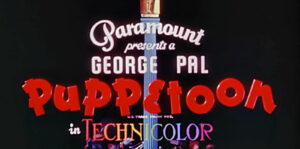
Immediately after the Bob Baker presentation, we shifted to George Pal, the famous stop-motion animator. The Puppetoon Movie: A Legacy Revisited is a new documentary from Pal historian and filmmaker Arnold Leibovit. Leibovit’s film is a reflective piece on Pal and the creation of The Puppetoon Movie (1987). Iconic filmmakers, animators, and historians all share their love for Pal’s imaginative works and influential stop-motion technology. Interestingly, many of the interviewees focused on how he kicked off the science-fiction and fantasy blockbusters way before Steven Spielberg and George Lucas ever set foot in Hollywood. The documentary was followed by two Puppetoon shorts, The 500 Hats of Bartholomew Cubbins (1943) and fan-favorite Tubby the Tuba (1947). The 500 Hats of Bartholomew Cubbins was based on a story by Dr. Seuss, and it’s a delightful tale with kooky characters and playful gags. My favorite character is the executioner because of his exaggerated muscles and Pinocchio-esque face; it’s just an odd contrast. The Technicolor adds to the story’s vibrant tone. Tubby the Tuba was wonderful to see on a second viewing, and Victor Jory’s performance is so versatile. There are echoes of Fantasia in the film’s climax, especially how the color gel cinematography times to the anthropomorphic instruments’ individual notes. George Kleinsinger’s compositions are the emotional heart of the story, and Tubby’s frog-inspired leitmotif is both solemn and an unforgettable earworm.
After being in a Technicolor wonderland, the mood shifted to a silent comedy called April Fool (1926). This film was restored by The Library of Congress. It was produced by Chadwick Pictures, an independent production company. Prior to seeing this film, the company was infamously known for the Larry Semon vehicle, The Wizard of Oz (1925). That film gets an unnecessarily poor reputation because it is often compared to the famous 1939 version, yet no one sees it as a showcase for Semon’s brilliant comic strip-inspired gags. April Fool proves that Chadwick was capable of creating sophisticated comedies. The film was based on a play by Alexander Carr and Edgar Alan Woolf. Carr also stars in the film as an umbrella salesman, Jacob Goodman, who goes through a rags-to-riches arc. Famous child actress Baby Peggy plays Irma Goodman. She’s adorable and brings a level of naturalism that Shirley Temple had in the sound era. Fans of Buster Keaton’s work will recognize Snitz Edwards from Battling Butler, and Edwards plays Jacob’s rival, Mr. Applebaum. April Fool is tied to early 20th century East Coast Jewish humor, right down to intelligent intertitles sprinkled with malapropisms. Adam Swanson’s lively piano accompaniment was a major highlight! Nat Carr got the most laughs as the matchmaker, Moisha Ginsburg. As a piece of silent comedy history, it is amazing to see a Jewish comedy survive. I hope the Library of Congress finds more Jewish comedies from this period. Alan Lewis Rickman has said that Yiddish films from the silent period are lost; hopefully, April Fool will spearhead further research.
After returning from lunch, it was time to saddle up for The Lucky Texan, a B-western starring the legendary John Wayne. This oater was a part of Lone Star Productions (a Western-focused label) for Monogram Pictures, and Wayne starred in sixteen films. Cineverse will feature The Lucky Texan alongside fourteen other films restored from their original camera negative in 4K. The fifteenth and sixteenth films are restored from their best surviving elements. This screening is promotion for a sixteen film Blu-Ray collection, John Wayne: Birth of a Legend, which releases this December. Now the film itself is highly entertaining, with Yakima Canutt’s stuntwork and the fluid cinematography of Archie Stout. Stout keeps the brisk pace with whip pans that give motion to scene transitions and action sequences. It is a thoughtful creative move. George “Gabby” Hayes has earnest camaraderie with Wayne, and it helps with the film’s out-of-left-field third act. I’m looking forward to buying the Blu-Ray collection later this year and expanding my love of B-westerns.
“Paris In The Spring surprised me!… we need a complete set of the Musical Parade Featurette series from Kino Lorber.”
Stu Shostak, Dick Van Dyke’s archivist, along with Stan Taffel, brought audiences back to the early days of television with Kinecon. The focus was on Titans of Television. Sid Caesar, Milton Berle, Jackie Gleason, and Jack Benny were celebrated for this special occasion. Milton Berle was in a hilarious sketch with Victory Jory set in a psychiatrist’s office on The Texaco Star Theater. Jory was corpsing for some portions of the segment. A parody of What’s My Line was featured on the Buick Berle Show, and it was nonsensical in all the best possible ways. Berle’s comedic timing shined here, and he had a Daffy Duck level of energy. Sid Caesar’s sketches varied from absurdist to domestic comedy. The clock routine moved at a slow pace, and it would fit right at home with the internet’s fascination with cringe comedy. Jackie Gleason’s early Honeymooners skits from Cavalcade of Stars sets up the dynamics we would come to see in the official series. Pert Kelton brings a level of toughness to Alice and bounces off Gleason’s manic behavior. The Season 4 premiere of The Jack Benny Program was shown to honor Marilyn Monroe’s centenary. Monroe seemed at ease in her light comedic flirting with Benny, and it was a joy to hear her natural singing voice. This portion of the festival was insightful and presented a new appreciation for these icons!
Up next was Manhattan Heartbeat (1940), a remake of Frank Borzage’s Bad Girl (1931). The film was shown on a preserved print from Walt Disney Pictures. This romantic-comedy drama was a B movie produced by Sol M. Wurtzel at 20th Century Fox. The other film I’ve seen from Wurtzel’s filmography is the Laurel and Hardy military comedy, Great Guns. This film starred Virginia Gilmore, who gets to show off her comedic chops. I easily recognized her from a World War II thriller, Berlin Correspondent (another B-film from Fox). Her co-star, Joan Davis, was the MVP of the film. Davis gets the snappiest lines and keeps the momentum going. While the film has a screwball touch, it captures the struggles of young love, financial choices, and the affordability of raising a child with a delicate tone. These issues are still relevant to people in my generation. Kudos to Kevin Schaeffer and the Disney archive team for keeping this film in excellent condition. I’d love to see a collection of 20th Century Fox B films in the near future!
The penultimate film of the day was The Hollywood Kid (1924), an all-star Mack Sennett short. Adam Swanson also tickled the ivories for this madcap short poking fun at the studio system of the 1920s. Roy Del Ruth’s direction embraces the grandiose insanity of slapstick comedy. It was awesome to finally see this film after glimpsing stills and snippets from it, both in books and documentaries. Footage from this silent short is heavily featured in Robert Youngston’s compilation documentary, The Golden Age of Comedy. The Hollywood Kid shows the Sennett Studio at the top of their game. Some memorable sequences include a car chase where Claude Climax (Vernon Dent) , a film director, is chased by a boulder and Mrs. Pico (Louise Carver) imagining herself as a love interest to a Rudolph Valentino-esque movie star (Ray Grey). There is also plenty of cameos from contract players from the Sennett Studio.
“ Monroe seemed at ease in her light comedic flirting with Benny, and it was a joy to hear her natural singing voice.”
Once dinner concluded, it was time to honor Barbara Eden. Eden was unable to make it due to her doctor’s orders, but we wished her a happy birthday and told her how much we loved her. Bryan, the producer of the festival, had her on speaker for this special moment. Pat Boone was also in attendance to celebrate his co-star. We watched All Hands on Deck (1961), a musical-comedy shot in Cinemascope and gorgeous DeLuxe Color from an archival print. Its storyline is quite similar to an Elvis Presley film with its elements of romantic miscommunication, catchy tunes, stingy authority figures, and vaudeville-style comedy. Eden and Boone were wonderful together. The film was rounded out with a fantastic supporting cast that included Gale Gordon and Ann B. Davis. Norman Taurog’s direction brought out sharp performances, and the original songs by Ray Evans and Jay Livingston have that Mid-Century crooner vibe that’s easy on the ears. Following the film, Boone was interviewed by Bryan and Stan. Bryan noted that he and Eden had several kissing scenes. Boone went into some backstory on how he initially did not kiss Shirley Jones in April Love, which made headlines back in the late 50s. He is very devoted to his wife and did not want to disrespect her. After delving into that fascinating story, Stan asked him about working with his co-stars. Boone talked about how Gale Gordon was a pro at his comedic bits and working out the complex physical comedy with Buddy Hackett. Following the interview, Pat Boone provided free autographs for patrons at the festival.
Cinecon 62 was a joyous celebration of classic cinema and television. While I only attended Saturday, it was a memorable experience. You can feel the love for film preservation and recreating the “Night at the Movies” experience. Stan and Bryan wear their hearts on their sleeves, and I appreciate the laid-back structure of the festival. Cinecon is a must-see film festival that takes classic cinema to a whole other level. I’m looking forward to next year’s line-up and all the rarities that will be in store!
"…Monroe seemed at ease in her light comedic flirting with Benny, and it was a joy to hear her natural singing voice."

I truly enjoyed reading this review of The Puppetoon. This made me feel a little magic the old movies productions gave to their audiences.