Your documentaries always intertwine people and the environment. What draws you to that connectivity? Do you see any hope for how people will treat the environment in the future?
You constantly hear everywhere that we are part of ecosystems, but it’s sometimes hard to really feel it, rather than just understanding it conceptually. Psychedelics can be a way to “feel” this interconnection, but that is not the only way. For us, it was important that the documentary felt interconnected: the characters, the motives, the losses, and the formal decisions, transitions, and the shape of the movie felt entangled.
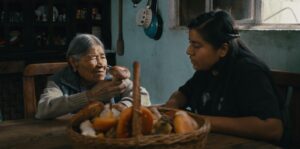
I believe there is space for a change of consciousness. It doesn’t need to come from psychedelics but from observing our environment and the forces that shape it in a completely different way, from our own sense of curiosity about the world we live in and those we share it with. Also, I think what Lis says in the film is crucial: you can’t love what you don’t know, and then you won’t protect either if that is the case.
Editing plays a crucial role in the film’s style. How closely did you work with editor Lorenzo Mora to achieve it?
We filmed during four summers, but we didn’t edit in between the first three, only between the third and final pick-up shots. This was once we knew what we needed to complete the stories, as we were still trying to understand the elements of the story and how to convey a non-human timeline between the two human stories. When we started editing, the whole process took 18 months. Lorenzo was almost full-time for a year. For the first two months or so, we held long discussions, but he was pretty much on his own, working through the material. Then we started working more and more closely, sometimes even simultaneously. I would be working on a different timeline, experimenting with things, while he was focusing on the human stories. Juli’s structure was the easiest to find, but Lis continued to work even after the year had passed. For her, we got inspiration from the four-act structure of kishotenketsu. Much later came the transitions and the fungal storyline, which was always latent but really came together then, in the final six months. We also had great collaborators, with Sandbox and Doc Society providing notes, as well as Sara Dosa as story consultant and Andrea Chignoli as a consulting editor in the final months.
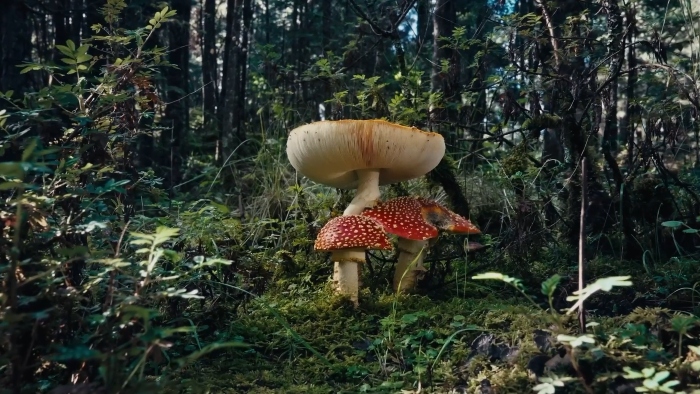
“…things that you try will fail, that is also part of the process…”
Mexican culture, heritage, and rituals play an important part in the interconnected message. Had you already known the deep roots tying Mexico and fungi together? What, if any, were the biggest surprises you discovered while making Daughters Of The Forest?
A few years ago, mycologist Guiliana Furci told us she felt that Mexico was a mushroom. I don’t think I understood what she meant then, but now I do. Mexico is so entangled, so many languages, cultures, identities, layers of culture built on top of each other. It’s not one thing but a multiplicity of things. I still find it hard to explain in words, but I feel it.
For example, I knew about the importance of Maria Sabina, the niños santos, and that there was a strong foraging culture in the center of Mexico. But I still didn’t know that its dimensions were so profound, and I also didn’t know what happened to Maria Sabina, until I started this project. I felt that for the entirety of making Daughters Of The Forest, the relationships we made were all surprises. We wanted to make a film that felt like fungi, so we allowed ourselves to be surprised all the time, because we didn’t know anything, and there is still so much we don’t.
I am also much more aware of what the knowledge of mushrooms really implies, and that it can easily be the line between life and death, on many levels.
How did Sandbox Films get involved?
The Sundance – Sandbox Fund was the second grant we applied to for this project in late 2021, and it was also our first international support. We had a small government grant from the Mexican Institute of Cinematography to produce a 10-minute sample. Then, we had the luck to work with Martin Boege, and so very early, we started thinking about the cinematic language for the film. Sandbox Films invited us to participate in Camp 4 Science in the Czech Republic, and we started building a relationship with them for a year before they came on board as co-producers. We also had a wonderful creative retreat with them in the mountains of Tepoztlan that started shaping the film quite early. They are great creative partners.
Finally, what advice do you have for aspiring filmmakers?
Fear and insecurity are all part of the process. You don’t need to know what you are doing all the time, and you don’t need to try to pretend to your team that you do. Sometimes, in fact, most of the time, things that you try will fail, that is also part of the process, or things won’t be what you expected. That is also a fungal learning to adapt, and learn to problem-solve. I think the carrier bag suggests that there is space for more than one form of storytelling. If you want to tell the traditional hero’s journey, that is fine, but if you think you want to explore other avenues, you should also try, experiment, and not be afraid of failure. There’s so much focus on the outcome and success, and not enough on the journey; the destination is always more uncertain than we think.
It’s also very important to choose your collaborators wisely: not only do they have to match creatively, but, more importantly, ethically as human beings.
Daughters Of The Forest will next play at SFFILM on April 26 and at the Margaret Mead Film Festival on May 3.