
Doctor Doctor is a dark indie comedy that takes fear, misinformation, and medical anxiety to absurd new heights. The story follows Oliver (Steven He), a germaphobic hypochondriac who learns everything he knows about medicine from TikTok. It appears he has sufficient medical information to be a danger. When armed robbers storm a rural clinic, Oliver is mistaken for a doctor and forced at gunpoint to treat the wounded. As chaos builds, including a pregnant woman going into labor, Oliver must confront his crippling fears and decide if he can rise to the moment.
I sat down with director Stevan Lee Mraovitch to talk about the making of Doctor Doctor. We discussed the unique challenges of crafting comedy within the high-stakes frame of a hostage crisis, and how the limitations of indie filmmaking shaped the film’s look and tone. Mraovitch also opened up about working with Steven He, the viral sensation behind the “Emotional Damage” persona, and how his internet-born comedic timing translated into a layered leading performance.
The conversation dives into the balancing act of tone, performance, and production design that made Doctor Doctor possible, offering insights for filmmakers and fans alike.
What inspired you to tell this story in the first place, and how did that idea evolve into a full script? What were some of the themes you wanted to explore?
Doctor, Doctor began with a ridiculous personal memory from the early pandemic. I walked outside in a swimming mask and plastic gloves on a warm day. It was absurd and honest at once, which became the film’s engine. I grew up with Molière, so I use farce and a touch of surrealism to look at real fears like health anxiety and isolation. The protagonist is a hypochondriac forced to pose as a doctor during a hostage crisis. He uncovers the clinic’s dark underbelly and faces a revelation about his mother that turns fear into action. The guiding idea is simple: fear lies to us until we confront it. The setting also echoes a real systemic issue: about 80 percent of U.S. counties face healthcare access challenges, which makes the isolated clinic both timely and symbolic.
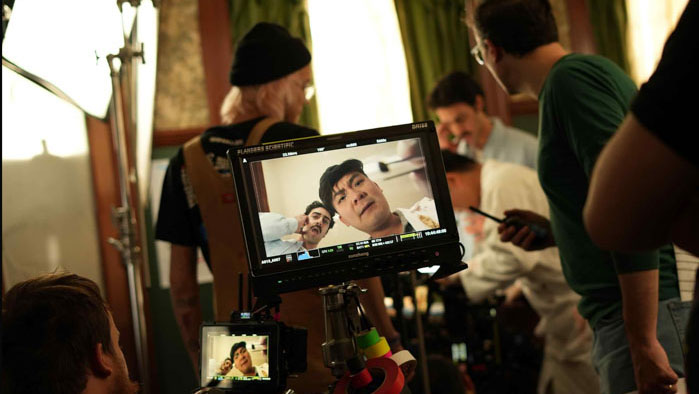
Steven He and the crew between takes on the set of Doctor Doctor.
“Doctor, Doctor began with a ridiculous personal memory from the early pandemic. I walked outside in a swimming mask and plastic gloves on a warm day.”
Can you walk us through the journey from idea to production, and what key steps led to it being greenlit?
I wrote the first draft, and then my longtime friend, Jonathan Turco, joined as co-writer. We formalized the partnership with his brother, Jared, at Three Hammers Productions. Two tipping points turned development into a green light: a SAG-AFTRA interim agreement during the strike, and support from the New Jersey Motion Picture & Television Commission. We built around trusted collaborators like DP Saro Varjabedian, production designer Almudena Caminero, composer Julian Cassia, casting director Mia Cusumano, and costume designer Ana-Li Mraovitch. We designed the film around our constraints: one rural clinic as a pressure cooker, performance-first blocking, and 35mm one-shot medium takes that keep timing inside the actors. Every craft choice serves story and budget, which is why the film plays as a character-forward dark comedy rather than a gear-forward production.
Working with Steven He, best known for his viral “Emotional Damage” persona, how did he get on the project, and what was it like working with him?
We reached out because behind Steven’s viral persona is a classically trained actor with remarkable depth. He studied at Regent’s University London and the Neighborhood Playhouse in New York, began acting on stage at thirteen, and already had screen credits, including Awkwafina Is Nora From Queens. At the same time, his online work had exploded to 18 million followers and over 5 billion views for “Emotional Damage,” making him one of the most recognizable comedy voices of his generation.
The film was conceived during a surge in anti-Asian sentiment, and it felt essential to place an Asian protagonist at the center of a story about resilience and transformation. Casting Steven was a deliberate counterpoint to stereotypes, and he delivered a performance that goes far beyond the meme: nuanced, funny, bruised, and ultimately heroic.
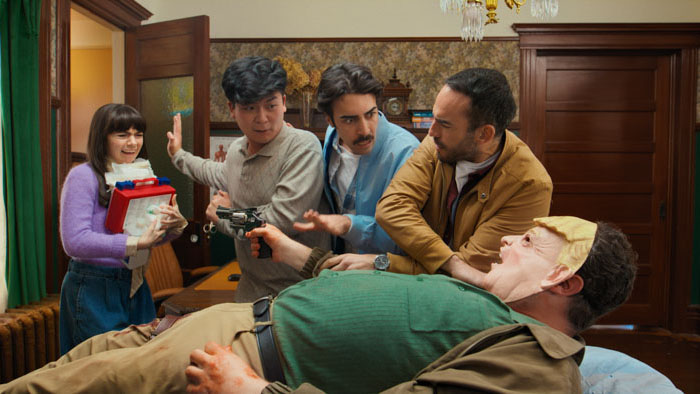
Oliver is forced to play doctor during a chaotic hostage situation.
“The guiding idea is simple: fear lies to us until we confront it.”
On set, Steven blended meticulous craft with playful instincts. He could dive deep into Oliver’s neuroses, then break the tension with humor that felt organic to the character. One of the most memorable moments was a practical water-spray gag that sent a jet of water across the room, leaving the entire crew in tears of laughter. Off set, we shared group dinners and even lived together part of the time, which gave the ensemble a genuine camaraderie that shows on screen.
Steven’s precision, charm, and empathy anchor the film. He brings Oliver to life as a man trapped by fear who discovers courage, and in doing so, he invites audiences to see him not just as a viral comedian but as a full-blooded leading actor.