In Déjà Vu: The Peril of Pauline, writer-director Cybela Clare explores the mysterious intersections of science, reincarnation, and the pursuit of truth. The story follows investigative reporter Cassie (played by Clare) as she becomes entangled in a modern murder mystery that echoes the unsolved death of scientist Pauline Joubert. As Cassie uncovers clues linking the two women across lifetimes, the film draws inspiration from the real-life innovations of Nikola Tesla and the metaphysical idea that justice may unfold over multiple lives.
Clare weaves a narrative across two parallel timelines, creating a cinematic bridge between love, loss, and cosmic cause and effect. With a nonlinear structure and a tone that moves fluidly between thriller and spiritual drama, Déjà Vu: The Peril of Pauline asks whether destiny is written in the stars or shaped by each soul’s choices in its return. It’s a story that merges intellectual curiosity with emotional depth, grounded in Clare’s fascination with Tesla’s hidden genius and the eternal search for meaning beyond one lifetime.
I had the opportunity to speak with Cybela Clare about the inspirations behind her latest film, the creative process of writing and directing while starring in the lead role, and the production’s inventive spirit that brought Déjà Vu: The Peril of Pauline to life.
Déjà Vu: The Peril of Pauline weaves together science, reincarnation, and mystery. What first inspired you to tell a story that connects Cybela Clare: Nikola Tesla’s lost invention to ideas of karma and life after death?
The inspiration for The Peril of Pauline started in 2020 after the death of my great friend and mentor, who was a Tesla expert. After his passing, I read Professor Jim Tucker’s book on children’s memories of their past lives. Tucker researched their stories extensively and found them to be factually accurate. After finishing the book, the idea of past lives fascinated me because reincarnation suddenly seemed a possibility. I’ve always admired the courage of whistleblowers and believe in justice for those who are unfairly targeted. And so I wrote The Peril of Pauline with hope and optimism as my guiding light.
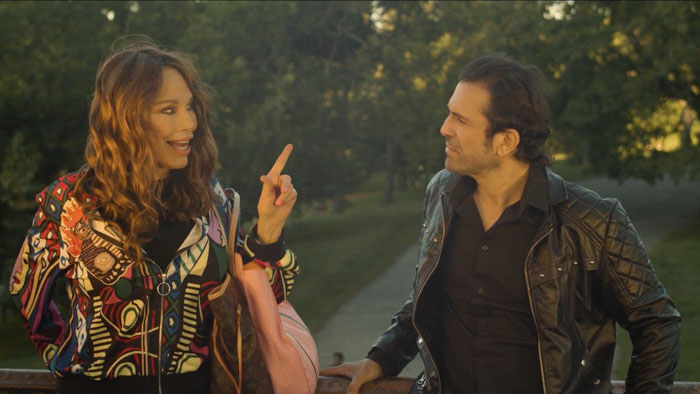
Cybela Clare and Charlie Bennett in a scene from Déjà Vu: The Peril of Pauline, written and directed by Clare.
“I wrote The Peril of Pauline with hope and optimism as my guiding light.”
The film moves between modern-day Manhattan and 1970s China, blending journalism, romance, and metaphysical intrigue. How did you develop these layered timelines and decide on the film’s nonlinear structure?
Nonlinear has always been my particular style. I’m an outside-of-the-box thinker and try to inspire others to see the world in a similarly open-minded way. The injustice of the 1985 murder of Pauline mirrors the injustice of a present-day true crime that captured my attention. History repeats itself in various ways, and sometimes justice takes generations. Because of the parallel themes, blending the stories’ timelines back and forth seemed only natural.
You not only directed Déjà Vu but also starred as Cassie, whose journey mirrors that of Pauline Joubert. How did you balance the dual challenge of performing in front of the camera while managing the creative vision behind it?
I’ve always both acted and directed in my films since my debut movie, Bird’s Eye View. The auteur method seems to come naturally to me, and I’ve always had a strong vision and know exactly how I want to portray my story on both sides of the camera.
Independent productions often rely on inventive problem-solving. Can you share a moment during filming when a limitation—budget, location, or logistics—ended up sparking a creative breakthrough?
I knew I wanted the end of the film to bring together both timelines in a way that would illustrate the continuation of Pauline’s life through both her son and Cassie, her reincarnated soul. Logistically, this was tricky until the final song came to me in the middle of the night, “They Say That Nothing Dies.” The music and lyrics play over the final montage, illustrating the ongoing juxtaposition of past and present.
The film touches on destiny, memory, and justice across lifetimes. What do you hope audiences take away from Déjà Vu: The Peril of Pauline once the credits roll?
Inspiration, hope, and the knowledge that everything is possible.