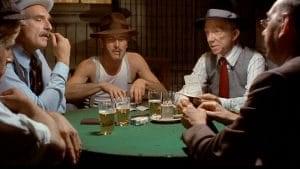
The Sting has a problem way before today’s argument starts… Where, exactly, is the casino?
George Roy Hill gives us no Vegas floor and no Bond across the baize. The decisive wager in the flick unfolds in a fake horse-racing parlour, staffed by grifters and built for an audience of one: Doyle Lonnegan.
A new study waved it through anyway and placed it first among 24 gambling films. Hill’s 1973 caper cost a reported $5.5 million, returned $156 million and carries an 8.2 IMDb rating. Together, those numbers yield a score of 79.7. The Hangover and Leaving Las Vegas share second; Casino Royale, with its $150 million budget and all, sits fourth.
Ultimately, a film about faking expensive surroundings has beaten films that paid for the real thing!
The Arithmetic Behind the Best-Value Casino Movies Ranking
The study started with each title’s reported cost and gross. It then placed those figures alongside its IMDb rating to compile the broader casino film ranking, with large budgets becoming a handicap. That is how Casino Royale can earn $616 million and still look up to a 1973 production assembled for $5.5 million.
Even the $156 million gross may be conservative. Current tracking puts it close to $160 million, though international records from the period are incomplete. The calculation ignores the film’s long afterlife, too: seven Academy Awards, Best Picture among them, and a place in the US National Film Registry since 2005.

A Tie That Shouldn’t Make Sense
The tie for second produces a vicious double bill. Mike Figgis walks Nicolas Cage into Las Vegas with one ghastly intention and refuses to soften it. Todd Phillips starts with a missing groom and several men whose memories have abandoned them. Leaving Las Vegas hurts, while The Hangover became a franchise.
Yet the formula hands each film 68.1. Figgis’s film grossed nearly nine times its production budget; Phillips found almost half a billion dollars in a bachelor-party disaster. Their IMDb ratings sit two-tenths apart. Few pairings demonstrate the elastic boundaries of gambling movies so neatly.
The number matches, sure. The experience, though, certainly doesn’t.
Big Budgets Meet a Meaner House
Daniel Craig’s first Bond outing takes fourth, which feels harsh until its $150 million budget enters the room. Casino Royale earned $616 million, and the poker game remains its finest pressure chamber. Martin Campbell lets the pauses work, as Bond’s composure frays one decision at a time.
That visual grammar has escaped the multiplex. Dealer choreography and immaculate green felt now recur across new online casino sites, an odd digital afterlife for images that cinema taught audiences to read. Casino Royale finds its suspense in clipped glances and the horrible wait for the river card.
Fifth place is even stranger. Soderbergh’s Ocean’s Eleven strolls through Vegas in a tailored suit, alongside The Cincinnati Kid, who sweats through a New Orleans card game. Put them side by side, and casino movie classics start to look like a wonderfully elastic category.
Scorsese Gets Beaten by His Own Budget
Scorsese is unlikely to lose sleep over a seventh-place ranking. Casino shares a 60.8 score with Rounders, with the study recording a $52 million budget against a $116 million gross. But in all honesty, a spreadsheet has no cell for the queasy force of Sharon Stone’s Ginger, or for casino management turned into an autopsy of American power.
Nobody leaves the casino thinking its chief problem was inefficient capital allocation. It remains the obvious answer when somebody asks for the casino film; The Sting answers a narrower, stranger question about value. The score does its job, then leaves the bar argument where it found it.
The Missing Costs and the Old Trick
It must be emphasised that every column has an asterisk. A reported production budget is often an informed estimate, while the marketing bill rarely reaches the public at all. IMDb does not stop moving once ticket sales do, either, and inflation to consider. The formula treats a 1973 dollar as if it held the buying power of one from 2009. Correct that, however, and the deck changes before a score is entered.
Streaming makes the next edition even trickier. At the time, the study flagged Edward Berger’s Ballad of a Small Player as a possible future contender. It later missed the Golden Globe nominations, and its Netflix release offers no comparable theatrical return. In other words, a modern film can disappear inside a platform’s private economics.
Without public marketing costs or comparable streaming revenue, the score can only measure how efficiently a film converted its production budget into popularity and ticket sales. Artistic greatness remains, thankfully, resistant to accounting.
Any ranking of the best casino movies should provoke an argument, and The Sting earns its share. Its production follows the con: performers distract the room while the machinery stays out of sight. Bigger films built brighter palaces; Hill offered one loose floorboard, making the fall feel like a pleasure.
For more film coverage, visit our Reviews section.