Right now, the film and animation industries are paralyzed by a wave of vocal “Doomers.” Walk into any production office, VFX house, or industry forum, and you’ll hear the same panicked refrain: Artificial Intelligence is an engine of pure soullessness, destined to automate away human imagination and reduce the majestic art of filmmaking to flat, automated “slop.”
But let’s be entirely honest with ourselves: Hollywood cemented its own creative doom years before a single AI data center ever went online.
The modern studio pipeline has long since evolved into a sterile, hyper-monetized, risk-averse machine run by committees, focus groups, and executive egos. It’s an ecosystem that copies and pastes intellectual property until the ink runs dry, treating audiences like cattle-like consumers while choking out original voices. The current industry-wide panic isn’t actually a noble defense of the “artistic soul,” it is pure cope from a bloated legacy system that has lost its grip on the cultural imagination, desperately blaming new technology because it doesn’t want to pay the piper for its own bankrupt choices.
The real threat to the creative soul isn’t the technology we use; it’s our own inflated human vanity. To understand how an artist truly loses the muse, you have to look at what happens when a creator achieves the ultimate industry dream: absolute, uncompromised control.
The Trap of Pristine Intent
In 2008, as a comic book fan, I got a copy of the Deluxe Edition of Alan Moore and Brian Bolland’s legendary 1988 graphic novel, The Killing Joke. I vividly remembered the visceral shock of reading that book for the first time, the toxic, suffocating atmosphere of the Joker’s madness. But when I opened the new anniversary edition, the wind was completely knocked out of my sails. It looked clean. It looked pristine.
And it was completely dead.
For the reissue, Bolland had used modern digital technology to completely recolor the book, stripping away John Higgins’ original 1988 colors. Bolland had always detested the original coloring, viewing it as a crude compromise forced by the primitive printing tech of the late ‘80s. Armed with modern software and high-gloss paper, he could finally show the world his exact, conscious intent.
He gave us realistic grey brick walls, natural flesh tones, and smooth, perfect digital gradients. In doing so, he accidentally proved a terrifying rule about the creative process: the moment an artist eliminates the natural friction of their medium, the magic vanishes.
To understand why the reissue failed, you have to look at the limitations Higgins was weaponizing in 1988. Comics were printed on cheap, porous newsprint using a restricted palette of 64 colors. The inks would bleed into the paper, turning everything muddy. Higgins didn’t fight the garbage paper; he surrendered to it. Because he couldn’t get photorealistic gradients, he used garish, clashing, expressionistic flat blocks of color. He drenched the panels in sickening lime greens, bruised magentas, and unnatural, psychedelic oranges. The colors didn’t tell you what the world looked like; they told you how madness felt. It was its own storytelling vocabulary born out of the paper it was printed on. Taking that away after the fact is like taking a freshwater fish and placing it in the ocean, and then wondering why it goes belly up.
“Hollywood cemented its own creative doom years before a single AI data center ever went online.”
When Bolland “fixed” it with digital perfection on glossy waxed paper, he dragged the story out of the collective unconscious and into literal reality. Marshall McLuhan famously argued that “the medium is the message,” that the tools we use alter human consciousness far more than the content we pump through them. What happens to the artist when the tool becomes so smooth, so efficient, and so powerful that it no longer fights back?
The “Genie” in the Subconscious
We have a fundamentally broken understanding of what creativity actually is. We treat it like an active, conscious muscle, something we own and operate. But the ancient Romans understood it better. They didn’t believe a person was a genius; they believed you had a genius. The genius (the root word of “genie”) was an external, semi-divine entity that temporarily lived in your wall and whispered ideas to you while you worked.
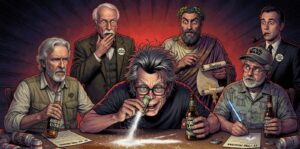
In a recent episode of The Joe Rogan Experience, Joe Rogan and tech investor Marc Andreessen parsed this exact phenomenon while discussing Stephen King. Rogan pointed out that he vastly preferred King’s work from the days when the author was completely blasted on cocaine and alcohol.
It’s a provocative point, but it uncovers a profound psychological truth: the creative process isn’t 100% ours. Carl Jung mapped this out with his concept of the Collective Unconscious, a deep, shared reservoir of archetypes and symbols common to all human beings. When King was operating in an altered, chaotic state, his conscious Ego was effectively knocked out. The background processing units of his mind were left entirely unhindered, plugging straight into the raw current of the collective unconscious to bring back terrifying, universal visions.
True creativity is a mechanism operating in the dark. We catch the vision, we feel the lightning hit the rod, and we do the manual labor of translating it into a story through the mediums of our time, whether that’s a film camera, an animation desk, or a digital canvas.
But then comes the trap: success.
The audience sees the finished masterpiece. They don’t see the dark, messy, subconscious pipeline; they only see you, and so how it made them feel is attributed to you. They applaud. They call you a genius, a smart guy with a big imagination. And your Ego (fat, happy, and inflated) believes them. You start thinking you are the god, rather than just the antenna. And that is exactly when you start getting in the way of the process.
The Chokehold of the Ego: From Lucas to Cameron
Once the Ego takes credit for what the subconscious delivered, the artist stops listening to the muse and starts manually steering the ship.
Look at George Lucas. When Star Wars exploded in 1977, it triggered a massive, global catharsis because it tapped perfectly into Aristotle’s principles of Poetics, specifically, the imitation of universal truths and organic unity. It didn’t belong to George Lucas the individual; it belonged to the cultural ether.
“True creativity is a mechanism operating in the dark.”
But decades later, Lucas’s Ego told him that Star Wars was his personal property (technically yes, but…), declaring that the original theatrical cuts were merely broken stepping stones toward his “true vision.” He went back and littered the frames with digital dewbacks, CGI rocks, and fundamentally altered characters (making Greedo shoot first). He treated a living, breathing cultural archetype like a piece of personal software that needed a patch update. The audience revolted because he violated the universal catharsis they had collectively experienced, all to serve his surface-level, conscious meddling.
James Cameron fell into the exact same trap. In his early, hungry days, his Ego was quieted by the sheer hustle of survival. He channeled visceral, raw, terrifying human survival beats in The Terminator, Aliens, and T2.
By the time he made Titanic, the surface-level talent had begun to mimic the old subconscious blueprints. Take a look under the hood: Titanic is structurally identical to The Terminator. You have a cold, unyielding, mechanical force (the machine / the iceberg) locked on an inevitable path of destruction. You have a working-class savior sent by fate (Kyle Reese / Jack Dawson) who rescues a woman trapped in an oppressive environment (Sarah Connor / Rose). The savior dies in ice or steel so that the woman can survive and evolve into a warrior.
It worked because the archetype was bulletproof. But by the time Cameron reached Avatar, the inflation was complete. Instead of letting a subconscious vision manifest organically through the physical friction of filmmaking, he spent hundreds of millions of dollars to build an environment of absolute digital control. With no limitations left to fight, he used his massive platform to preach high-and-mighty, surface-level political allegories. The medium stopped being a tool for deep discovery and became a megaphone for his conscious opinions.
The Real Friction: Why Paradoxically AI Keeps the Muse Alive
This is why the current hand-wringing over AI is missing the entire point. The danger of AI isn’t the technology itself; it’s how the inflated artist reacts to it. If a creator treats a generative network as a magic shortcut to instantly output their surface-level conscious intent, or uses it merely to slap together slick, immediate commentary on current events, of course, they will fail. They will become exactly like Brian Bolland with Photoshop or George Lucas with his digital dewbacks; technically flawless, visually polished, and entirely hollow.
However, if you actually look at how independent animators, VFX artists, and storytellers are using these tools to bypass the broken studio system, a completely different reality emerges.
AI does not eliminate friction; it fundamentally alters it. It introduces a brand-new, chaotic digital playground where the conscious Ego is stripped of total control. When an independent creator builds complex node structures, blends anything from CGI to live-action miniatures with neural rendering networks, or experiments with frame-to-frame parameters, they aren’t getting a perfect mirror image of their conscious intent. The machine constantly throws back beautiful, bizarre, unintended mutations, unexpected glitches, and visual artifacts. Why would any truly creative person see that as a flaw?
“The tool forces the artist back into a state of discovery.”
My friends, this is the exact point where the modern muse sneaks back into the room.
The tool forces the artist back into a state of discovery. You are no longer a dictator enforcing your high-and-mighty conscious blueprint upon the canvas; you are a collaborator standing on a new frontier, forced to react to the unexpected genius thrown at you by a new medium. It keeps you on your toes. It breaks your patterns. It forces your conscious mind to wait, to adapt, and to discover archetypes you could never have planned for on a whiteboard.
The muse is far too ancient and powerful to be killed by a new piece of technology. She survived the printing press, the synthesizer, and the digital camera. The tech isn’t the problem; the artist’s inflated ego is. The muse will step out of your way for that every time, but good luck doing anything worthwhile without her. If independent creators want to build an era of truly undeniable storytelling, we have to stop trying to kill new mediums because they don’t conform to the limited vision thinking that says, “This is how we’ve always done it, so it’s the only way it can be done.” That’s just repeating old blueprints, and why Hollywood sucks today. We have to kick the “smart guy” out of the driver’s seat and start listening to the unexpected lightning hitting our wires.
Christopher Moonlight is an animator, special effects artist, and the director of the ‘Award This’ winning movie, The Quantum Terror. His upcoming animated sci-fi adventure, Escape From Planet Omega-12, combines traditional film-making special effects with AI to create something never seen before in independent film. You can follow the behind-the-scenes, including tutorials, tips, and tricks, on his YouTube Channel, Substack, and christophermoonlight.productions website.


Good article. I’m glad it ends on a positive note rather than the typical “AI bad” reactionary thinking that pervades all discussion with creatives. There are flaws with the tools–intellectual property concerns, environmental concerns–and the valid points here about how AI affects the nature of creativity. These conversations need to be had. Philosophers need to weigh in. Thoughtful lawmakers need to weigh in. It’s all good. And in the meantime, creatives should recognize generative AI for what it really is: a powerful way to extend their will, and as this article points out, a new creative foil to make happy accidents.