The dream of every independent filmmaker follows a familiar script: years of grueling production, a triumphant festival premiere, and finally, the holy grail—a digital distribution deal that puts the film in front of millions of streaming viewers. But in the modern landscape of algorithmic platforms and automated aggregators, the signing of that contract is often where the real horror movie begins.
The Film Was Done. The Deal Was Signed. The Rights Were Gone.
In 2019, Filmmakers Alliance—a Los Angeles-based nonprofit that has supported independent filmmakers for over two decades—published a quiet warning on its blog. It wasn’t a press release. It wasn’t sent to Deadline or The Hollywood Reporter. It was directed at its own membership: read your aggregator agreements carefully, because some of you have signed away rights you don’t know you’ve lost.
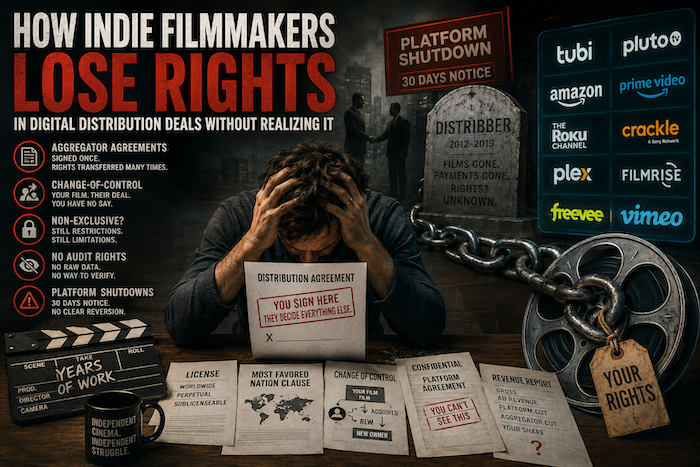
The specific trigger was the collapse of Distribber.
Distribber was not a fringe operation. It was a widely used, well-reviewed aggregator that had delivered films to iTunes, Netflix, Amazon, and Hulu for hundreds of independent filmmakers. In mid-2019, it stopped responding to emails. Films began disappearing from platforms without explanation. Revenue payments stopped arriving. The company eventually filed for dissolution in California, leaving filmmakers with:
– No delivered files or platform placements
– No outstanding revenue payments
– No clarity on which rights had transferred and to whom
– No entity left to contact, negotiate with, or sue
IndieWire covered it. Screen Daily covered it. Filmmakers posted in forums trying to figure out what they had actually signed. The answer, in most cases, was: more than they realized.
That was 2019. The contracts got longer. The platforms multiplied. The problem got quieter, which is not the same thing as getting better.
What the Aggregator Agreement Actually Says
Most independent filmmakers don’t read their aggregator agreements the way a lawyer reads a contract. They read them the way a person reads terms of service—scanning for obvious problems, assuming the rest is standard, and signing because the film is finished and they need to move forward.
Filmhub’s standard filmmaker agreement—which is publicly accessible and worth reading in full—grants Filmhub “a non-exclusive, royalty-free, worldwide license to use, reproduce, distribute, and create derivative works” of submitted content metadata, artwork, and promotional materials. The distribution license for the film itself is separate and governed by channel-specific terms that Filmhub negotiates independently with each platform partner.
The FilmStruck Lesson Nobody Fully Learned
When WarnerMedia shut down FilmStruck in November 2018, it gave 30 days notice—not to filmmakers, but to subscribers. The official shutdown announcement, posted October 26, 2018, told users their access would end November 29. Filmmakers whose work was on the platform learned the same way subscribers did: from the press release.
What followed for independent rights holders was a quiet administrative crisis that never got the coverage it deserved. The reversion process required filmmakers to:
1. Affirmatively notify the platform of their intent to reclaim rights.
2. Confirm the terms of wind-down in writing within timeframes that varied by contract.
3. Identify which rights had transferred, to whom, and under what conditions.
4. Navigate this process with no centralized support from the shutting-down platform.
The Change-of-Control Problem, Documented
The FilmStruck situation was an acquisition-driven shutdown. The pattern recurs whenever platforms change hands, with specific legal consequences worth understanding concretely.
When a platform is acquired, its content licenses are typically treated as assets of the business and transfer to the acquiring entity. Unless the original license contains a change-of-control clause—language requiring the filmmaker’s consent before the license transfers to a new owner—the filmmaker has no right to object to or renegotiate the transfer.
In 2021, when Chicken Soup for the Soul Entertainment acquired Crackle from Sony, every content license on that platform transferred with the deal. Filmmakers who had licensed to Sony’s Crackle were now licensing to a different company with:
– Different strategic direction and content curation priorities
– Different revenue reporting infrastructure and payment timelines
– Different editorial relationships with the content they had placed
– The same contract terms they had negotiated with an entity that no longer controlled the platform
What “Non-Exclusive” Actually Means in Practice
The term “non-exclusive” in a distribution agreement sounds like protection. It is not always what it appears to be.
A non-exclusive license means the filmmaker can license the same rights to multiple parties simultaneously. It does not mean the agreement contains no restrictions on other distribution activities. Specific mechanisms that cause damage in practice include:
– Most favored nation clauses: Require that terms offered to that platform match or exceed those offered to any other platform. A filmmaker cannot offer a better revenue split to a smaller, filmmaker-friendly service without triggering renegotiation obligations with the larger one.
– Holdback provisions: Prohibit specific distribution types (theatrical, physical media, certain streaming categories) during the contract term, even when the primary license is nominally non-exclusive.
– Territorial exclusivity carve-outs: The license is non-exclusive globally except in specified territories where it operates as exclusive. The filmmaker was never told about the territorial arrangement because it lives in the aggregator’s deal with a local platform partner.
– Derivative rights language: Grants the platform rights to create promotional materials, clips, and adapted metadata that may persist beyond the primary license term.
The Revenue Reporting Black Box
In 2022, Film Independent published findings from conversations with its filmmaker membership about streaming revenue reporting. The picture was consistent: most filmmakers had limited ability to verify whether the revenue statements they received from aggregators and platforms reflected actual viewing data.
The mechanics are not complicated. Streaming revenue for ad-supported platforms—Tubi, Pluto TV, Freevee, Plex—is calculated based on advertising revenue generated by the content, divided by a formula that weights viewing hours, completion rates, geographic location, and platform-level revenue share agreements.
At each stage, the filmmaker receives a report, not raw data. Without audit rights—a contractual entitlement to examine the underlying records—the filmmaker cannot verify the accuracy of what they’re being told.
This opacity is pushing some creators to look outside traditional Hollywood finance entirely. A growing number of filmmakers are turning to alternative digital funding sources, including tech entrepreneurs and decentralized platforms. However, entering these alternative ecosystems requires extreme due diligence. Just as players look to an independent review by bestaucasinolist to verify the financial integrity and licensing of a digital platform before risking capital, filmmakers must apply the same ruthless scrutiny to non-traditional distributors. Without that verification, you are simply trading one black box for another.
Conclusion
Independent filmmaking has never been easy. But digital distribution introduced a new kind of vulnerability — not born of malice on the part of platforms, but of a structural imbalance between what is signed and what is understood.
The collapse of Distribber, the shutdown of FilmStruck, the Crackle acquisition — none of these were anomalies. They were predictable outcomes of a system where contracts are written for lawyers and signed by filmmakers who just want their work to be seen.



Interesting. Thank you for the article. I’m currently in potential negotiations with the Up All Night Roku network for a “Non-Exclusive” rights agreement. Definitely some food for thought in that process here.