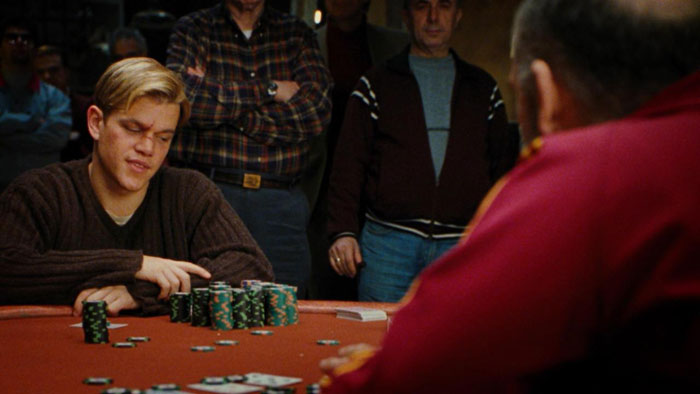
There is a moment near the end of Rounders where John Malkovich’s Teddy KGB twists an Oreo apart next to his ear, and the entire film tightens into that single gesture. No music swells. Nobody explains it. The camera just lets you watch Matt Damon watch the cookie, and somehow that is more tense than any gunfight in a louder movie.
That is the trick of the great casino scene. The cards barely matter. What matters is how the thing is shot, and gambling has given directors one of the most efficient pressure cookers in all of cinema: a small table, hidden information, money in the middle, and a clock that never stops ticking.
The Geometry of the Table
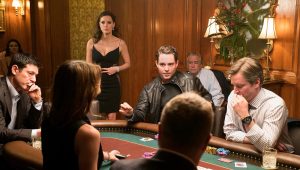
A card game is a gift to a director because it comes pre-blocked. Two or more people, fixed positions, a shared object in the centre that everyone wants. The camera barely has to invent anything. The default move is shot-reverse-shot, the same grammar used for a romantic conversation or an interrogation, which is exactly why a poker hand can feel like both. You cut between faces, and the eyeline geometry across the felt turns two players into duellists. Tighten the lens as the stakes rise. Let the background fall away. By the river card, the whole world has shrunk to two sets of eyes and a pile of chips.
What is fascinating is how often the best filmmakers withhold rather than show. When John Dahl made Rounders, he deliberately refused to photograph the players’ hole cards, even though televised poker was already leaning on the “lipstick cameras” that reveal them. He looked at scenes that showed the cards and decided they were, in his words, incredibly uninteresting. So he kept them hidden. The audience reads the players instead of the hands, which is precisely how the characters are forced to play each other. The restriction creates the tension.
Light, Shadow, and the Look of Money
Lighting is where a casino scene declares what kind of story you are in. The classic move is the pool of light over the table with everything around it sinking into shadow. It isolates the players, flattens the outside world, and tells you nothing exists right now except this hand. Scorsese understood the opposite end of it too. Casino drowns its Las Vegas in gold and neon and mirrored surfaces, a vision of the city so saturated it becomes its own character, beautiful and rotten at the same time. The glamour is the warning.
Then there is the underground game, which gets the reverse treatment. The back-room poker dens of Rounders are grubby, dim, lit like somewhere you should not be. Compare that to the gleaming, choreographed Las Vegas of Ocean’s Eleven, where Soderbergh lights the floor like a runway and the heist plays as elegance rather than menace. Same broad subject, opposite visual arguments. One says danger, the other says style, and the lighting does almost all of that work before a line of dialogue is spoken. Texture matters as much as light. Dark wood, brushed metal, green or charcoal felt, the weight of a chip in shallow focus. These are the details that tell you whether you are in a temple of money or a trap.
Cutting for Tension, and Knowing When to Hold
Editing is where the casino scene lives or dies, and the counterintuitive truth is that the most unbearable moments usually come from cutting less, not more. A heist sequence is built on kinetic montage: fast cuts, parallel action, the clockwork pleasure of a plan executing across multiple rooms at once. That is the Ocean’s Eleven mode, and it is genuinely thrilling. But the single-table showdown does the opposite. It slows down. It holds. The camera sits on a face a beat longer than is comfortable, then a beat longer than that, until the stillness itself becomes the threat.
The Rounders finale works because it dares to be patient. It lets the silence stretch, lets you sit inside Mike’s read, and refuses to release the tension until the hand is over. A lesser film would have chopped that scene into a dozen reaction shots and killed it. The discipline to hold the frame is what separates a great gambling scene from a merely busy one. Filmmakers chasing this effect could do worse than study how the genre has handled it, suspense is almost always a function of structure rather than spectacle.
The Realism Question
Here is the thing none of these scenes will tell you: most of them are nonsense, mathematically speaking. The climactic hand in Casino Royale is the famous example. The final showdown stacks a straight flush against a full house against other monster hands, all in a single deal, a scenario so improbable it would never occur in a real game. Dahl’s Rounders, often praised for authenticity, still has Teddy KGB making river bets several times the size of the pot, the kind of play a serious professional almost never makes.
The films bend the odds because drama needs a payoff that real poker, with its long grind of folded hands, rarely provides. Modern audiences clock this, partly because the real version is no longer a mystery. Where a viewer in 1998 took the movie’s word for how a game worked, today the actual rules, odds, and licensing are a search away. UK players can line up regulated, licensed options through PlayCompass, which sets out the terms in plain sight, the unglamorous, fully disclosed reality that a film cheerfully discards the moment it needs a straight flush on the river. That distance between full transparency and cinematic sleight of hand is, in its own way, the entire point.
What the Table Teaches
The casino scene endures because it distils everything a director is trying to do into one confined space. Stakes you can see. Information you cannot. A decision that cannot be taken back. Strip away the chips and the felt and you are left with pure cinema: faces, light, time, and the agonising wait to find out who was bluffing.
The best filmmakers know the cards are almost beside the point. What they are really shooting is the human being on the other side of the table, deciding whether to risk everything. Get that right, and you do not need a straight flush. You just need to hold the shot one more second than feels safe.