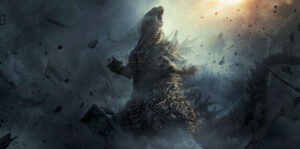
In 1945, the United States dropped atomic bombs on Hiroshima and Nagasaki, devastating those two cities and leaving Japan struggling to recover from World War 2. The movie, Godzilla Minus One, shows a fictional version of the aftermath of those bombings, placing Japan’s efforts to rebuild its country against the arrival of yet another catastrophe. As Japan struggles to recover, a 165-foot titan, Godzilla, rises from the ocean, threatening the Japanese who have barely begun to put their lives back together. Imagine that you are returning to work after a war that took countless loved ones, with bodies still being recovered from the rubble, only to watch the building that you work in collapse beneath a monster that’s capable of reducing entire city blocks to rubble. Then, as if that wasn’t enough, Godzilla begins to glow blue and unleashes a beam from his mouth that obliterates everything in its path, making millions relive those horrendous bombings once again.
In Godzilla Minus One, this isn’t something the characters have to imagine. It’s their reality. Through the main cast’s sheer will, cooperation, and a borderline insane plan that pushes them to the limits of what seems possible, they manage to defeat Godzilla, who appears beyond their ability to defeat. Their victory comes at an unrecoverable cost, with countless friends dying, but it proves that Godzilla can be defeated even though the odds seem impossible.
But defeating Godzilla is just the beginning. Japan has already endured a war, and now its people must rebuild after another catastrophe. Even victory leaves an unsettling question behind. What happens if Godzilla returns? And what happens if next time he’s not the biggest threat?
“Personally, I’d be on the next plane out of Japan at this point because it’s bombs, recovery period, Godzilla, recovery period, Ghidorah, Godzilla returns.”
Godzilla Minus Zero starts out with a village of people being terrorized by Ghidorah as it frolics around, eating people, destroying buildings, and shooting lightning beams from its mouth. For the people of Japan, this is yet another catastrophe in a seemingly endless cycle of devastation. They have already endured a duo of atomic bombs, struggled to rebuild their lives, and sacrificed nearly everything just to survive Godzilla the first time. Now, before they have even had a chance to recover, they may be facing something even more powerful. Personally, I’d be on the next plane out of Japan at this point because it’s bombs, recovery period, Godzilla, recovery period, Ghidorah, Godzilla returns. How many times can people be expected to pick up the pieces before they finally get a break?
Not everyone has the option or drive to leave, though. The characters in these movies are truly “built different,” as the kids say. They have repeatedly demonstrated that they would rather fight than surrender. That determination is part of what makes these movies so compelling. Throughout their time on Earth, civilizations have spent centuries developing tools and weapons to protect themselves from predators as well as other humans while assuming that any threat can eventually be overcome with enough ingenuity or firepower. But what happens when that thought process becomes the core of one of their biggest problems? In Godzilla Minus One, the team’s plan to defeat Godzilla relies on preparation, cooperation, and an assumed understanding of his weaknesses. In Godzilla Minus Zero, the response to a new threat is to escalate, using increasingly dangerous weapons against these creatures with little understanding of how they will react. Humanity is learning from its encounters with these monsters, but it may be learning the wrong lessons. Rather than questioning whether it understands the forces it is fighting, it keeps searching for a bigger weapon and therefore making these kaiju even stronger.
Following Ghidorah’s attack, Dr. Noda, leader of the Large-Scale Disaster Response Bureau, and his team spring into action to locate more information about the new monster. Only two people survive the initial attack on the town, one of whom is Professor Murakami, who reveals that Ghidorah can consume different animals and gain their physical traits. They devise a plan to attack Ghidorah using a new type of bomb, with a backup plan just in case. Ghidorah survives the bombing, so they drop a lightning rod into his back that seems to kill him, but instead he rapidly mutates, grows three heads, and gains the ability to shoot a gravity beam that can pick up and drop buildings at will. Off the coast, Godzilla re-emerges and is bigger and more aggressive due to the previous attacks on him.
This was my a-ha moment while watching the movie. The main theme of the movie is that humanity’s actions can have consequences it never intended. Through attempting to destroy the monsters, the Japanese have only made them more dangerous. The bomb fails to kill Ghidorah, and the lightning rod that is intended to finish the job instead triggers his transformation into an even greater threat. They continue to think that they are doing damage to these creatures, but because they don’t understand what they are fighting, they are actually helping the creatures in the long run.
“They continue to think that they are doing damage to these creatures, but…they are actually helping the creatures in the long run.”
The same problem extends beyond the battlefield. After the bombing of Hiroshima, Professor Murakami vows to take revenge on the Americans. In my opinion, his anger is understandable. He has lost the two people he loved the most in a horrific act, and the desire to make those responsible suffer is easy to comprehend. But his plan to use the Resonance Wave to lead Godzilla to New York risks inflicting the same kind of devastation he wants to avenge. Luckily, Noda is able to convince him that answering violence with violence would only extend the cycle of destruction. The Professor chooses not to follow through with his plan, realizing that the proper way to avenge his family isn’t to inflict the same suffering on others, but to refuse to perpetuate the violence that took them from him.
Noriko’s G-Cells offer another example of how surviving a catastrophe can come with consequences of its own. The cells leave her carrying a piece of Godzilla wherever she goes. They are a reminder of what she has survived, but they also threaten her life if they mutate out of control. And yet, those same cells make her essential to the plan to bring Godzilla to Ghidorah. Her survival has left her with a dangerous burden that may be the only way humanity can survive the next threat.
After Godzilla reemerges, the Professor pitches that the only way to take the monsters out is to have them fight one another and then take out the survivor. The team has serious reservations, but they understand that no man-made weapon is going to be able to take them both down. Noriko is asked to lead Godzilla to Ghidorah with the Resonance Wave because her “G-Cells” allow her to become a homing beacon for Godzilla. The same thing that marks Noriko as a survivor is the most important part of this plan. If the plan fails, Ghidorah and Godzilla remain separate threats, free to continue wreaking havoc. If Noriko dies, the team loses its means of directing Godzilla toward Ghidorah. There are no second chances. Luckily, the device and Noriko are able to summon and lead Godzilla. Upon leading Godzilla to Ghidorah, the final battle commences.
During the fight, Godzilla tears off one of Ghidorah’s heads, but Ghidorah responds by severing one of Godzilla’s arms. Both regenerate their injuries, and the battle escalates when Ghidorah consumes Godzilla’s flesh. This causes Ghidorah to rapidly mutate, developing three Godzilla-like heads capable of firing the heat ray. However, he cannot control the power of all three heads at once, giving Godzilla the opening he needs to defeat him. Ghidorah’s transformation is another example of actions having consequences. By consuming Godzilla’s flesh, he gains a devastating new ability, but his inability to control it ultimately leads to his downfall.
“Humanity has secured another opportunity to rebuild, but it remains dependent on a monster it cannot reliably control or eliminate.”
After the fight, Godzilla starts returning to the ocean as he is badly beaten. On his retreat, he is targeted by a military attack, being assaulted with missiles, mortar shots, and tank blasts. Noda’s team tells the military to stand down, essentially because there is no way of knowing whether another kaiju might emerge in the future. They understand that while Godzilla may be dangerous, he could also be the only weapon capable of defeating whatever comes next. They also repeatedly mention that Godzilla was lured into this fight rather than coming to the fight of his own accord. While the team managed to lure the two monsters into a fight, there is no guarantee they could repeat the process since the Resonance Wave was destroyed. So, by sparing Godzilla, they aren’t naively showing they trust him, but rather they begrudgingly recognize that humanity cannot afford to eliminate a force it might need to protect them again, even if it has no reliable way to control him.
This leaves Godzilla alive, but an air of unease is almost tangible. Godzilla is a loose cannon because he “protected” Japan, but tomorrow he could come back to destroy it. Humanity has secured another opportunity to rebuild, but it remains dependent on a monster it cannot reliably control or eliminate. Does the savior of today become the savior of tomorrow, or do they come back to rain terror unchallenged?
That’s the uncomfortable reality facing the people of Japan. They have survived yet another attack, but they have no guarantee that the next one won’t come tomorrow. Godzilla’s defeat of Ghidorah gives them another opportunity to rebuild, but it doesn’t guarantee peace. These people have learned to cooperate, cope with loss, and survive against seemingly impossible odds. But survival and security are not the same thing. If humanity’s continued existence depends on a force it cannot reliably control, can it ever consider itself safe? Or will its people be forced to keep picking up the pieces, never knowing how long they have before the next catastrophe arrives?