The sky over Central Texas wasn’t giving up easily.
On Thursday, April 9th, my producing partner Doug Mayfield, practical effects artist Jenna Green, and I spent ninety minutes white-knuckling a vehicle through heavy, sunlight-choking storm cells on our way to Downtown San Antonio. We weren’t just heading to a speaking engagement; we were transporting a hybrid of old-school craft and new-world technology, a mechanical tentacle puppet and a spaceship built from found objects, into the heart of the Westside.
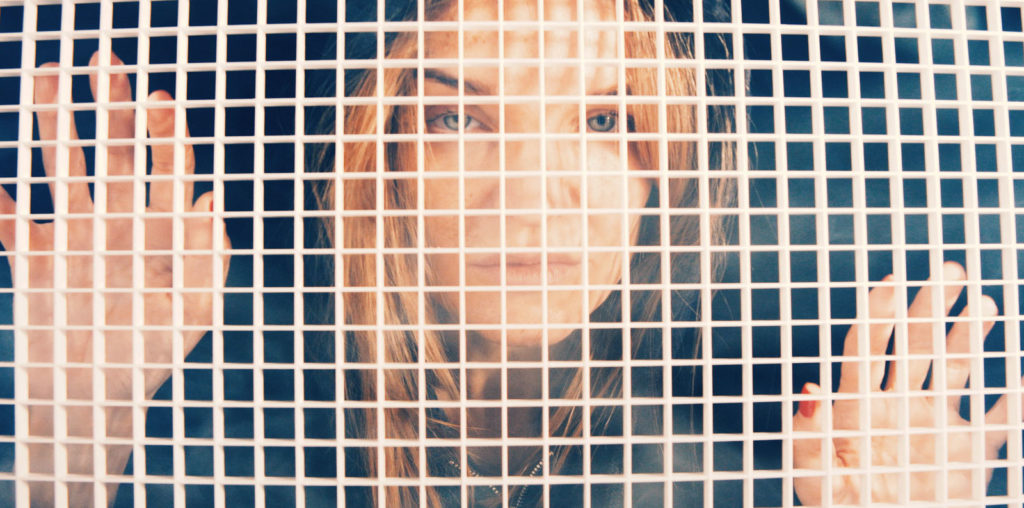
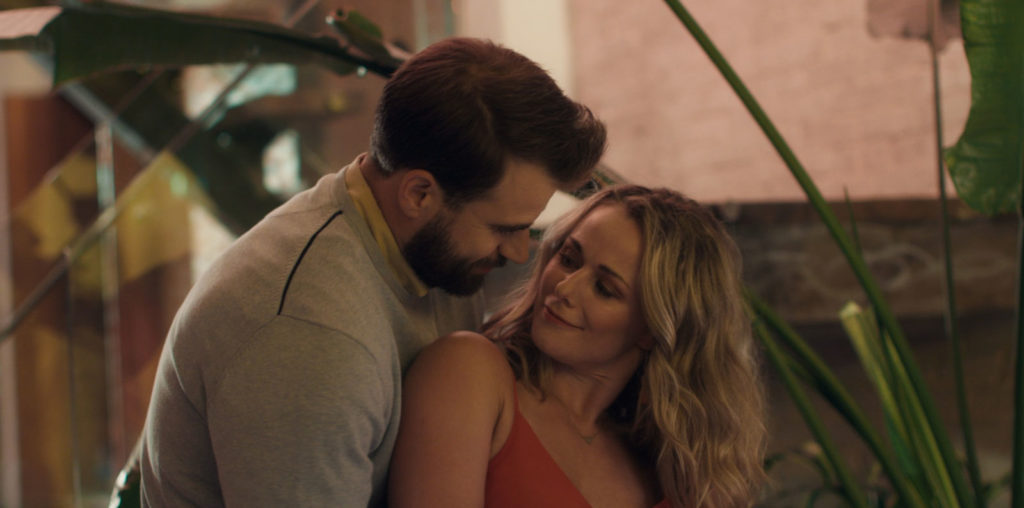
As we navigated the tight, rain-slicked streets of downtown, I was more focused on the road than the scenery until Jenna, who was a contestant on SyFy’s make-up challenge show Face/Off, and my lead practical effects artist on my movie The Quantum Terror (so she knows a thing or two about spectacle), suddenly pointed out the window.
“Dude,” she said, “your name is on the marquee.”
There it was, in black and white against the glow of El Progreso Hall: a physical anchor for a digital revolution.
The Ecosystem of the Westside
Inside, the hall was a sanctuary from the weather. The air smelled like rain and high-end street tacos, the latter courtesy of Tomas Vasquez and the Beyond The Canvas team. Tomas is one of those rare pillars in the local scene who isn’t just talking about “community”, but putting his money where his mouth is and building the infrastructure for it.
“The machine was the leverage to make that happen.”
The room was buzzing. Among the crowd was Bardo Perez, owner of the legendary Fruit & Chocolate Sensations, looking sharp in a tailored suit. While his business wasn’t the official sponsor for the night, Bardo is a fixture of these events, representing the kind of local entrepreneurial spirit that keeps the arts alive in San Antonio. The night was a collaborative effort, a “Business of Film” seminar backed by the Avenida Guadalupe Association and PNC Bank, in conjunction with the tech organization Geeks and Drinks, as part of their AI-April; proof that when the “Permissionless Studio” speaks, the local institutions listen.
After a professional sound tech helped me bridge my laptop into the hall’s projector, the room began to fill. By 7 PM, about forty creators had trickled in, who were filmmakers, producers, and artists from every corner of the city.
The Stan Lee Phalanx
I didn’t start with a technical breakdown. I started with a shield for those who have endured the assaults of AI-Derangement Syndrome.
I played a clip of Stan Lee from his 2017 UCLA keynote. In it, the architect of the Marvel Universe tells a graduating class: “If you have an idea that you think is really good, don’t let some idiot talk you out of it.”
In the modern creative landscape, the “idiots” are usually the gatekeepers, or the doomers, telling you that AI is either a “Luciferian” replacement for the human soul or a shortcut for the lazy. I challenged the room immediately: I told them I wanted them all to get rich doing what they loved, and that the machine was the leverage to make that happen.
But talk is cheap. To prove the point, I reached into my bag and pulled out what I’ve been calling the “Human Moat.”
Space Ships and Alien Birds
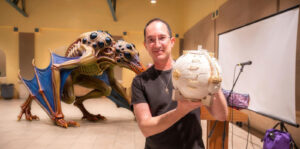
I showed them the escape pod for my current project, Escape From Planet Omega-12. Up close, it’s a kit-bashed fever dream: a hamster ball detailed with bottle caps, discarded plastic packaging, paint, and hand-applied gold-leaf foil. Next to it, I operated a cable-controlled tentacle mechanism, made from lightweight foam, springs, and bike brake cables.
The room shifted when I showed the “Digital Bridge.”
“The AI didn’t build the bird. I did.”
Using a digital service called Polycam, I had scanned that hamster-ball model into a 3D mesh and imported it into After Effects. On the screen, the audience saw that $30 kit-bash transformed into a cinematic asset, rotating under virtual lights and cameras. I showed them my hand-drawn sketches of alien birds, admittedly “cartoonish” on paper, and tracked their evolution through iterative AI prompting into realistic, screeching nightmares performing against animated thunderclouds. I talked about using chatbots as business partners, how to use AI to create transformative works that can be copyrighted; really driving home the point that it can do anything, if you have the imagination to realize that so can you.
I wanted my message to be clear: The AI didn’t build the bird. I did. The AI didn’t design the ship. I did. The machine simply provided the “rendering engine” that Hollywood usually spends millions to gatekeep.
Slop, Signal, and the Cameron Catalyst
During the Q&A, the inevitable question arose: Is AI just going to flood the world with “slop”?
My response was to take them back to the 1980s. When Teenage Mutant Ninja Turtles became a breakout hit, the market was flooded with hundreds of “me-too” black-and-white indie comics, rushed out to cash in on the collector’s trend. Most were poorly drawn, cheap, and rightfully forgotten. But that same era, using the same accessible materials, gave us James O’Barr’s The Crow.
“Let other people make slop. That has nothing to do with us,” I told them. “Our job is to be the Signal.”
I urged them to look at James Cameron. In the 80s, Cameron wasn’t just using cameras; he was re-wiring them. He was using miniatures and rear-projection in ways his peers couldn’t understand until they saw Terminator and Aliens on the big screen. He had a map to a destination, and he used technology to build the road.
The Great Equalizer
The most profound moment of the night didn’t happen on the screen. It happened in the chairs.
Hollywood loves to use “diversity” as a PR prop, but the room at El Progreso Hall was the real thing. It was a multicultural cross-section of Texas, but it might as well have been for every part of our country or even around the world; men, women, young students, and veteran producers.
“They don’t need a studio’s permission to be great.”
In the back, a man in a motorized wheelchair watched with an intensity that hit me hard. For him, the “Permissionless Studio” isn’t a theory; it’s a prosthetic for the imagination. It’s a way to bridge physical and financial gaps that have kept creators like him on the sidelines of the “Permission Machine” for a century.
These creators weren’t looking for a handout or a diversity quota. They were there to learn how to seize their own destiny.
As the night wrapped up, I spent time on the floor with the audience. There’s something universally human about a mechanical tentacle; everyone wanted to see how the bike cables worked, feeling the tactile resistance of the foam. In that moment, the digital “magic” and the practical “craft” finally merged.
Hollywood isn’t afraid of a “Luciferian” AI. They are afraid of that room in San Antonio. They are afraid of the day when every creator in a garage realizes they don’t need a studio’s permission to be great.
They just need a good idea, and they shouldn’t let some idiot talk them out of it.
Christopher Moonlight is an animator, special effects artist, and the director of the ‘Award This’ winning movie, The Quantum Terror. His upcoming animated sci-fi adventure, Escape From Planet Omega-12, combines traditional film-making special effects with AI to create something never seen before in independent film. You can follow the behind-the-scenes, including tutorials, tips, and tricks, on his YouTube Channel, Substack, and christophermoonlight.productions website.