There is a loud, hysterical narrative out there that artificial intelligence is here to replace the screenwriter. Every doom-and-gloom headline wants you to believe a computer will magically spit out slop that studio execs will embrace over a human masterpiece with the push of a button, leaving creative minds out in the cold.
As an independent filmmaker actively in the trenches of production, let me burst that bubble: AI cannot write your movie. It has no soul, it hasn’t experienced heartbreak, and it doesn’t know the specific, sweaty texture of 1980s pulp sci-fi fantasy like I’m making, right now.
What it can do, however, is act as a tireless, hyper-competent script supervisor: one that keeps a guy like me from derailing his own project before the cameras (or in my case, the sound booth recordings) even roll.
I have ADHD and dyslexia. Like, the real thing that comes with a diagnosis. Not the online attention-seeking kind. If you deal with either, you know it sucks and that staring down an 80-page production script isn’t just an exercise in storytelling; it’s an absolute minefield of rogue typos, dropped words, accidental character name swaps, and formatting discrepancies that your brain simply chooses to edit out. When you’re juggling practical miniatures, green screens, and a micro-budget indie VFX team, you can’t afford sloppy administrative mistakes.
On my animated sci-fi feature, Escape From Planet Omega-12, I brought on Emmy winner Bill Oberst Jr. and veteran artist Val Mayerik to voice key characters. When you have high-caliber talent in a voiceover booth for a single, tight recording session, time is currency. You do not want to realize in post-production that you missed two vital screams, an off-screen gasp, or a line of dialogue because your script supervisor (who is also you, because you do everything) had a lapse in focus.
Here is how I used a local, iterative AI model as an administrative scalpel to bulletproof my production draft and generate foolproof actor cue sheets.
Step 1: The Mechanical Polish (Catching the Blind Spots)
After locking my narrative structure, I fed my raw teleplay into the model with explicit constraints: Do not rewrite my story. Do not change the tone. Be my copy editor. Find the blind spots: everything from spelling mistakes to formatting errors.
When you write fast, inconsistencies multiply. In my draft, my female lead swung between “Tera” and “Tara.” A supporting military rank flipped names mid-act. A character’s surname shifted between dialogue tags and an on-screen action. Because the AI evaluates text systematically rather than skimming it intuitively, it flagged every mechanical discrepancy without touching my creative voice. It caught phonetic slips, homophones, and rogue scene headings that my dyslexic eyes breezed past ten times in a row.
Step 2: The Non-Verbal Harvest
This is where the process pays off for any director preparing an audio recording session.
Most traditional script breakdowns only index dialogue blocks. Reading through the script to isolate them for your actor can be hours, if not days, of work. In genre filmmaking, especially animated, horror, or action-heavy cinema, half an actor’s performance lives in the non-verbal margins. The gasps. The physical exertion grunts. The pained screams as a creature drags them across the floor. The transition from rapid, adrenaline-fueled panting to silent, broken sobbing. On a set or a location, that’s intuitive work as you shoot, but if you’re animating everything frame by frame, you need to be sure to record it.
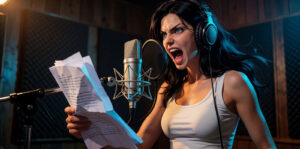
I tasked the model with parsing the entire script and isolating a dedicated Vocal Cue Sheet for my lead actress.
Instead of a generic list of spoken lines, the output mapped every vocalized human noise chronologically against scene headers and action descriptions:
Cue 05 | Page 4 | EXT. ESCAPE POD – CONTINUOUS
Action/Sound: Desperate stretch; wild panic scream while firing the ray gun in a sweeping arc.
[VOCAL SOUND CUE]: Horrified gasp/slip; desperate stretch; wild panic scream.
Cue 06 | Page 4 | EXT. ESCAPE POD – CONTINUOUS
Action/Sound: Aftermath of killing the swamp worm.
[VOCAL SOUND CUE]: Heavy, rapid, adrenaline-fueled breathing transitioning into quiet, traumatized weeping.
Cue 10 | Page 7 | EXT. THE CAMPSITE – CONTINUOUS
Context: Drawing the sword, attacking the creature to free Brio.
TARA
(screaming)
LET HIM GO!
Step 3: Studio Session Insurance
When your actor steps up to the mic, handing them an 80-page script means flipping pages, losing track of energy levels, and accidentally skipping secondary vocal reactions buried inside long paragraphs of scene description.
Handing them an isolated, 6-page vocal cue sheet changes the entire dynamic. You can track off-screen sounds (O.S.), walla, physical exertion beats, and dialogue runs sequentially. You can check off each cue in real time, ensuring that when the actor walks out of the booth, you have every phonetic element required to build your animatic scratch track, with zero pick-up sessions required.
The Takeaway
We often focus on AI’s uses as an image generator or animation tool, but don’t forget the many practical utilities. It’s been said enough times that if you use AI to generate your story, you’ll get bland, homogenized garbage. But if you use it as an assistive engine to compensate for neurodivergent hurdles, audit your logistics, and prep your talent packets, it becomes the ultimate force multiplier for low-budget cinema, and you can spend more time with what really counts.
Work smart, protect your shoot days, and use every tool at your disposal to get the movie out of your head and onto the screen.
Christopher Moonlight is an animator, special effects artist, and the director of the ‘Award This’ winning movie, The Quantum Terror. His upcoming animated sci-fi adventure, Escape From Planet Omega-12, combines traditional film-making special effects with AI to create something never seen before in independent film. You can follow the behind-the-scenes, including tutorials, tips, and tricks, on his YouTube Channel, Substack, and christophermoonlight.productions website.