
Alexander Hammer’s Room to Move is not just another arts documentary. It’s a revelatory, emotionally complex, and artistically daring portrait of choreographer Jenn Freeman, who receives a life-altering diagnosis of Autism Spectrum Disorder at age 33. But this film doesn’t reduce itself to a profile of a person with a condition. Instead, it rises, frame by frame, into something that blurs the lines between performance, therapy, and transcendence.
Hammer, known for his collaborative editing on Homecoming: A Film by Beyoncé and Expecting Amy, steps into the director’s chair with remarkable restraint and compassion. Also serving as editor and cinematographer here, and that triple-duty pays off. Filled with intimacy, the camera lingers in close-up, not just on Freeman’s face as she recalls her past, but on her hands, her muscle memory, and her movements, capturing a body that speaks the truths her words sometimes struggle to.
Focusing on Freeman’s deeply personal dance piece Is It Thursday Yet?, her first evening-length solo performance. Co-created with renowned choreographer Sonya Tayeh (Tony Award winner for Moulin Rouge!), the piece serves as both culmination and crucible. The exploration of Freeman’s past, re-examined considering her diagnosis. Their collaboration is at the emotional heart of the documentary. Tayeh, bold and nurturing, brings structure to Freeman’s chaos without dulling its edges. In the film’s most riveting moments, the two artists argue, stumble, cry, and ultimately fuse their visions into something uniquely cathartic.
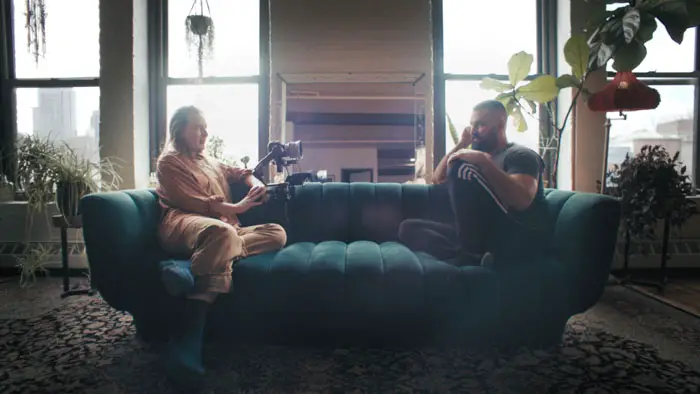
Choreographer Jenn Freeman reflects on her journey during an intimate interview in Room to Move
“…a revelatory, emotionally complex, and artistically daring portrait of choreographer Jenn Freeman…”
What makes Room to Move stand tall is its refusal to rely on standard documentary tropes. This isn’t a film filled with talking heads or recycled archival footage. It moves like a living essay, sometimes linear, sometimes impressionistic, always intentional. Hammer edits with a musicality that matches Freeman’s choreography, and the result is a film that feels danced even when the screen is still.
Executive producers Amy Schumer and Chris Fischer bring credibility and warmth to the film’s framing, particularly given Fischer’s own experiences with autism. Their presence never overshadows Freeman’s story, instead, it contextualizes it within a broader, compassionate discourse on neurodivergence. There is nothing wrong with people who have autism. They are just wired a little different from the rest of us.
Freeman herself is an extraordinary on-screen presence. The frankness and humor with which she approaches her unfiltered struggle make for a compelling protagonist. But it’s her refusal to simplify her identity, to reduce herself to either a label or a triumph, that makes her story linger. She is, above all, a working artist.
Room to Move isn’t a movie you walk away from unmoved. It forces you to sit with discomfort, but also offers release. It celebrates neurodiversity without romanticizing it. It speaks to the power of art’s ability to reveal and sometimes repair the fractures within us.
In a cinema landscape increasingly flooded with disposable content, Room to Move is that rare thing. A film with a soul.

"…the result is a film that feels danced even when the screen is still."