
Further proof of a radical sea change of cleverness in the horror genre can be found in the unconventional indie chiller Yellowbrain, written and directed by Jeffery Husselman. It opens with a shot of a shelf lined with spooky paperbacks. As the camera pans across the shelf, more and more blood is splattered across everything. On the floor, in a pool of blood, there is a body with a hole instead of a face. The body is then dragged off camera by something the audience doesn’t see. The next scene is in a support group, where Beth (Megan Guynn) is sharing her feelings of being stuck in the categories others make for her. The moderator, Eugene (Nick Vallaire), calls time and gets Beth’s name wrong, despite the name tags.
Silent John (Matthew Smith) leaves the group and goes home to his house by the woods. He pours himself a drink of whiskey, sets up a film projector, and gets drunk while watching what he is watching, which the audience is not privy to yet. John is a blacksmith, with a workshop where he crafts forgotten metal he dredges from the river with a magnet on a line. One night, he sees the man in the house across the street hauling something strange. John continues his routine, banging on hot metal and going to meetings during the day, while drinking himself to sleep alone in front of his movie at night. Until one night he isn’t in his house anymore, as he is wrapped up in his chair, with raspy voices in old speech, pouring out of the darkness in the woods, where yellow fungus grows on tree branches. A hand with long, black claws reaches out for John…
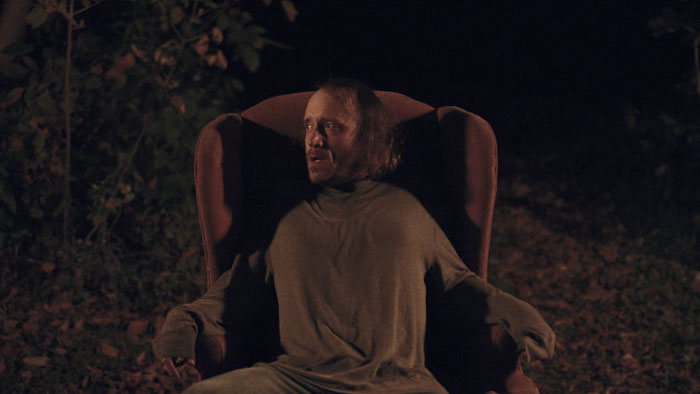
John (Matthew Smith) finds himself trapped in his chair in the nighttime woods in Yellowbrain.
“As the camera pans across the shelf, more and more blood is splattered across everything.”
One of many devilish details in Yellowbrain is that Smith’s character drinks from this asymmetrical water glass that is mystifying. I feel Husselman is offering the same kind of aesthetic by delivering an asymmetrical horror movie that trespasses into art territory. While the concept of entering the mind of a maniac is on open display, the storytelling method Husselman employs is highly unusual. The audience is lulled into John’s routine, with the lush forestry slapping a lullaby on our nerves. Then strange intrusions upon the perceived normality occur, pulling the curtain back on a hideous nightmare that sits invisible in front of your face. But it doesn’t play like your regular horror movie, not at all. That is what’s so asymmetrical about the way this flick plays, as it avoids predictability by not going around the usual corners.
That isn’t to say Yellowbrain doesn’t trade in horror tropes, as it certainly does. Husselman uses these purposely to lead the audience into unusual emotional places. John is presented right away as a loner, with shades of Ed Gein being thrown by his backwoods ballcap look. The array of knives and other weapons is hung on the wall, just waiting to be pulled down and used. The awareness that these are the signs of a serial killer looms over the proceedings like rain clouds full of blood. You also get a lot of familiar horror business with the demonic visions. Everyone’s black-and-white makeup looks very scary. I also enjoyed how the old speech of the demons was half-intelligible, with a lot of the words melting into a wall of madness. I could have used a little more variety in the demon voices, as they all sounded like the unicorn horn-stealing goblin in Legend. But no one will mistake Yellowbrain for anything outside of horror, no matter how outside the puzzle box it gets.
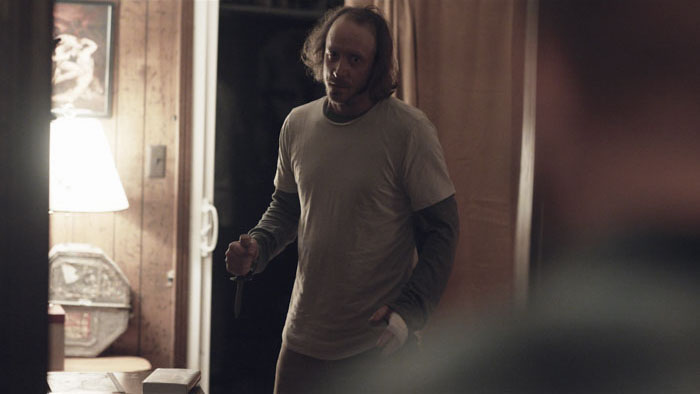
John (Matthew Smith) grips a knife inside his house in Yellowbrain.
“But it is the setting up of a normalcy to chip away at that is the Lynchian path that Husselman follows to great success here.”
What keeps this fresh is that Yellowbrain employs a lot of tools from the toolbox of the director I consider the scariest of the modern age: David Lynch. There is one scene with a wailing egg embryo that is a direct reference to Eraserhead. But it is the setting up of a normalcy to chip away at that is the Lynchian path that Husselman follows to great success here. Like Blue Velvet, Mulholland Drive and Lost Highway, the audience is presented with a too-perfect state of tranquility, which is shortly flooded with dark undercurrents. It will go into the outskirts of reality at the drop of a hat, making the ground beneath your feet an uncertainty. There is also the masterful use of music, in this case the dynamite compositions by Adam Amos. The music in Yellowbrain is outstanding, sending an electric fire through several of the images it plays over. It almost plays like a homicidal Pink Floyd: The Wall.
This is the kind of art that will make sure horror is never boring. I love how Husselman drives us crazy throughout the picture by making us wonder what the Hell John watches on his projector every night. It is purposefully kept off-screen until a huge reveal at the end, then boom-boom, out go the lights. I know a lot of people are going to picture a lot of things in their heads, but be warned, you will not be expecting what you will end up seeing at all. It changed my entire emotional reaction to the finale, as well as the film itself. I would love to see Husselman apply this type of cinematic storytelling to a Hellraiser movie, as this is ten times scarier than any installment of that franchise. Yellowbrain improves the dread by feeding your head in the most delightful way, before biting it off like a chocolate bunny.

"…an asymmetrical horror movie that trespasses into art territory."