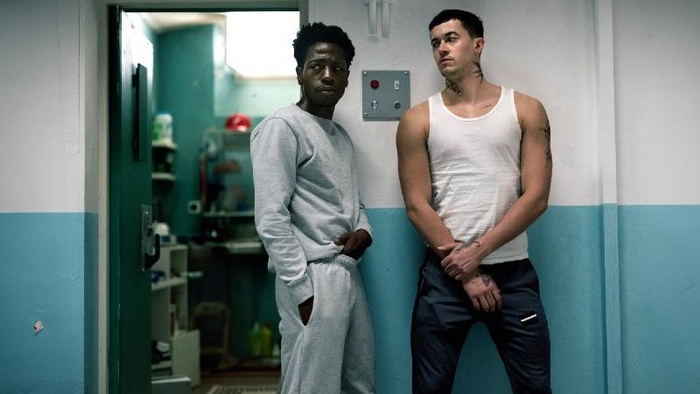
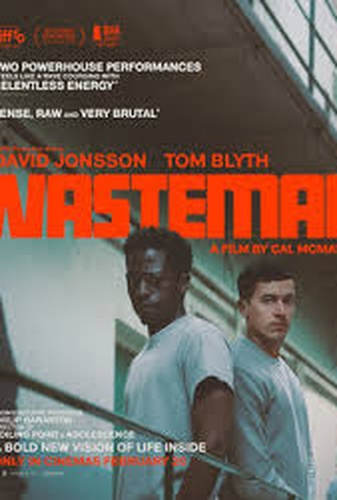
An altogether different kind of prison drama, Wasteman is an engrossing redemption tale centering on the devastating effects of wanton destructiveness within confined spaces, written by Hunter Andrews and Eoin Doran. David Jonsson plays inmate Taylor with unsparing sympathy, a dutiful cook in an overpacked detention facility on the cusp of an early release, partially due to overcrowding. Dee’s (Tom Blyth) recent arrival rocks the boat. His snarling disposition is viciously at odds with Taylor’s, and this dichotomy is immediately observable even as the two initially form a slightly askew companionship.
Dee has arrived with a chip on his shoulder and will batter his way to whatever he wants without hesitation. He is also a drug dealer, and Dee’s activities inside the institution ultimately cause near-catastrophic disruptions to Taylor’s everyday peace-keeping. These include dishing out haircuts (which he pledges will form his post-release livelihood), and appeasing some of the “stash” seeking toughs housed in neighboring cells. Sure, Dee may dole out a grain or two of empathy here and there, but it’s part of a self-serving scheme.
Wasteman is distinctly of the times (phone footage is often used to dizzyingly effective effect), and its depictions of fighting land with searing force. The rough and tumble way in which these sequences are shot is in keeping with the hard-bitten tone of the piece. Director Cal McMau ushers the viewer into this dangerous environment. One feels as if they’re being tugged by the shirt sleeve into the cold fray of the hostile halls and spaces.

“…Dee’s activities inside the institution ultimately cause near-catastrophic disruptions to Taylor’s everyday peace-keeping.”
The grime-heavy soundtrack has a propulsive, stomping drone to it, a palpable sense of threat that never subsides over the course of its 90-minute duration. There’s an adherence to tight framing and hectic camerawork – and this technique amplifies the impact of the more confronting moments. Steve McQueen similarly achieved this in Hunger, although McMau’s movie doesn’t approach the levels of stomach-churning harrow as the former.
Complicating the plot is the fact that Taylor has been inside for 14 years and has missed his teenage son’s entire childhood as a result. Through Dee he is able to contact his estranged son via an online message, promising that his release is imminent, and therefore sprouting a whole new thread of purpose for him to cling to. Dee’s backstory is fraught, and he is inside for a 5-year sentence, it’s revealed.
A dealer on the outside, he concedes that some of his buyers perished as a result of his product. One gets the sense that remorse is a reluctant tenant somewhere in his conscience, even if it’s never a vocal part of his personality – and it’s a credit to Blyth’s performance. He’s like a rampaging striker on the hunt for the winning goal, unperturbed by fouls committed along the way. Conversely, Jonsson’s finely-tuned, nuanced work follows a string of memorably soulful performances (such as in Alien Romulus). Wasteman is peppered with moments of cortisol-spiking tension. There’s an intensity that rivals Franklin J. Schaffner’s 1973 classic Papillon.
The finale is a will he, won’t he game as Taylor tries to connive his way out of a deadly ultimatum that could jeopardize the welfare of his son. A grungy blur of bravado, delinquency, and rebellion – Wasteman touches on the issue of prison overpopulation, as well as the substantial tension the collision of wounded psyches and dubious pasts can beget. Meditations on the toll of waiting, the damage of estrangement and the fickleness of trust echo in a well-acted, assuredly directed, sometimes brutal, watch.
"…well-acted, assuredly directed, sometimes brutal..."