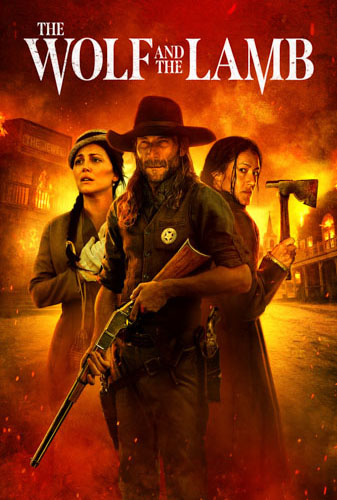
To indulge in some real terror out in the territory, saddle up for the higher-end indie western horror picture The Wolf And The Lamb, written and directed by Michael Schilf from a story written by Schilf and Miah Smith. Out in the Montana Territory, in the 1870s, two parents in a cabin get torn to pieces while their little girl is whisked away by an unknown force. The townspeople of Hemlock Gulch are in turmoil, as there has been a rash of children disappearing lately. The Sheriff, Frank Martin (Zach McGowan) and his deputies, Charlie Quinn (Elias Kacavas) and Jim Cooley (James Landry Hebert) have no leads as to what’s happening to the missing kids. The widow Jo Beckett (Cassandra Scerbo) seeks solace with her son, Henry (Jaydon Clark), at the church led by the Reverend Elias Fremont (Angus Macfadyen).
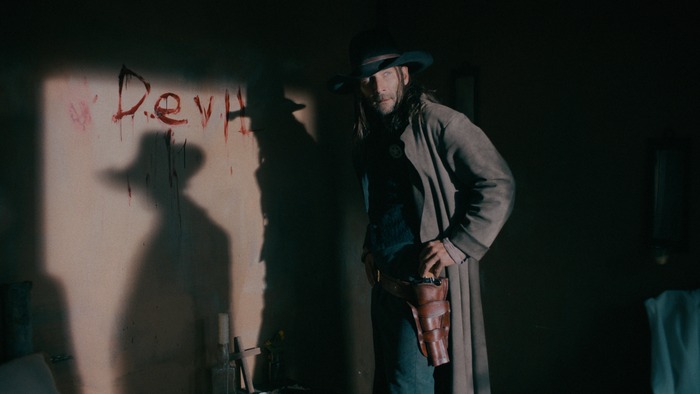
“During a town party thrown by Derne, young Henry disappears…”
Meanwhile, local hotel owner George Derne (Clint Howard) is hatching up a plot to take over the spot occupied by one of the town’s two brothels, specifically the one run by Monsieur Jean LaGrange (Rob Nagle). LaGrange is a fancy gentleman who garnishes his attire with peacock feathers, who affects a French accent but is rumored to be just another cocksucker from Missouri. Dr. Roy Hawkins (Eric Nelsen) tends to the venereal diseases of the sex workers in both LaGrange’s brothel as well as the one owned by Liz (Adrianne Palicki). Sol Ross (Sammi Rotbi) and his lady, Mary (Q’orianka Kilcher) are good friends of the doctor but are looked upon with suspicion by the Sheriff for reasons dealing with assumptions on race. During a town party thrown by Derne, young Henry disappears, taken away without a trace. Jo is beside herself, but she gets even more unhinged when Henry is found, as he isn’t right at all…
The Wolf And The Lamb is a wonderful example of why the western has refused to die. Director Schlif has crafted a sagebrush universe that you could walk inside and live in. Philip Roy’s cinematography captures yesteryear with many masterfully composed shots, bringing to life Shelly Walker’s fantastic production design, as well as all the details of Macee Barry’s impeccable art direction. The classic foundations of old west cinema mythology are maintained, while building upon them a spire of vulgarity that towers above the attempts to instill convention on chaos. The dialogue mirrors the juxtaposition of tamed versus untamed, with some using fancy talk as a badge of civilization while others use the vocabulary of those living as wild beasts in the west. This is the kind of care taken that keeps viewers wanting to keep seeking westerns, as history and imagination gnaw at each other’s throats.
"…a sagebrush universe that you could walk inside and live in."