Fantasy is probably the genre best suited for artificial intelligence, but are we there yet? AI filmmaker Samo Rera takes on the challenge of creating an epic futuristic Game of Thrones, building his world through this controversial medium. Is this the future of indie storytelling?
Before there were borders, the world was united. Then came seven books that split the world into seven kingdoms. Each one guarded its book like a crown jewel, passing it from one king or guardian to the next. Each book holds a piece of a greater truth, and legend says that if all seven books were ever united, they would reveal it. That has never happened. Instead, the world was almost destroyed during the War of a Thousand Suns.
One hundred fifty years after the war, five of the books have come together under the Merath Kingdom. Two of the kingdoms refused to join. The Orketh do not trust the Merath and suspect their true motives. A group of Orketh infiltrates the Merath and finds a hidden bunker full of secrets. Inside, they discover an experiment the Merath have been conducting that could tamper with evolution and split the seven kingdoms all over again.
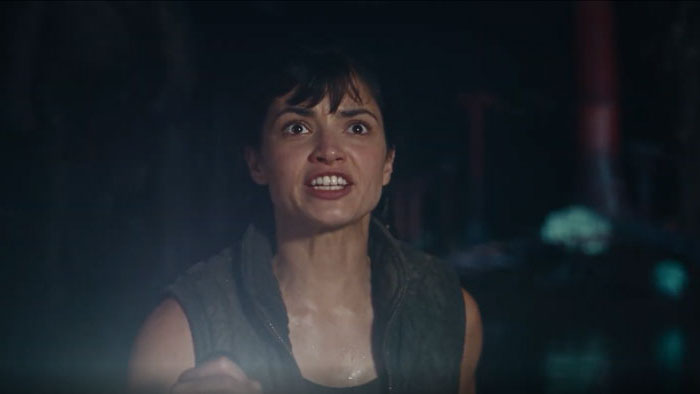
A frightened woman stares into a beam of light in a dark space in The Seven Books.
“Then came seven books that split the world into seven kingdoms.”
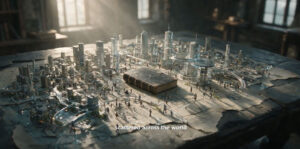
Let’s say the AI debate isn’t even close to over. I’ve been reviewing AI films for a while, and admittedly, they’ve gotten better every year in visual integrity and beauty. The Seven Books shows off both. The locations, character designs, and world-building are stunning, and the details are breathtaking. The opening animated introduction feels like something out of a classic fantasy epic, presenting history like a living diorama. The film starts in a fantasy world, shifts into a futuristic fantasy world, then moves into the main story, and the AI is scary good throughout. Even the characters stay consistent from scene to scene, which was a complaint of mine when AI films first came out.
However, the AI still falls far short when it comes to character performances. It just feels like lines are being delivered by robots. There’s no nuance, and it rarely feels authentic. These are not real people. The film also struggles to create smooth transitions. I’m not sure how much of the story is AI-driven, but with seven books representing seven kingdoms in a short film, it’s hard to keep track of which kingdom is which. I can only name two of the seven kingdoms, and I couldn’t tell you which book belongs to which. But there is potential for something greater. What The Seven Books does well is set up a potentially larger story, like Game of Thrones, but in a futuristic fantasy setting.
Walking away from The Seven Books, I feel that human performances are the next big hurdle to cross. I doubt AI can truly give an Oscar-winning performance, but will it be good enough for audiences? Story-wise, I’m intrigued by what The Seven Books offers as a bigger epic, but it will need more human intervention to tell a well-paced, pleasing story.
For more information, visit the The Seven Books official Instagram page.

"…Let’s say the AI debate isn’t even close to over."