THE WILD BUNCH FILM FESTIVAL 2026 REVIEW! Standing out like a burning billboard on the road to movie heaven is the earth-shaking experimental Western feature The Last Outlaw, directed by the maverick auteur Theodore Carl Flood, who adapted the short story by D. Preston Davidson for the screenplay. Set in 1913, the film opens one morning in Texas, with the farmer (Robert Antonelli) and his wife (Karen Hidey) getting the coffee going before he hits the wheat field. All the businesses in downtown Electra open up for the day, with Glenda (Glenda Cottle) setting up her photography shop, and the movie theater starting showings of The Great Train Robbery for a nickel. In front of the movies, a Creek native boy (Memphis Carrizales) does a tribal dance. An old cowboy (Dayton Geotz Sr.) strolls along and starts twirling a pair of toy pistols in time with the dancing.
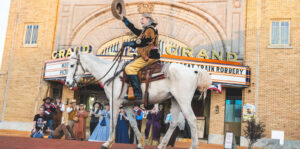
In front of the Grand Theater, there is a sign for auditions for the Wild West show, run by Buffalo Bill Cody (D. Preston Davidson), and starring Annie Oakley (Gigi Davidson). Glaring at the sign is Brushy Bill Roberts (David Butterfield), who then moves on. Inside the Grand, Cody and Oakley sit in the rear seats while different actors try out for parts. After watching the less-than-stellar work like that of the two would-be stagecoach robbers (Norman Butterfield, Vernon Butterfield), Cody wonders out loud to Oakley why anyone would give them 25 cents to watch this show when they can see a movie for a nickel. Determined to go out with a bang, Cody and Oakley prepare to give Electra a show they have never seen the likes of.
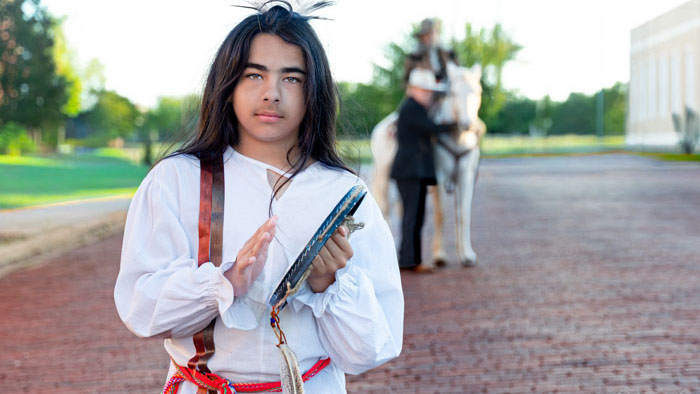
A Creek native boy (Memphis Carrizales) stands in the streets of Electra in The Last Outlaw.
“…there is a sign for auditions for the Wild West show, run by Buffalo Bill Cody, and starring Annie Oakley.”
Even though it is literally my job to describe things, it is difficult to describe the awe that washed over me during the 46 minutes of The Last Outlaw. I haven’t felt like this since Paris, Texas wrapped its slow neon glow around me back in the 80s. Like sunsets on a Western horizon, Flood gives us shots that are long, languid, and beautiful. By employing the long take methods used in the slow cinema movement, Flood has unleashed hidden geysers of emotional resonance in the Western picture. There is this sequence where Gigi Davidson is practicing shooting in a vacant lot that spoke to me volumes about the resilience of style. Reality gets torn open with each gun blast, with Davidson showing how legends change the air around them.
During the first act of The Last Outlaw is the magnificent tribal dance sequence, with Carrizales mesmerizing the viewer with his fantastic footwork. Twinned with the gun twirling by Geotz Sr., the visual impact of these two in front of the movie theater hits like lightning. The impact then spreads out into reflection, as the camera follows the movement for many minutes, many more than the average viewer would expect. Flood sits back and lets everyone drink in the dance, until the dance takes on unsaid meanings of its own. This also goes for the third act twilight in the corral sequence. The long, uninterrupted take without dialogue allows something so momentous to be communicated that words fail while the visuals put it so eloquently.
“Like sunsets on a Western horizon, Flood gives us shots that are long, languid, and beautiful.”
That Flood utilizes this kind of visual vocabulary to apply to a Western tale is legendary unto itself. These are highly experimental techniques that are not seen in popular entertainment, so seeing the outcome of combining them is a revelation. The Last Outlaw is the most successful experimental film using cowboys ever made, easily besting Warhol’s dreary Lonesome Cowboys, while going even more into cowboy culture than Cremaster 2. Even Lynch’s whimsical The Frenchman & The Cowboy doesn’t go as far into unclaimed territory as The Last Outlaw does. That someone would even attempt this with a pop culture staple shows how much guts Flood has as a filmmaker, as well as his range of influences.
The more traditional sequences in The Last Outlaw have great comic timing, which provides needed seasoning between the experimental sequences. Like Wes Anderson, Flood knows when it is time to be droll, as that releases the pressure created by the great moments. Norman and Vernon Butterfield pull off some of the best non-acting acting I have seen; they are a laugh riot. The haunting final sequence with David Butterfield is a great example of the two tones being combined, with a slow gaze that cracks wise at the end. D. Preston Davidson kills it as Buffalo Bill Cody, as he shows the audience how a legend glows in the dark. Bursting with innovation and overflowing with talent, The Last Outlaw shows how our Wild West past is entering an even wilder future.
The Last Outlaw screened at the 2026 The Wild Bunch Film Festival.

"…the most successful experimental film using cowboys ever made..."