Opening Night: A Legend Is Honored
CinemaCon 2026 opened under the roof of Caesars Palace with Michael O’Leary, President and CEO of Cinema United, presiding over the evening’s ceremonies. The annual gathering — the world’s largest convention of theatrical exhibitors — kicked off with one of its most emotional tributes in recent memory.
The honoree was Ellis Jacob, President and CEO of Cineplex, Canada’s preeminent entertainment company, who was presented with the Legend of Cinema Award — only the second person ever to receive the distinction, following the legendary Martin Scorsese. O’Leary lauded Jacob as a leader, builder, and innovator whose decades in exhibition helped bring the moviegoing experience to corners of the world few others had reached. Jacob, who is set to retire this year after more than two decades at Cineplex’s helm, was visibly moved.
Sony Takes the Stage: Rothman’s Olympic Challenge
Sony Pictures entered the Colosseum at Caesars Palace with a declaration: This is going to be an Olympic year for movies.
Tom Rothman, Chairman and CEO of Sony Pictures Motion Picture Group, opened the studio’s presentation with a rallying cry framed around the Paris Olympics spirit — “Faster. Higher. Stronger.” — while simultaneously challenging theater owners to step up alongside the studios or risk losing the ground they’ve been trying to reclaim since the COVID pandemic reshaped the industry.
Rothman was blunt about the challenges. Admissions are still down from their pre-pandemic highs. The industry, he said, must deliver variety to diverse audiences — families, action fans, anime enthusiasts, and everything in between. But he placed equal responsibility on the exhibitors themselves, offering a pointed three-part directive:
Rothman’s Olympic spirit had a hard edge to it. He then laid out a three-part prescription for saving the theatrical business, and he didn’t sugarcoat it. Longer: enforce longer exclusivity windows and stop ceding ground to streaming before a film has had time to breathe in theaters. Shorter: cut the bloated pre-show advertising that turns a night at the movies into a gauntlet of commercials before a single frame of film rolls — “Get off the ad crack,” he said, to knowing laughter from a room that knows exactly what he means. Cheaper: make tickets and concessions affordable enough that moviegoing feels like an option again, not a luxury. Rothman was clear that none of this would be painless for studios or exhibitors alike. But he framed it as a shared obligation — Sony would hold up its end of the bargain with a diverse, ambitious slate, and he expected theater owners to make the hard calls on theirs. “Now is the opportune time,” he said. “Together.”
“It’s not going to be easy. Now is the opportune time. Sony must hold up their end — and so will you. Together.”
With that, Sony’s slate unfurled — and it was formidable.
The Films: From Spider-Man to Open World
Sony’s presentation spanned theatrical genres with the ambition of a studio swinging for the proverbial fences — a phrase that Sanford Panitch, President of Sony Pictures Motion Picture Group, used explicitly when he took the stage later in the evening.
The presentation opened with a surprise: comedian and first-time film star Nate Bargatze, who introduced The Breadwinner, his feature film debut. Bargatze leaned into the meta-joke, acknowledging that he wanted to make sure his first movie wasn’t also his last, and making a straightforward appeal to the audience: he wants to sell tickets. He was joined on stage by his movie wife, Mandy Moore, for a special look at the film. The Breadwinner is a warm, commercially savvy family comedy aimed squarely at the kind of audiences studios and exhibitors most want to bring back to multiplexes.
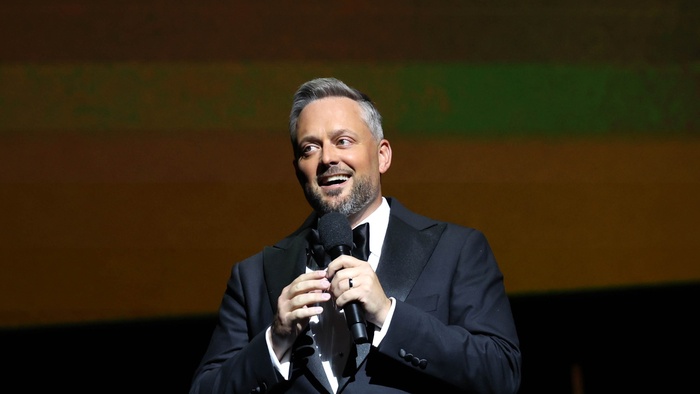
Nate Bargatze appears onstage to present The Breadwinner at CinemaCon 2026.
The biggest Columbia Pictures title in Sony’s history followed. Spider-Man: Brand New Day — the direct sequel to the billion-dollar No Way Home — has already broken records before a frame has been shown theatrically. Its trailer became the single most-watched in history, crossing one billion views in under a week. Directed by Destin Daniel Cretton (Shang-Chi and the Legend of the Ten Rings) and produced by Kevin Feige and Amy Pascal, the film features what Rothman called “Tom Holland’s finest performance.” Holland himself appeared — via hologram — in a moment that electrified the room, followed by an eye-roll.
A clip followed, placing Peter Parker and Ned at a party. This version of Spider-Man is older, more grown-up, and dealing with genuine consequences. MJ has moved on. There’s a “Spidey Tracker” Peter has built in secret. The tone is markedly different — these are young adults now, navigating a world that’s moved on without them. The audience was told “It’s the most emotional Spider-Man yet, and perhaps the most cinematic.”
Adam Bergman, President of Sony Pictures Distribution, introduced the next chapter of the Insidious franchise: Insidious: Out of the Further. The trailer centers on a woman with the terrifying ability to drag demonic entities back from the spirit world into the living one — a concept that promises to be the franchise’s most frightening entry.
Sony made a strong statement about the theatrical potential of anime. The Demon Slayer franchise has now generated over $800 million globally, and with CrunchyRoll as a distribution partner, anime’s appetite for the big screen is only growing. The next theatrical release in the That Time I Got Reincarnated as a Slime franchise was highlighted as a key title in an expanding anime theatrical business — one that Sony is positioning itself at the center of.
Zach Cregger — who directed Barbarian and has rapidly become one of horror’s most exciting voices — stepped onto the stage to present his Resident Evil reboot. Cregger spoke about his lifelong love of the game franchise and his intention to take a singular protagonist from point A to point B across one terrifying, relentless night. “Big scary ride,” he said. “In Dolby Atmos.” First-look footage was screened to an enthusiastic response.
Nicole Brown, President of TriStar Pictures, took the stage to present the label’s upcoming slate, which she framed around ambitious adaptations driven by complex female stories.
First up: Klara and the Sun, directed by Taika Waititi and starring Jenna Ortega as Klara — a solar-powered artificial being chosen by a young girl named Josie to be her companion. Based on the Kazuo Ishiguro novel, the film is a quiet, emotionally rich sci-fi drama about what it means to be seen and to be chosen. A first look was screened for the audience.
TriStar also announced a release window for The Nightingale, based on Kristin Hannah’s beloved and phenomenally successful novel. Starring Dakota Fanning and Elle Fanning — the first time the sisters have appeared on screen together — the film centers on two sisters finding hope and courage in the face of Nazi occupation during World War II.
Sanford Panitch, taking the stage to assert that Sony intends to “swing for the fences,” introduced one of the presentation’s most unexpected reveals: Grandgear, a massive kaiju vs. giant-robot spectacle directed by Takashi Yamazaki — who helmed the Academy Award-winning Godzilla Minus One — and produced by J.J. Abrams and Bad Robot. Early footage suggested a visceral, ground-level perspective reminiscent of Cloverfield, unsurprising given Abrams’ involvement. The film is set for release on February 18, 2028.
Production has officially wrapped on the live-action Legend of Zelda, directed by Wes Ball (the Maze Runner franchise) and produced with the involvement of the game’s original creator. Sony also announced an R-rated animated adaptation of FromSoftware’s gothic PlayStation masterpiece Bloodborne, co-produced by Seán McLoughlin — better known to tens of millions as Jacksepticeye — through his Lyrical Animation banner. The announcement was met with an eruption of enthusiasm from the room.
Justin Lin stepped onto the stage to present Helldivers, the live-action adaptation of the bestselling cooperative shooter game starring Jason Momoa. Lin described his approach in terms that should resonate with both fans of the source material and general audiences: action-packed, character-driven, and grounded in relatable themes that balance the game’s sharp satirical edge with genuine humanity. Lin said he played the game extensively and spoke directly with the “rabid fans” who made it a cultural phenomenon. Production is based in New Zealand, with a November 2027 theatrical release.
Perhaps the most galvanizing moment of Sony’s presentation came when Aaron Sorkin walked on stage to introduce The Social Reckoning — a companion piece to his landmark 2010 film The Social Network. The new film, written and directed by Sorkin, centers on engineer-turned-whistleblower Frances Haugen (played by Mikey Madison), who partners with Wall Street Journal reporter Jeff Horwitz (Jeremy Allen White) to expose the most guarded secrets of Mark Zuckerberg’s social media empire. Jeremy Strong stars as Zuckerberg, an older, more powerful version of the character than audiences saw in 2010.
The footage was screened, and it crackled with the verbal precision and moral urgency that define Sorkin’s best work. “What is this girl doing?” the footage seemed to ask. “She’s disrupting.” The Social Reckoning opens October 9, 2026.
Sony Pictures Animation: Sequels, Spiders, and Talking Plants
Kristine Belson, President of Sony Pictures Animation, opened her portion of the presentation by thanking theater owners for their support of the studio’s recent releases, then turned to what’s ahead.
Two new animated features were teased. Buds is a comedy set in a secret world of plants — a world where the cardinal rule is never to speak to a human. When one brave hero breaks that rule, the results are comic and consequential in equal measure. K-Pop Demon Hunters 2, the sequel to the record-breaking Netflix animated hit, was also confirmed, with Belson signaling that the creative team intends to push even further, bolder storytelling, more personal, with a mandate to make choices that might make people uncomfortable.
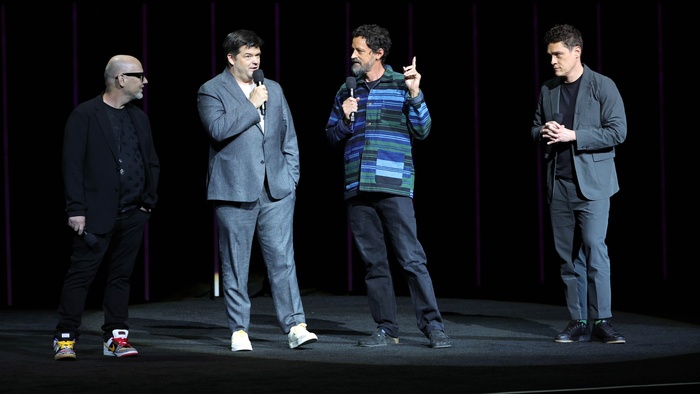
The Spider-Verse creative team appears onstage at CinemaCon 2026 in Las Vegas.
Belson then brought out the creative core of the Spider-Verse: producer-directors Phil Lord and Chris Miller, alongside fellow creative architects Bob Persichetti and Justin K. Thompson, to introduce footage from Beyond the Spider-Verse. The room was treated to early material presented in PLF format — a deliberate choice, given the film’s commitment to reimagining what theatrical animation can be. Miles Morales returns for what Lord and Miller called “the most emotional Spider-Man story ever told.” Miles, they promised, will first have to face himself before he can face anyone else. There is no rule book. Early footage confirmed the jaw-dropping visual ambition that the franchise has made its signature.
Jumanji: Open World — Closing the Show
Jake Kasdan, who has directed all three Jumanji films in the rebooted franchise, returned to introduce Jumanji: Open World — and he brought friends. Dwayne Johnson, Kevin Hart, and Jack Black took the stage together in what became a raucous, profanity-laced celebration of a franchise that has become one of Sony’s most dependable properties.
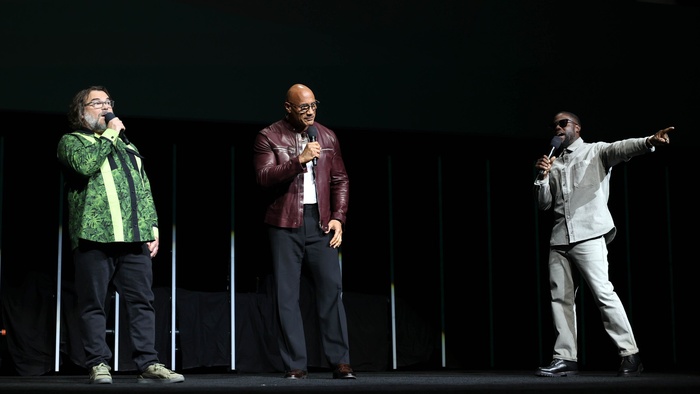
Jack Black, Dwayne Johnson, and Kevin Hart take the stage during the CinemaCon 2026 presentation for Jumanji: Open World in Las Vegas. The image reflects the big-event energy of a major studio theatrical presentation.
Black, clearly enthusiastic about the project, said the franchise “means a lot” to him, adding that working on it gets more fun each time. “It’s gonna be wild,” he said. The new installment flips the series’ central conceit: rather than the characters being pulled into the game, the world of Jumanji — in a kind of “demo mode” gone catastrophically wrong — spills out into reality. For the first time, the human characters and their avatar counterparts will exist in the same world simultaneously. A tribute to Robin Williams was woven into the presentation, and one of the original dice from the 1995 film was confirmed to play a role in the story.
Jumanji: Open World opens Christmas Day, 2026 — and based on the temperature in the Colosseum when that footage played, Sony’s holiday season looks very bright.