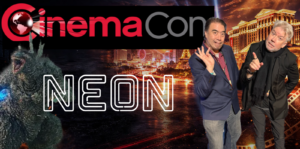
The second day of CinemaCon 2026 opened with the annual State of the Industry presentations before handing the stage over to Neon for one of the convention’s most buzzworthy showcases. Here’s a full recap of everything that went down.
GKIDS: Bringing the World’s Best Animation to American Theaters
The morning kicked off with GKIDS, the studio dedicated to bringing the finest in worldwide animation to North American audiences. Dave Justice, President of GKIDS, set the tone by reaffirming the studio’s core mission: delivering the best of global animation to theaters and introducing a new generation of moviegoers to the theatrical experience.
The headliner of GKIDS’ presentation was the highly anticipated Godzilla Minus Zero, and the studio brought the man behind it all — Academy Award-winning director Takashi Yamazaki — to the CinemaCon main stage for the very first time.
Yamazaki, who took the stage with genuine humility and immense gratitude for the Oscar his previous film earned, described how Godzilla Minus One was halted during the pandemic and nearly canceled entirely. That history made its ultimate success all the more meaningful — and all the more reason to go bigger the second time around.
“This film will be a direct sequel to Godzilla Minus One,” Yamazaki told the crowd through a translator. “It will continue to follow the story of the Shikishima family.” He added, “An even deeper despair will descend upon Japan and the Shikishima family. The journey from Minus to Zero will not be an easy one.”
Yamazaki spoke with conviction about the theatrical experience, emphasizing that films like this are meant to be seen on the big screen. Godzilla Minus Zero makes history as the first Japanese film shot with IMAX cameras — a deliberate choice to push both the audience and the technology to their absolute limits, capturing the sheer terror and immensity of Godzilla in a way no home screen could contain.
The presentation closed with behind-the-scenes footage and an electrifying first look at the film — culminating in an iconic image: Godzilla reaching the Statue of Liberty.
Godzilla Minus Zero — A direct sequel to the Oscar-winning original, following the Shikishima family into even deeper despair as Japan faces an inescapable, overwhelming force. Opening November 6.
Motion Picture Association: Trust, Copyright, and the Future of Film
Charles “Charlie” Rivkin, Chairman and CEO of the Motion Picture Association, took the stage with a quip that landed perfectly: “I thought I’d bring some positive DC vibes to Las Vegas.” The line drew laughs, but his message was serious and wide-ranging.
Rivkin addressed the ongoing fight to keep U.S. film production on domestic soil, championing state production subsidies and calling for a federal film tax incentive — a pitch he framed as vital to Hollywood’s economic future under the current political climate. He touched on President Trump’s Hollywood ambassadors as part of that broader ecosystem.
On the subject of audience trust, Rivkin declared that MPAA ratings remain among the most trusted systems in American life, cited by 97% of parents. He pledged to protect that trust by keeping the industry free from censorship and maintaining the integrity of the ratings system. In a notable win, he announced that Instagram and its parent company Meta had agreed to the content limits the MPA demanded, following a hard-fought battle over the integrity of age-appropriate ratings.
Copyright was another major pillar of his address. “Copyright is the lifeblood of this industry,” Rivkin said, adding that innovation has always been part of the industry’s DNA. Every time a new technology threatened Hollywood — and there have been many — the industry found its way through. He sees AI as no different, but only if it is developed responsibly. The message was unambiguous: you cannot train AI on stolen copyrighted material. He noted that TikTok’s parent company, ByteDance, had taken the MPA’s feedback seriously and developed guardrails accordingly.
Rivkin closed on a note of purpose: “Cinema helps us grasp perspectives we thought we could never grasp.” Trust, innovation, and creativity — he called them the twin pillars and vital foundation of America’s cultural future.
Cinema United: The Theatrical Experience Is Thriving
Michael O’Leary, President and CEO of Cinema United, delivered an impassioned address grounded in one of his core beliefs: “Film was not born in the United States, but it is where it grew up. The world talks to each other through movies.”
O’Leary’s message to theater owners was an optimistic one. He pointed to original films as a major driver of 2025’s success, with five of the year’s top ten performing films rated PG — a sign that theaters are once again becoming a destination for the whole family. Gen Z attendance is on the rise, up 25%, and among that demographic, going to the movies ranks as the number one social activity.
The first quarter of 2026 has already shown strong momentum, boosted by Project Hail Mary, Hoppers, and Super Mario Galaxy. O’Leary emphasized Cinema United’s ongoing efforts to help theaters not just survive, but genuinely prosper — framing the theatrical experience as an irreplaceable community event that no streaming platform can replicate.
Dolby: Premium Formats Are Having a Moment
Jed Harmsen, Head of Cinema and Group Entertainment at Dolby Laboratories, highlighted a banner year for the Dolby experience. Over 860 films were presented in Dolby Vision and Dolby Atmos during the past year, delivering the highest box office returns the format has ever seen. Dolby also celebrated the opening of India’s first Dolby Cinemas — a milestone reflecting the format’s growing global footprint.
Harmsen underscored a clear trend: audiences are actively choosing premium formats more than ever before, a signal that moviegoers want the best possible experience when they make the trip to the theater.
Neon: Originality Is the Business
Elissa Federoff, Chief Distribution Officer of Neon, opened the indie studio’s presentation by tracing an unlikely journey — from six people at a WeWork in 2017 to a global studio with genuine awards muscle and a growing theatrical footprint. The through line? Ambition, originality, and an unwavering belief in great filmmaking.
Federoff noted that Neon has leaned into mid-budget genre films — horror, romance, genre-bending originals — and the result has been a quarter billion dollars at the global box office. The message going forward: take even more daring swings.
And the slate she unveiled made a strong case that Neon is doing exactly that. Every single film in the presentation is an original.
Hokum
Director Damian McCarthy presented this supernatural horror film set at a haunted hotel, earning comparisons to The Shining from the moment the first images appeared on screen. Then Adam Scott walked onstage — and the room went electric.
Scott, who was just announced as the winner of the CinemaCon Award of Excellence in Acting, received a massive response from the crowd of theater owners. He spoke about being drawn to movies as a kid — not sports, not anything else — just movies. Horror in particular. He described the unique power of the genre: its ability to insert an image directly into your mind, a kind of third rail that no other type of storytelling quite reaches.
“Hokum,” he explained, means nonsense — and his character makes the fatal mistake of non-belief. The new trailer confirmed plenty of scares and that intangible quality Scott described. It is a proper haunted house story, built to terrify.
Hokum — A novelist retreats to a remote, haunted inn and confronts terrifying supernatural forces after his dangerous skepticism leaves him utterly defenseless. May 1.
I Love Boosters
Boots Riley (Sorry to Bother You) stepped on stage to present his latest, and by his own description, it is the biggest swing of his career so far. The film follows a crew of shoplifters called the Velvet Gang as they set their sights on taking down the fashion industry — with the kind of verve and political energy that made Sorry to Bother You an instant cult classic. LaKeith Stanfield joined Riley on stage.
“This movie will make you feel,” Stanfield said. “So much that you’ll catch something different every time you see it.”
Riley described building I Love Boosters as a visceral roller coaster — a bigger production than Sorry to Bother You, based on a song Riley wrote of the same name. He was visibly energized on stage. So energized, in fact, that he had to be coaxed off it.
I Love Boosters — A sharp and stylish Boots Riley film following the Velvet Gang, a crew of shoplifters on a mission against the fashion industry. May 22.
Leviticus
One of Neon’s most talked-about acquisitions out of Sundance, Leviticus is a queer horror love story built on a chilling premise: an entity that takes the form of whatever two people describe most — and in this case, that’s each other.
Leviticus — A Sundance queer horror love story in which a terrifying entity takes the form of what two people desire most — one another.
A Place in Hell
Director Chloe Dumont brings a psychological thriller starring Daisy Edgar-Jones, Andrew Scott, and Michelle Williams to screens on Christmas Day. The film explores control — the lenses through which people seize it, lose it, and reclaim it. Williams plays a lawyer whose cases are handed off to a new colleague while she goes on maternity leave. As Federoff put it with a wry smile: “Sometimes a box full of shit makes a great gift.”
A Place in Hell — A psychological thriller exploring power and control, as a lawyer returns from maternity leave to find her world upended. December 25.
Hope
Neon closed with a late acquisition that had the room buzzing: Hope, described as their next great Korean pickup. A pulse-pounding sci-fi action thriller starring Michael Fassbender and Alicia Vikander, the film follows a local incident that escalates into something far beyond what anyone could have anticipated. An exclusive clip screened for the audience.
Hope — A pulse-pounding Korean sci-fi action thriller starring Michael Fassbender and Alicia Vikander, as a local incident spirals into something terrifyingly larger.
The Bottom Line
If there was a theme running through the entire day — from GKIDS to the MPA to Cinema United to Dolby to Neon — it was this: the theatrical experience is not just surviving, it’s evolving. Audiences are hungry for premium formats, for community, for films that can’t be replicated at home. And Neon made the clearest possible argument for why originality is the engine driving all of it.
As Federoff put it: the future is based on original filmmaking. Every film Neon is bringing to theaters is proof of that belief.
Reporting from CinemaCon 2026, Caesars Palace / The Dolby Colosseum, Las Vegas.