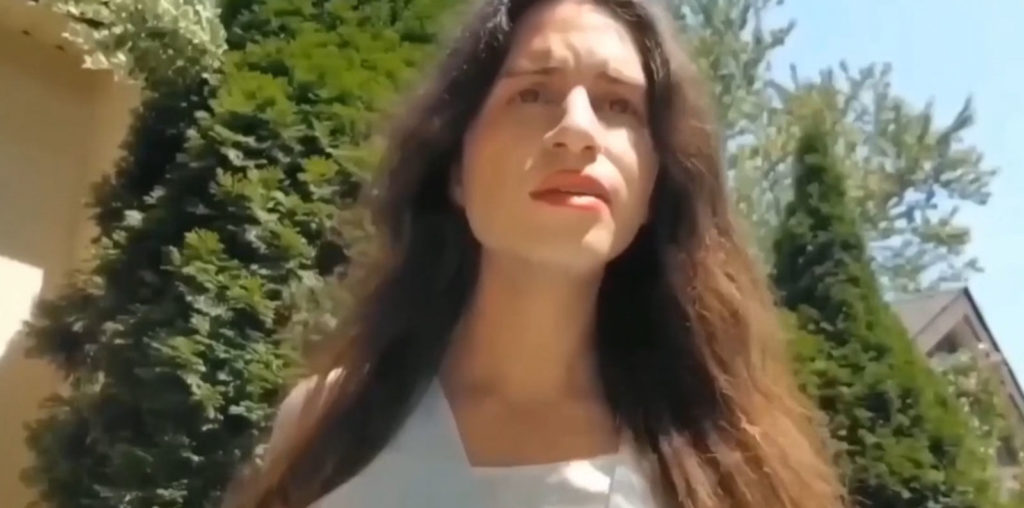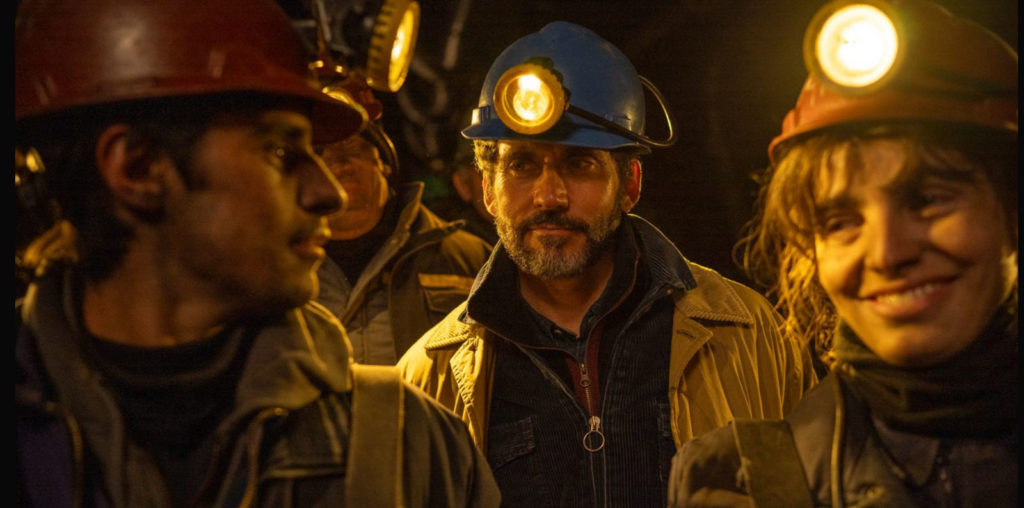
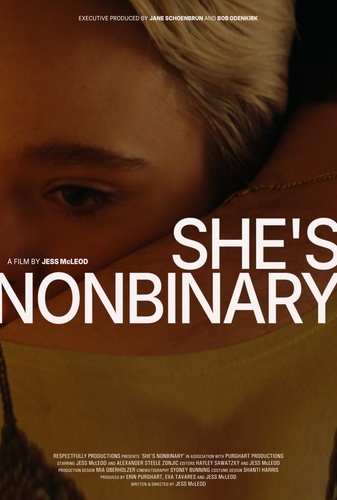
Nonbinary trans writer / director / star Jess McLeod plays Max, who is also nonbinary and trans, in their short film She’s Nonbinary. An accidental misgendering by their straight, cisgender male boyfriend, Jake (Alexander Steele Zonjic), sparks a relationship crisis. Max is scheduled for top surgery, and Jake is in an unexpected last-minute panic about that. Jake is more concerned with being a supportive ally than he is examining and confronting his own feelings.
He can’t accept that he sees Max as a woman. Up until now their nonbinary trans identity was only conceptual, but Jake hits a wall about the physical change. If he was honest with himself and with Max, he would have already concluded that they can’t continue as a couple because his sexual map is coded to female bodies and personalities. He sees this as a character flaw.
Max accuses Jake of not wanting to be seen as gay / bi or anything other than straight, but that’s not it. His self-deception is not admitting that he is sexually and romantically straight as an arrow. Whether he was lying to Max or to himself, Max should have at least been curious about what his ultimate, visceral reaction would be. The expectation that Jake would roll with it and things would be the same was naive. The betrayal and rage Max feels is mirrored in Jake’s shame and fear. Reality hits like a merciless sledgehammer.
This is painful because Jake desperately wants to be the good guy, progressive and forward-thinking, but he is ambushed by his own caveman heterosexuality. He is a heterosexual cisgender male, just as Max is a nonbinary trans person. Jake has a complete meltdown because he does in fact, genuinely love Max.
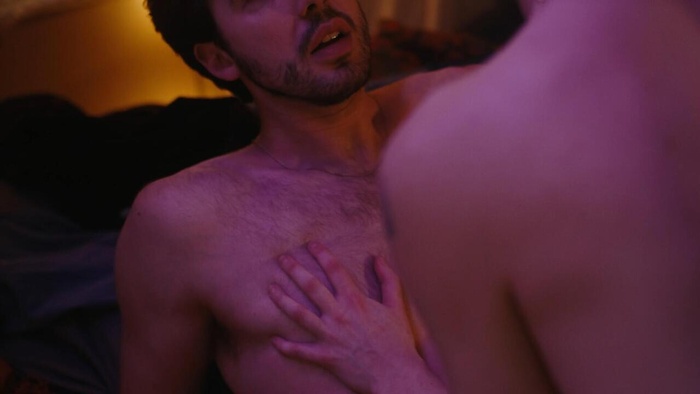
“… Max is scheduled for top surgery, and Jake is in an unexpected panic…”
As long as we’re being candid here, as a cisgender het-male myself, the change is especially hard to accept because McLeod’s female body is as hot as fire. We can’t address these issues if we never drag them into the light (as demonstrated by the film). Despite best intentions, deep down, we’re all pretty shallow. Perhaps it’s more accurate to say we need to acknowledge our core selves. Mistakes were made. Lessons were (hopefully) learned.
McLeod said in an interview with Gayety magazine that the incident is pulled from real life. “It’s something that’s happened to me, and I know so many people that have had a similar interaction with a partner.” They also said their plan to have the real surgery put pressure on the production. “There was such a tight timeline because I knew I was getting surgery.”
The details and working mechanics of straightness haven’t been traditionally explored. Growing up expected to be binary means the roles are dictated and one need not look too deeply. Of course, this mode of thinking was never authentic. As we move into a more openly accepting culture, everyone will find it crucial to genuinely interrogate their own place on the spectrum in terms of who you are and what you want. McLeod and Zonjic bring to bear a startling depth of raw emotion in this brief moment of incandescent cinema. A viewer who doesn’t hurt for both Max and Jake is not in good emotional working order. The film is positioned as dark comedy, but the humor is lost on me.
Executive producing support comes from Bob Odenkirk (McLeod appeared in his film Normal) and Jane Schoenbrun, director of I Saw the TV Glow. Schoenbrun said “She’s Nonbinary bravely confronts the silent stuff that never gets talked about in this particular relationship dynamic…”
"…bravely confronts the silent stuff that never gets talked about"