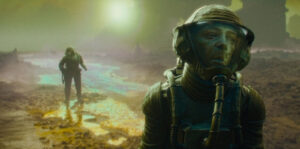
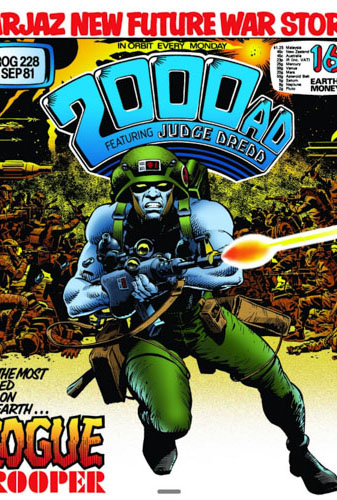
BFI LONDON FILM FESTIVAL 2026 REVIEW! Rogue Trooper, the hero of writer/director Duncan Jones’s kaleidoscopic, intergalactic new war movie first debuted in the British sci-fi comic, 2000 AD. Written by Gerry Finley-Day, a veteran of both the 70s WW2 Commando comics and the actual paratroop regiment, the original strip was brought to life with exquisite, pitch-black art from maestro Dave Gibbons.
Rogue was the last genetic infantryman, a lab-bred, blue-skinned, white-eyed ronin on a quest for revenge against the traitorous general who killed the rest of his kind. Built to survive the poisoned planet Nu-Earth, site of an endless war between the ‘Norts’ and ‘the Southers,’ Rogue was also custodian to the talking backups of killed squad mates augmented into his kit. He made a classic hero, a stark figure bullshitting with his dead buddies under the inky black skies of a planet devoted to death.
So does Jones have the same sure touch in deep space that he showed in Earth’s orbit with his pimped-out 2009 paranoia trip, Moon? Well, no, if you’re looking for that film’s simplicity or the strip’s pre-grimdark 70s war comic vibe. But if you’re after great slabs of prime 2000 AD rendered perfectly for the screen, then this has your back.
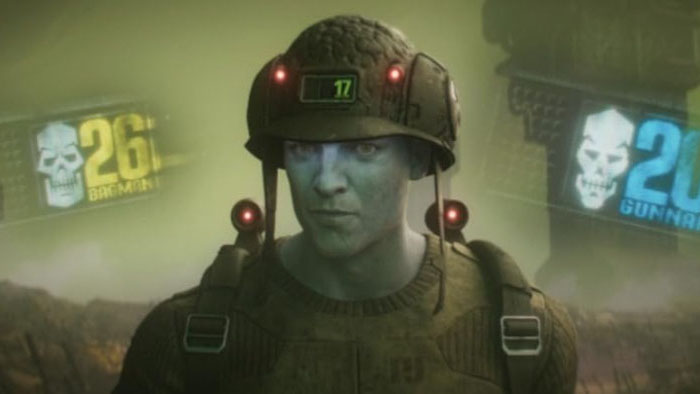
Rogue (Aneurin Barnard), Bagman (Reece Shearsmith) and Gunnar (Jack Lowden)
“Rogue was the last genetic infantryman, a lab-bred, blue-skinned, white-eyed ronin on a quest for revenge against the traitorous general who killed the rest of his kind.”
Things get off to a great start in an opening planet drop scene, where Rogue and the rest of his squad hurtle through enemy fire and the fiery atmosphere of Nu-Earth while the space station bound brass (the dually delicious Sean Bean and Diane Morgan) squabble over a cricket ball. This immediately foregrounds perhaps this film’s chief virtue: 2000 AD had an arguably better roster of villains and grotesques than its endlessly filmed stateside brethren at DC and Marvel, and their presentation here does nothing but intrigue as to the animated and live-action possibilities for further stablemates. The cast is a mad roster of vivid, freaky characters, with plenty of standouts, but lead Aneurin Barnard grounds things very nicely indeed as Rogue, his softly spoken Welsh accent used pointedly to set him apart.
Nu-Earth looks spectacular, with guns the size of mountains, the first assault on one thrilling. Although this is also where the story begins to trip over itself. When we are introduced to Rogue’s buddies, Helm, Bagman, and Gunnar, they are still in corporeal form, only to inevitably die to get integrated into his kit. The strip only called back to this action once the ongoing story was set, but here it is rewritten as dramatically throttled oscillations from three key deaths presented by way of introduction.
There was always a sweetly naff clunkiness to the implausible interactions between Rogue and his talking gun, helmet and pack in the comic, and that survives here. Bagman (Reece Shearsmith), Gunnar (Jack Lowden) and Helm (Daryl McCormack) season the trio with a ton of inventive sauce, but not much of the dialogue between them felt effective, rather crowding the inherent pathos.
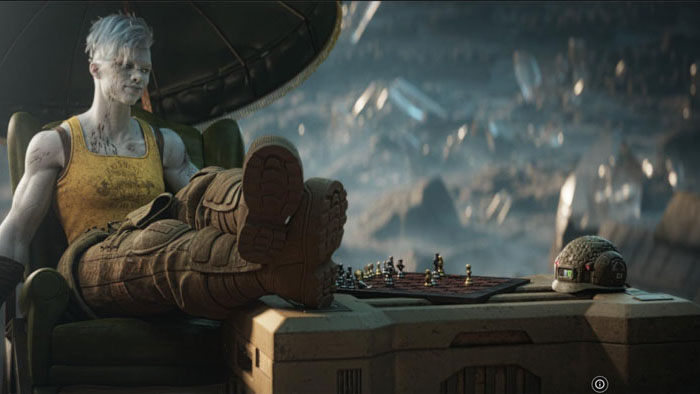
Venus Blue Genes (Hayley Atwell) at play with Helm (Daryl McCormack)
“…if you’re after great slabs of prime 2000 AD rendered perfectly for the screen, then Jones has your back.”
The strip was endlessly fascinated by the conceits and wonky arithmetic of war, with each issue revelling in new, foul forms of weaponry. And Rogue Trooper gets this, with a ton of novel death and treachery motivating things. But since Gibbons’s artwork was so masterfully graphic, the look here, a comparatively diffuse rainbow of nonetheless glorious particle effects (superb work from boutique, Bournemouth-based UK effects studio, Treehouse) feels less fitting than Moon‘s earlier, monochrome Moonage Nightmare (Jones is David Bowie’s kid) of a dead landscape. But then the film looks like 100 million bucks when estimates have it at less than 20. Virtually the entire (comparatively leisurely, four-year) production took place within the video game software production suite, Unreal Engine, and it works, holding faith with and building out from the early, uncanny mocap promise of Beowulf.
That said, the tooling has problems still. There were not many affecting close-ups but a surfeit of ensembles and wider action, which sometimes shortchanged the payoff from the propulsive voice acting. However, the film feels like it learns what to do as it goes, and the visual style really snaps into place with the astonishing bruiser Venus Blue Genes (a terrific Hayley Atwell), possibly a token to proceedings but maybe the only girl boss you’ll ever care about.
I succumbed totally to this bright and fun interpretation. This is an entirely different animal to 2012’s Dredd, lighter and friendlier by far. It repeats the low-tech inspirations of 2000 AD itself, using the most democratic of tools. Everyone involved should be delighted with themselves. It’s definitely not perfect, but I can’t wait to watch it again.
"…the film looks like 100 million bucks when estimates have it at less than 20"