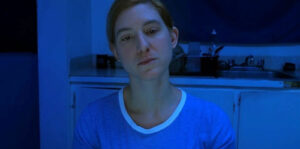
In Philippe Bourret’s short film, Red Tiles, late at night, a woman (Micheline Chartier) lies on her sofa, restless and putting off an important task. Necessity forces her to confront her computer as she stares at a blank screen and opens a blank document. Nothing comes, so she reaches for a pen and a notebook instead. That goes nowhere too. She searches Google for inspiration in the horror genre, scrolling through anything that might shake loose whatever is stuck inside her. When she finally starts typing again, the letters come out wrong — jumbled, useless.
Then, without warning, her nose starts to bleed. It’s just a drip at first, the kind of thing you tilt your head back for and wait out. But the blood doesn’t stop. It keeps coming, spreading, until it’s everywhere — on the keys, on the screen, on the floor. What starts as a quiet, creeping annoyance soon turns into a morbid coolness.
“…without warning, her nose starts to bleed. It’s just a drip at first, the kind of thing you tilt your head back for and wait out. But the blood doesn’t stop.”
Right off the bat, I loved Red Tiles because I didn’t know where it was going. The other reason is that the story grabs you, then leads you to the next plot element while lulling you into a false sense of security. A writer suffering from writer’s block starts bleeding from her nose. Now, a comedy sketch would just give you a Monty Python–esque scene where a flood of blood fills the entire room, but instead, it’s the woman’s reaction to the blood that is the pièce de résistance, and who doesn’t love a bit of nudity, too?
Red Tiles does what every short film must do: engage with your audience and carry them through your story right to the end. This is especially important when your story starts to go off the rails.
For more information, visit the Red Tiles official Facebook page.

"…I loved Red Tiles because I didn't know where it was going."