Writer/director Chloé Cinq-Mars’s Nesting is an emotional and poetic drama that pulls you into the fractured mind of a new mother, where exhaustion and isolation lead to a breakdown many mothers experience not long after the birth of their child.
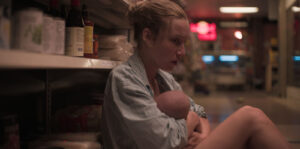
Pénélope (Rose-Marie Perreault) is a new mother waging an internal battle between exhaustion and love. She recently gave birth to a newborn who demands everything from her, and her husband, Gaspard (Simon Landry-Desy), who works all day and needs his sleep. Wishing Gaspard would attend to a midnight cry from the baby, she takes her child out for air and into a nearby liquor store. Before you know it, the store is being robbed, and when Pénélope looks at the robber, she recognizes her as her dead sister, Charlotte (Marie Bélanger). When the robber runs off, she heads home hysterical and blames Gaspard for not taking care of their baby.
What we see is that Pénélope is going through severe post-partum depression. Her doctor thinks the baby is too small. Her mother-in-law thinks she’s not breastfeeding enough and doesn’t have the heart to mention the pain from the baby’s teething. She insists on sleeping pills from her doctor, and Gaspard complains that she’s the lucky one because she doesn’t have to work all day.
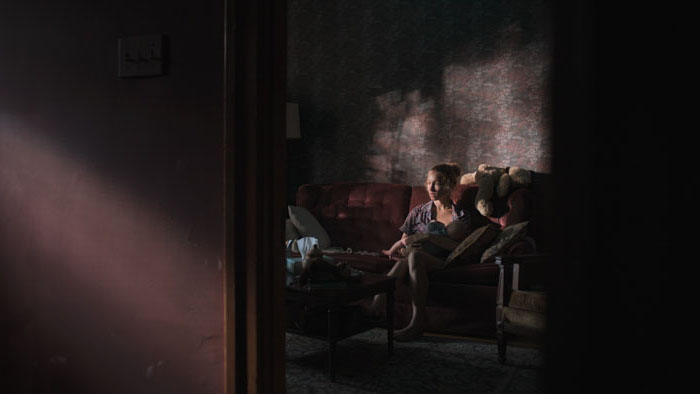
“…a new mother waging an internal battle between exhaustion and love.”
At her wits’ end, Pénélope visits an old friend, Edward (Saladin Dellers), at his gallery. Edward is instantly enamored by her beauty. After a massive blow-up with Gaspard’s mother, Pénélope returns to Edward for some comfort, and before you know it, advancements—a massage, a caress, and a kiss.
Watching Cinq-Mars’s Nesting is like a breath of fresh air. It reminded me of why I had problems with Nightbitch and If I Had Legs, I’d Kick You. I love comedies, but making post-partum depression a comedy can be problematic if done poorly, as in those two films. Nesting turns PPD into a piece of art and draws us into the situation through emotion and empathy. At no time did I feel pity or shame for Pénélope; I felt understanding of what she was going through.
It all works because of the script and Rose-Marie Perreault’s performance. Rather than being observers of Pénélope’s behavior, we are participants. The film guides us through her state of mind, her tragic past, and her relationship with Gaspard. There’s even a moment where we walk in Gaspard’s shoes as he tries to reconnect emotionally and physically with Pénélope, only to see him reach his breaking point. We see how she is led down a path that compromises her personal morals and the state of her marriage.
I love and will always recommend movies like Nesting because they give us a glimpse into a subject that I (and most of us) need more clarity on. I’m not saying I’ve become an expert on Post-Partum Depression, but I understand it in a way I didn’t before, and that it challenges what I thought about the subject and shapes my understanding of it today.
For screening information, visit the Nesting official website.
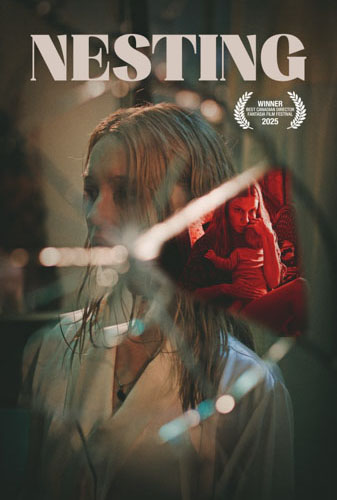
"…turns PPD into a piece of art and draws us into the situation through emotion and empathy."