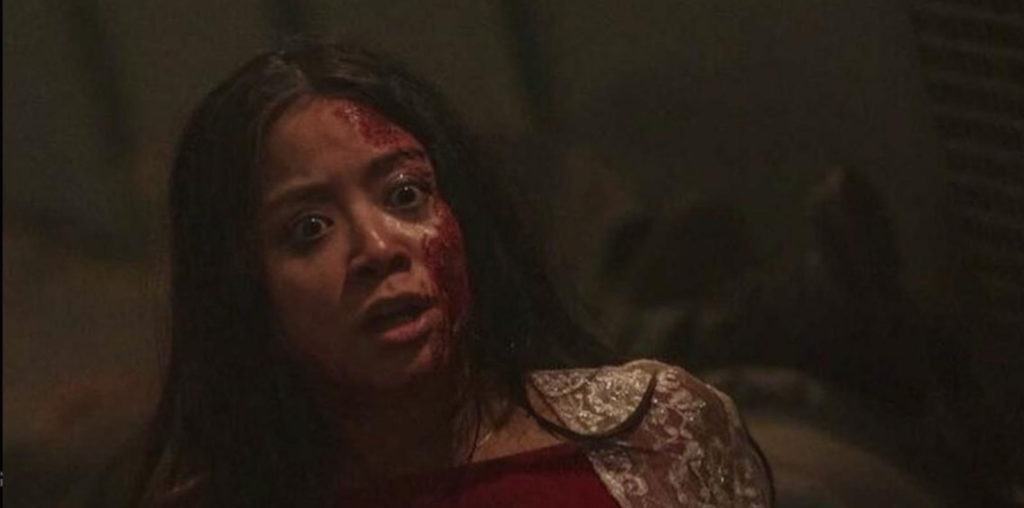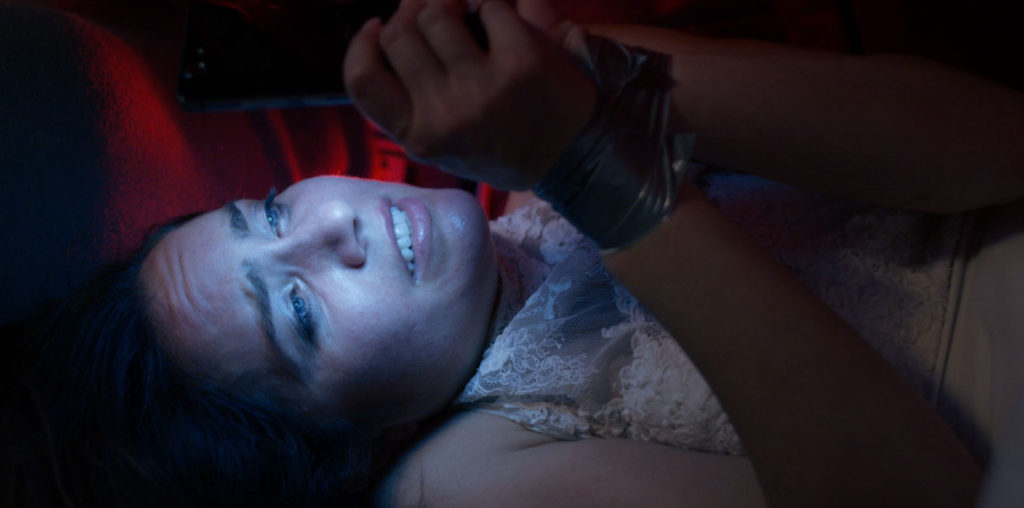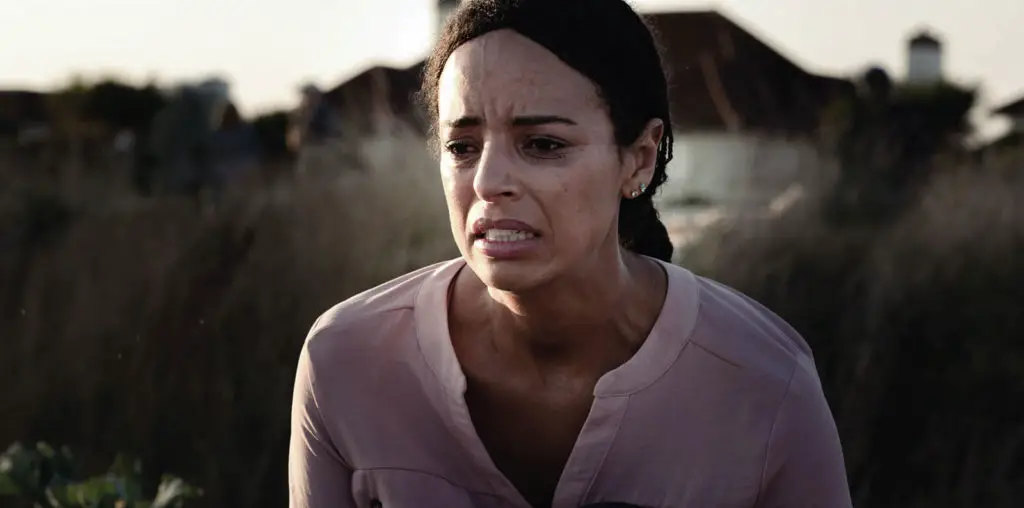
Director-writer Lou Ferrer rolls out an anxious, terrifying tale of abduction in his feature Mia. Aaron (Shah Motia) is a vagrant wanderer in a rusty pickup truck. He abducts 17-year-old Emma (Emiliana Jasper) and insists that her name is Mia. He tells her that he’s her father and that she was taken from him and his wife when she was a toddler. His mission all this time has been to find her and return her to her mother. Aaron is clearly disturbed, but what is unclear is whether he’s right that Emma (Mia) is his daughter. Emma doesn’t believe the story and thinks this routine is how Aaron abducts girls. Aaron talks incessantly, saying he’s been looking for her and that he wants to take her to his cabin. It seems this would all have been handled better with an email and a simple DNA test. Aaron may believe what he says is true but is mentally ill and deluded.
As the initial shock wears off, Aaron and Emma wind up talking as Aaron tries to convince her that she’s his daughter. There’s also the possibility, of course, that Aaron does have a daughter who was abducted, but he’s lost the plot and grabbed the first girl of matching age he found. When Aaron starts drinking, his story seems even thinner and his mind more fractured. When he talks to the woman who he says is Emma’s mother, she reminds him that their daughter had a funeral. In dealing with Aaron, Emma shows maturity and empathy beyond her years.

“…He abducts 17-year old Emma and insists that her name is Mia…”
Mia is atmospheric and moody. We see much of the action through Aaron’s eyes, and a throbbing drone in the soundtrack keeps the tension high. There are quick cuts of partial conversations, and the viewer is left to figure out for themselves much of the action, or what the action might be, it’s not clear if the story is being told in a reliable way. Are we getting the distorted reality of a mentally ill drifter? The narrative is a patchwork of tableaux that have several possible interpretations. The lighting is kept low throughout so that the viewer is literally kept in the dark. The film is intensely claustrophobic. Camera angles are forced into tortured positions, and a great deal of action takes place off-screen.
For most of the film, the viewer will imagine all the ways Aaron could be punished for this behavior. We wish for a John Wick hero to rise from the street and execute him. Does Ferrer want us to think about “parental rights” in this context? That’s possible, as the narrative is tilted toward not knowing if Aaron really could be Emma’s father. The possibility is teased that Aaron is both deranged and correct that Emma is his daughter. But Aaron is as unsympathetic a character as one can imagine. That we hate Aaron so fervently and feel such fear for Emma speaks to the performances of Motia and Jasper. Jasper carries the film with her portrayal of Emma.
Mia is artful and tense, with unexpected twists and turns, which speaks to the quality of the film-making, particularly given the low budget, but the messages are mixed and the apprehension so real that it’s a struggle to suggest a viewer will enjoy the film. One can respect the craft, however, and go along for the dark, painful ride.

"…artful and tense, with unexpected twists and turns."