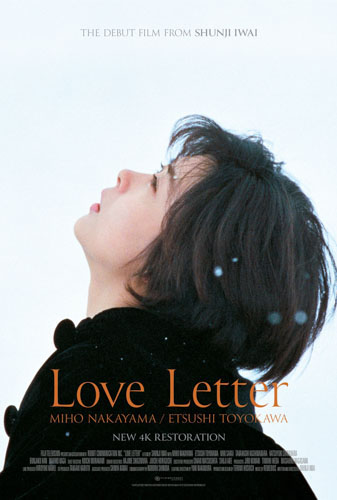
Originally released in Japan in 1995, Love Letter, a romantic drama from director Shunji Iwai and winner of numerous awards, is being re-released in 4K for North America. What happens when a woman writes a letter to a deceased loved one, and the letter is answered?
On a snowy hilltop, a memorial is being held for Itsuki Fuji (Takashi Kashiwabara). It’s been two years since his death in a mountain-climbing accident. All of his family, friends, and his fiancée, Hiroko Watanabe (Miho Nakayama), are there to pay their respects.
When Hiroko returns home with Itsuki’s mother, they go through his old things, and she finds an address from where he grew up as a child in another town, Otaru. One day, Hiroko decides to write a simple letter to the address, which she believes is just a highway now. To her surprise, she gets a response back from Itsuki Fuji. She shares the news with her friend Akiba (Etsushi Toyokawa), who has been in love with her. To help her find closure, he offers to go with her to Otaru to unravel the mystery of the answered letter.
In Otaru, the Itsuki Fuji who exists is not a man but a woman (also played by Miho Nakayama). On the day that Hiroko and Akiba arrive, they discover that the house at the address actually exists on a bridge above the highway. Itsuki is not home, but the big discovery is that Itsuki and Hiroko have an uncanny resemblance to each other. Both the male and female Itsuki Fujis were classmates. As Hiroko goes back home, she begins to wonder if somehow her Itsuki (male) and the other Itsuki (female) might have been childhood crushes, and whether her resemblance to Itsuki (female) is how her own relationship with Itsuki (male) started. This furthers a pen-pal relationship between the two women and unlocks memories for Itsuki (female) of growing up with Itsuki (male) before he moved away, as well as the nature of their own relationship.
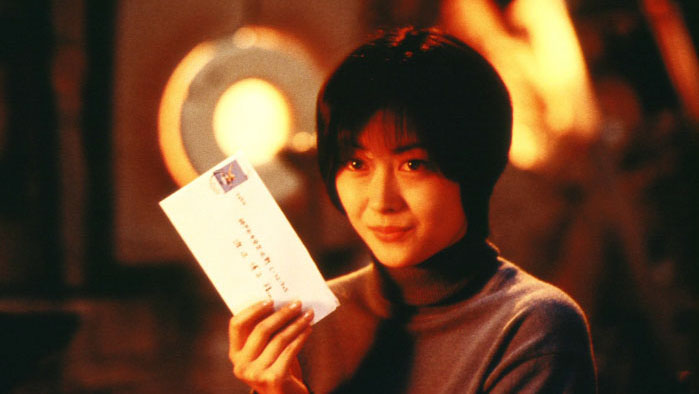
“What happens when a woman writes a letter to a deceased loved one, and the letter is answered?”
I really enjoyed this film. It actually took me back to that ’90s era of filmmaking, especially in Asia. The director uses a lot of shots with soft lenses to give it that romantic feel. Although the genres aren’t the same, it also reminded me of John Woo’s The Killer. Obviously, there are no action sequences, but when you compare how the score was used in that film to create the relationship between Chow Yun-Fat’s character and the blind singer, the same effect is done here with the storytelling of the female Itsuki and male Itsuki and how it’s being told to Hiroko.
You also have to keep in mind that the story takes place in 1995, so all the advances we have now in technology don’t exist. The internet is in its infancy, digital communication isn’t really a thing yet, and long-distance phone calls aren’t cheap. The world is a bit simpler, and you can’t just connect via FaceTime. This adds a necessary layer to the conversations that happen between Hiroko and female Itsuki and their discovery of male Itsuki.
As I read up on the film, I learned that the Japanese Academy Film Prize gave actress Miho Nakayama the Best Newcomer award, along with her co-star Miki Sakai. It also won for music and was nominated for Best Picture and Best Supporting Actor for Etsushi Toyokawa. It all makes sense to have a 30th-anniversary re-release. There are many hidden gems among Asian films, and this is one I’m definitely adding to my collection.
The most unfortunate thing about this new re-release is that actress Miho Nakayama died in 2024. It would have been wonderful to hear her take on the film 30 years later.
"…There are many hidden gems among Asian films..."