
Why have India and Pakistan been at each other’s throats for decades? The answer is not that simple, and the consequences have been deadly. But what about the people who are literally caught in between? That is the story of Travis Hodgkins’ thriller, Line of Control.
In 1947, British India was split into India and Pakistan. After the two countries went to war, a ceasefire line, later known as the Line of Control, was drawn through Kashmir, and India and Pakistan have fought over the region for political and religious reasons ever since. It’s 1993, and tensions are rising as Pakistan intensifies the fight for Kashmir, while many Kashmiris fight to be independent of both countries.
Our story follows a teenager known only as The Boy (Nikhil Singh Rai). He hangs out with his best friends Hussain (Serdar Altan), Gul (Reiss Kershi), and Ashfaq (Shamail Ali). They get into mischief and dream about going to university. The Boy is also quite fond of Asma (Anastasia Jairath). He passes her little notes that say only “butterflies” and recites Kahlil Gibran to her in the fields.
Trouble begins to brew as artillery shells fall nearby, and the brutal Captain Kadian (Rudi Dharmalingam) of the Indian Army demands that the boys fight for India. As Muslims, Gul and Ashfaq run away to the Pakistani side, leaving their families to bear the shame of their actions. Because The Boy is seen as the weakest of the group, Captain Kadian makes a deal with his parents: he doesn’t have to serve in the Indian Army. All he has to do is sneak out onto the battlefield when the fighting stops, collect the IDs and weapons of fallen fighters, and return them to Kadian for intelligence purposes.
As Kadian continues to collect The Boy’s friends, including Hussain, The Boy begins to realize how lucky he was not to have to fight. At one point, he must choose between loyalty to his friends and family and safety from Kadian’s tyranny.
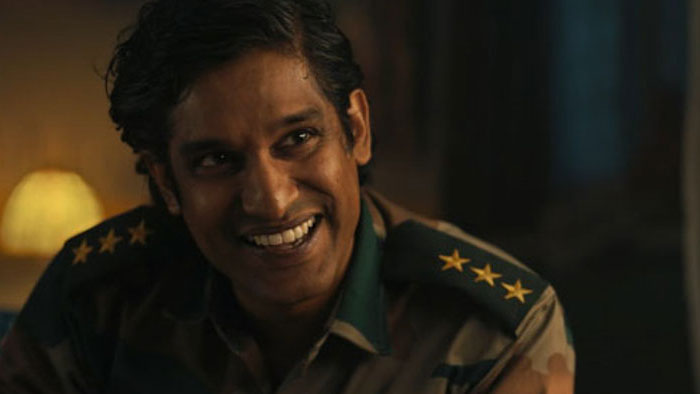
Captain Kadian (Rudi Dharmalingam) grins in a lamp-lit room in Line of Control.
“As Muslims, Gul and Ashfaq run away to the Pakistani side, leaving their families to bear the shame of their actions.”
Based on Mirza Waheed’s novel The Collaborator, Travis Hodgkins’ Line of Control hits on the wartime theme of freedom. All the people of Kashmir want is to exist—make a good living and raise a family. Instead, they are caught in a conflict between two countries to which they feel no real allegiance. When your once-peaceful life is turned upside down, you must make tough choices: Do you fight, knowing you’re a pawn in a losing battle? Do you go to the other side and put your family at risk? Lastly, do you betray your friends for your own and your family’s supposed safety?
Throughout Line of Control, I constantly ask myself, “What would I do?” Could I live with myself if I made certain decisions? The choices are extreme, the punishment is brutal, and Travis Hodgkins makes it all feel grounded.
The world is a big place, and we are starting to see a slow trickle of international films that give us a perspective on global conflicts I knew nothing about. Line of Control is a history lesson, delving into the intense hostilities between India and Pakistan. They are two very proud nations who refuse to give an inch, to the point of war.
Nikhil Singh Rai shines as The Boy. It is a complex performance, as he has to appear weak in spirit and sometimes in character, only to strengthen his resolve to do what is right in the end. Rai is supported by an equally good performance from Rudi Dharmalingam as Captain Kadian. As they say, you’re only as good as your villain. Dharmalingam gives that kind of performance. He’s brutal, and at one point you almost feel for him.
Thanks to film, the world gets smaller and smaller, and the battles happening far away, ones we never see, start to feel very familiar. Travis Hodgkins’ Line of Control tells one such story, giving shape to the global events we see from all the way over here.
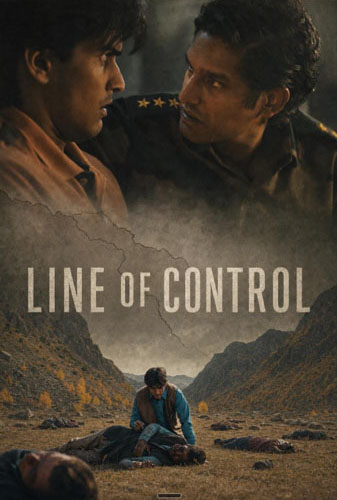
"…Do you fight, knowing you're a pawn in a losing battle?"


I was riveted to the movie! Didn’t know much about this history before so defy their waked away getting a good flavor of it. Excellent performances by each actors Edie halt The Boy.