
Director Habib Shahzad’s Jujji sheds light on the harsh truth about Pakistan’s neglected labor force through two cops trying to crack a series of murders that nobody gives a damn about. The film opens with the murder of Munshi, an elderly shoe shiner whose body is found brutally attacked and moved from its original location, leaving the crime scene compromised. Officers Arshad (Anjum Habibi) and Naveed (Mustafa Rizvi), working the night shift, arrive at the crime scene. While Arshad prefers the quiet of night duty, Naveed believes dangerous people roam the streets after dark, and the senseless killing of a poor citizen is unsettling. With no identification or money on the body, Naveed pushes past the usual bureaucratic indifference toward the poor and brings the case to his inspector, explaining that Munshi had, in fact, come to the station earlier seeking help.
As Naveed digs deeper, it becomes clear that Munshi’s murder is tied to a serial killer, Jujji, targeting low-wage working-class men. The victims share the same method of death—necks violently separated from the spine, a precision that leads the coroner to suggest the killer might be a chiropractor or someone trained in spinal manipulation. The officers learn the killer lures men with offers of a massage before striking.
Naveed’s obsession with Munshi’s case and the serial killer strains his relationships, particularly with his daughter, Fatima, and his wife, Mahnoor, who grows frustrated when Naveed misses Fatima’s doctor’s appointment. What Naveed doesn’t tell anyone is that his obsession with justice for the poor stems from a tragic incident early in his career.
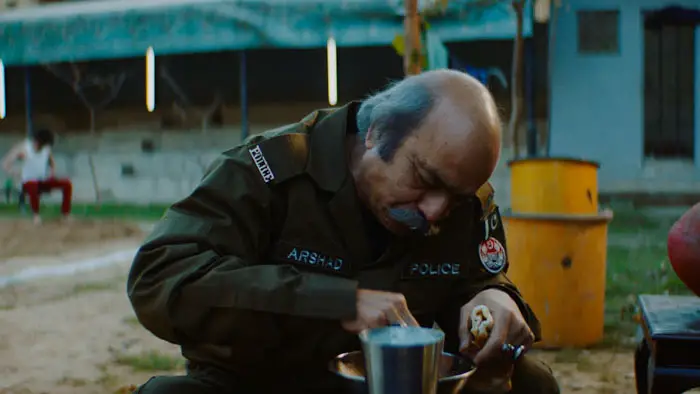
“It becomes clear that Munshi’s murder is tied to a serial killer targeting low-wage working-class men…”
Director Habib Shahzad has said his inspiration for Jujji came from real cases in Pakistan where the murders of working-class men were dismissed or deprioritized, pushing him to tell a story about lives society overlooks. Shahzad explains that the film’s central theme is the value of every human being, regardless of status, and how a justice system’s indifference can become its own form of violence. Writer Ahmad Umar Ayaz echoes this idea in the press material, noting that the story was shaped around “the people no one fights for,” using the pursuit of Jujji as a lens to explore dignity, duty, and the moral consequences of apathy.
What I love about Jujji is its true indie spirit as a low-budget film from Pakistan. There’s not much big-money support for a film that spotlights the plight of lower-class Pakistanis. The lack of budget accounts for the short runtime and the nearly non-existent production budget. On the upside, it employs a lot of guerrilla filmmaking techniques, like setting up your scene in the middle of the street in the middle of the night to get your dramatic shots.
To filmmaker Shahzad’s credit, he hammers home the injustice of the working man. The police are too busy to investigate the murders of people who appear to have no apparent “value” in society and a serial killer willing to take advantage of that. Why not commit crimes when the police don’t care? Our hero, Naveed, shows that there are people who care, who can do something about the problem.
I also appreciate the character of Arshad, Naveed’s partner. Arshad is older and definitely old school. He’s been in the system a long time and understands the “futility” of investigating crimes that are unlikely to be solved. He also came up in the ranks during a period of terrible turmoil in Pakistan years before, when multiple murders happened every day. He sees today as a better time.
Ultimately, Jujji emphasizes how easily our most at-risk citizens fall by the wayside when the system abandons them. Shahzad forces us to see what happens when crime is ignored and urges us to never give up on those less fortunate than us.
For more information, visit the Jujji official website.
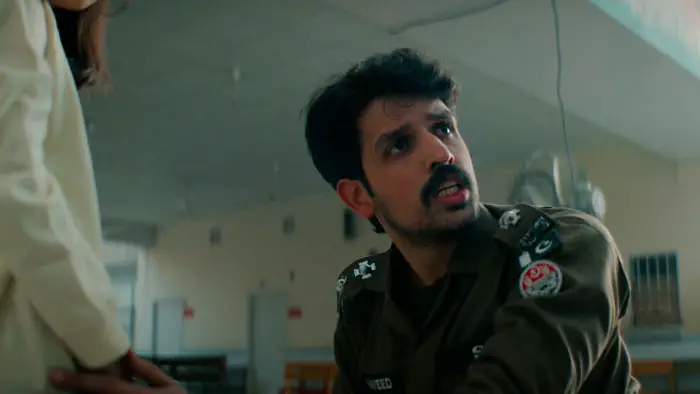
"…emphasizes how easily our most at-risk citizens fall by the wayside when the system abandons them."




I loved watching “Jujji” because it kept me hooked from the very first scene to the end without feeling exaggerated. The premise is frightening in a straightforward way: a masseur kills people during massages and steals from them. It is straightforward and immediately creates tension.
But what kept me invested was not only the killer. It was the nuanced interplay between Naveed and Arshad’s characters. Naveed’s idealism gives the film a backbone. You feel that he cares about the victims and refuses to let the case become routine. Arshad’s cynicism adds weight. Once the film shows what shaped him, you start watching him differently. He may sound harsh, but there is a moral seriousness under that hardness. He is trying to do right in a world that has already shown him its worst side.
The film also deserves credit for how real it feels. It shows the streets, the fear, the rumours, the pressure on police, and the slow grind of pursuing a killer. Nothing looks staged for comfort. That rawness is precisely why the suspense works.
I can safely say this: “Jujji” is tense and emotionally heavy in the right places and memorable because it treats its story like something that matters.
It is a thriller I would happily recommend!